
Orodes himself invades Armenia and forces King…
53 BCE
Orodes himself invades Armenia and forces King Artavasdes, the son of Tigranes the Great, to abandon the Romans.
By the victory of Carrhae the countries east of the Euphrates are secured to the Parthians.
Plutarch relates that Orodes understood Greek very well.
After the death of Crassus, the Bacchae of Euripides is presented at Artavasdes' court, with the head of Crassus himself allegedly being used as an accessory for a scene actually including a severed head, on the order of the king.
Locations
People
Groups
Topics
Commodities
Subjects
Regions
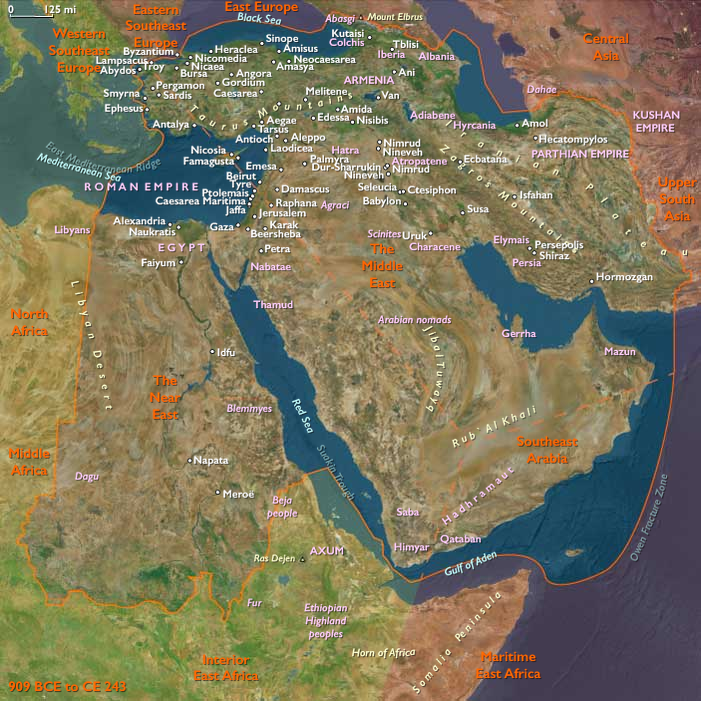
The Near and Middle East
View →Subregions
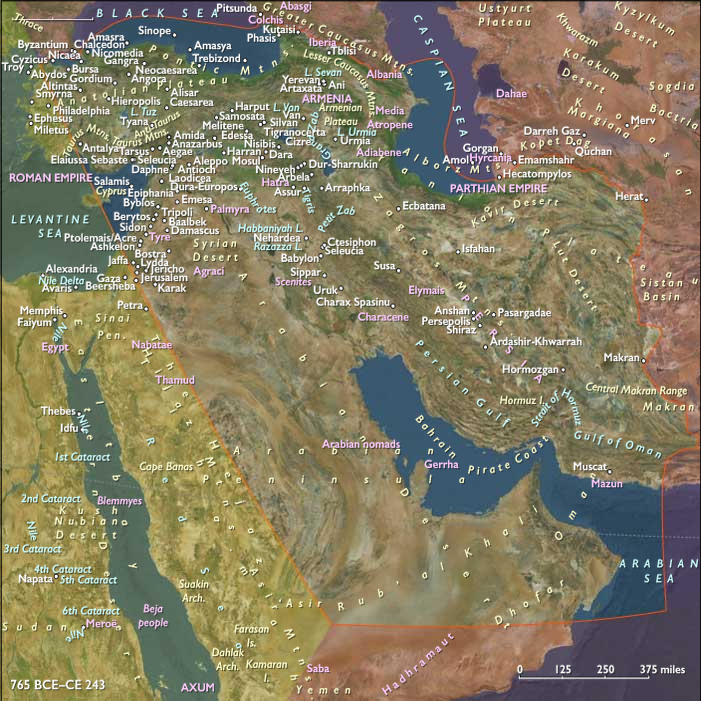
Middle East
View →Related Events
No active filters.
Showing 10 events out of 62532 total
Crassus has meanwhile begun his attempt to conquer the east: the Romans in 53 BCE advance on the western Arsacid vassalaries.
Orodes II in response sends his cavalry units under Surenas to combat them.
Gaius Cassius Longinus' first office is as quaestor under Crassus in 53 BCE, an office in which he proves himself to have a capable military mind.
He has traveled with Crassus to the province of Syria, and attempts to dissuade him from attacking the Parthians, suggesting that they secure a base at the Euphrates.
Ignoring Cassius, Crassu leads the army into the Battle of Carrhae, during which he also ignores Cassius' plans for strengthening the Roman line.
The result is the most famous Roman rout since the Second Punic War.
Crassus, learning that Surenas (i.e., “the Suren”) is in the desert east of the Euphrates River, leaves the cover of the river and strikes out toward Carrhae.
(Some later historians will condemn this move as rash, but, because Seleucia on the Tigris is Crassus' ultimate objective, he must at some time cross open country.)
Suddenly the Parthians are upon him, with a force of about a thousand armored knights and nearly ten thousand horse archers.
His troops, though superior in numbers, are neither acclimatized nor adapted to desert warfare.
While his son Publius launches an unsuccessful covering attack with his cavalry, the main Roman forces form a square against the encircling Parthians and attempt unsuccessfully to cover both body and head with their shields against the showers of Parthian arrows.
Surenas' provision of a corps of one thousand Arabian camels, one for every ten men, enable the Parthians to retire by sections and replenish their quivers.
Crassus, lacking provisions, is compelled by his demoralized men to negotiate but is cut down by the Parthians in the attempt.
About ten thousand Romans escape, but the rest of Crassus' men are either captured or killed.
Cassius manages to save the remnants of the army with the help of Crassus' legate, Gaius Octavius.
The army in turn tries to make Cassius its new commander, but he refuses out of loyalty to Crassus.
Crassus is killed by Parthian forces after treacherous guides lead him astray during the retreat from Carrhae, but Cassius manages to escape with five hundred and nine cavalry and meet up with the surviving legionaries.
The Parthians have dealt a stunning blow to Roman prestige in the East, and the death of Crassus is to have serious repercussions on Roman political life.
Although this feat of arms takes a severe toll on the Roman troops (Plutarch speaks of twenty thousand dead and ten thousand prisoners), and "produced a mighty echo amongst the peoples of the East," it did not cause "any decisive shift in the balance of power," that is, the Arsacid victory did not gain them territory.
For Surena, "it soon cost him his life. Probably fearing that he would constitute a threat to himself, King Orodes II had him executed."
Pompey has irresolutely veered increasingly further away from Caesar, the marriage link between the two having been broken in 54 by Julia's death.
The issue is whether there should or should not be an interval between the date at which Caesar is to resign his provincial governorships and, therewith, the command over his armies and the date at which he will enter his proposed second consulship.
If there is to be an interval, Caesar will be a private person during this time, vulnerable to attack by his enemies; if prosecuted and convicted, he will be ruined politically and might possibly lose his life.
Caesar must ensure that, until his entry on his second consulship, he shall continue to hold at least one province with the military force to guarantee his security.
This issue has already been the object of a series of political maneuvers and counter-maneuvers at Rome.
The dates on which the issue turned are all in doubt.
As had been agreed at Luca in 56, Caesar's commands have been prolonged for five years, apparently until February 28, 49, but this is not certain.
Rome’s equestrian class, who as farmers of the taxes had suffered heavy losses during the disturbances in Syria, are greatly embittered against Aulus Gabinius, and, when he appears in the Senate to give an account of his governorship, he is brought to trial on three counts, all involving a capital offense.
On the charge of maiestas (high treason) incurred by having left his province for Egypt without the consent of the senate and in defiance of the Sibylline books, he is acquitted; it is said that the judges were bribed, and even Cicero, an enemy of Gabinius, was persuaded by Pompey to say as little as he could.
On the second charge, that of repetundae (extortion during the administration of his province), with special reference to the 10,000 talents paid by Ptolemy XII for his restoration, he is found guilty, in spite of evidence offered on his behalf by Pompey and witnesses from Alexandria and the eloquence of Cicero, who has been induced to plead his cause.
Nothing but Cicero's wish to do a favor to Pompey could have induced him to take on the task; it is hinted that the half-heartedness of the defense contributed to Gabinius's condemnation.
The third charge, that of ambitus (illegalities committed during his canvass for the consulship), is consequently dropped; Gabinius goes into exile, and his property is confiscated.
In late 53 BCE, when Milo is a candidate for the consulship, and Clodius for the praetorship, the rivals collect armed bands and clash in the streets of Rome.
Some sources state that on December 6 of this year, Clodius and Milo (each accompanied by an armed escort) chance to pass each other on the Appian Way near Bovillae.
A fight erupts between members of the two groups, and Clodius dies in the ensuing mêlée.
His enraged clients build his funeral pyre in the Senate House, which ignites the building and ultimately burns it down.
The Destruction of the Eburones and the Collapse of the First Triumvirate (53 BCE)
By 53 BCE, Julius Caesar was determined to eliminate the Eburones as punishment for their role in the Belgic revolt of 54 BCE, in which Quintus Titurius Sabinus and Lucius Aurunculeius Cotta were killed, along with nearly 6,000 Roman soldiers. Caesar’s response was ruthless and systematic, ensuring that the Eburones and their name disappeared from history.
The Eburones: Germani Cisrhenani or Belgic Gauls?
- Caesar wrote that the Eburones, Condrusi, Caeraesi, Paemani, and Segni, despite being considered Belgae (a type of Gaul), were actually called by the one name of Germani.
- He described them as Germani Cisrhenani, meaning "Germans on this side of the Rhine"—peoples who had migrated from east of the Rhine and settled in northern Gaul generations before.
- This classification suggests that the Belgae were a cultural mix of Celtic and Germanic influences, though their exact language and identity remain uncertain.
Caesar’s Campaign of Annihilation Against the Eburones
-
In 53 BCE, Caesar invaded the territory of the Eburones, forcing Ambiorix to flee, while King Cativolcus poisoned himself with yew.
-
Caesar’s legions struggled in the wooded and swampy terrain, making it difficult to pursue the scattered remnants of the Eburones.
-
To ensure their total destruction, Caesar invited neighboring tribes to plunder and slaughter the Eburones, writing:
"In order that the life of the Gauls might be hazarded in the woods rather than the legionary soldiers; at the same time, in order that a large force being drawn around them, the race and name of that state may be annihilated for such a crime."
(Gallic Wars VI.34) -
The Sicambri, a powerful Germanic tribe, were among the main raiders, seizing cattle, slaves, and plunder.
-
Caesar remarked that the Sicambri were:
"Born for war and raids... No swamp or marsh will stop them."
The Sicambri’s Betrayal and the Attack on the Roman Garrison at Aduatuca
- While Caesar was campaigning against the Eburones, he left Quintus Tullius Cicero with a legion to guard supplies at Aduatuca—the same location where Sabinus and Cotta had been killed.
- However, Ambiorix convinced the Sicambri that the Roman supplies and loot were far more valuable than hunting refugees.
- After raiding the Eburones, the Sicambri turned on the Romans, ambushing some of Caesar’s units.
- The remains of the legion withdrew into Aduatuca, and the Sicambri, satisfied with their plunder, returned across the Rhine.
The Fate of the Eburones and the Rise of the Tungri
- Caesar burned every village and building in Eburonian territory, drove off all cattle, and his men consumed or destroyed all remaining grain.
- He left any survivors to die of starvation in the winter.
- The Eburones disappeared from history, their lands later occupied by the Tungri, a new Germanic tribe.
- However, Tacitus later suggested that the Tungri were the original "Germani" who had first crossed the Rhine, leading some historians to believe that the Eburones survived under a new name.
The Collapse of the First Triumvirate and Rome on the Brink of Civil War
- While Caesar was in Britain, his daughter Julia, Pompey’s wife, died in childbirth, weakening the alliance between Caesar and Pompey.
- Shortly afterward, Crassus was killed during his disastrous invasion of Parthia at the Battle of Carrhae (53 BCE).
- Without Julia or Crassus to maintain balance, tensions between Caesar and Pompey escalated.
- In an emergency measure, the Senate appointed Pompey as sole consul, effectively siding with the optimates against Caesar.
- Pompey sealed his break with Caesar by marrying the daughter of a political opponent.
With Crassus dead and Pompey turning against him, the First Triumvirate collapsed, bringing Rome to the edge of civil war.
Significance of These Events
- The destruction of the Eburones demonstrated the brutality of Roman reprisals, setting a precedent for how Rome dealt with rebellious provinces.
- The rise of the Tungri suggests that Rome’s conquest of Gaul was not as absolute as Caesar claimed, with tribal identities shifting rather than being erased.
- The collapse of the First Triumvirate meant that Rome’s next great war would not be against foreign enemies, but against itself.
By 53 BCE, Caesar had conquered Gaul, but the price was political instability in Rome—the final step toward the Great Roman Civil War (49–45 BCE)
The Parthians had invaded Syria in 53 BCE, but with little success, for Surena, whose achievements had made him too dangerous, is killed by Orodes.
For the two years following the disaster at Carrhae, Cassius has governed the province of Syria as proquaestor, quelling an uprising in Judea in 52, and defending the border against Parthian incursions until the new proconsul arrives.
The Sequani in 71 BCE, before the arrival of Julius Caesar in Gaul, had taken the side of the Arverni against their rivals the Aedui and hired the Suebi under Ariovistus to cross the Rhine and help them.
Although his assistance had enabled them to defeat the Aedui, the Sequani were worse off than before, for Ariovistus had deprived them of a third of their territory and threatened to take another third, while subjugating them into semi-slavery.
The Sequani had then appealed to Caesar, who had driven back the Germanic tribesmen in 58 BCE but at the same time obliged the Sequani to surrender all that they had gained from the Aedui.
This had so exasperated the Sequani that they have joined in the revolt of Vercingetorix and share in the defeat at Alesia in 52.
Caesar takes the region of Franche-Comte in eastern Gaul, occupied by the Sequani since the fourth century.
Pompey's new theater, completed in this year, is a gigantic, architecturally daring, self-contained complex on the Campus Martius, complete with shops, multi-service buildings, gardens and a temple to Venus Victrix.
The latter connects its donor to Aeneas, a son of Venus and ancestor of Rome itself.
In its portico, the statuary, paintings and personal wealth of foreign kings can be admired at leisure.
Pompey's triumph lives on.
His theater makes an ideal meeting place for his supporters.
Mark Antony’s Role in the Gallic Wars and the Carnutes’ Revolt (54–52 BCE)
By 54 BCE, Mark Antony had become a staff officer in Caesar’s armies, assisting in military campaigns in Gaul and Germany. His close friendship and family ties with Caesar ensured that he remained a key supporter, making himself constantly available for Caesar’s military efforts.
Antony, though an able commander, had a disruptive personality, which would later create political tensions in Rome. However, in the Gallic Wars, he proved his military competence, playing a vital role in Caesar’s campaigns against the Gallic revolts, particularly the Great Revolt of 52 BCE, led by Vercingetorix.
The Rise of Vercingetorix and the Pan-Gallic Revolt (52 BCE)
- Previous Gallic revolts, such as the Eburones uprising under Ambiorix in 54 BCE, had failed to secure widespread tribal support.
- In early 52 BCE, while Caesar was in Cisalpine Gaul raising troops, Vercingetorix, a chieftain of the Arverni, managed to unite the Gallic tribes against Rome.
- His father, Celtillus, had been executed for attempting to rule all of Gaul, but Vercingetorix succeeded in achieving this goal, adopting modern warfare strategies to counter the Romans.
The Carnutes: The Sacred Center of Gaul and the Catalyst for Rebellion
- The Carnutes, a powerful Gallic tribe, inhabited the region corresponding to modern Eure-et-Loir, Loiret, and Loir-et-Cher.
- Their territory was considered the sacred center of Gaul, where Druids held their annual pan-Gallic synod.
Political Organization:
- Like several other large Gallic polities, the Carnutes had previously been ruled by kings but later adopted an oligarchic or proto-republican system.
- Rome preferred to deal with client states through kings rather than fractious councils or senates, making it easier to control them through centralized power.
Caesar’s Imposed Rule Over the Carnutes
- After his campaign against the Belgae in 57 BCE, Caesar set up a protectorate over the Carnutes and installed Tasgetius as king, choosing him from the ruling clan as a reward for loyalty.
- Tasgetius’ rule was presented as a restoration, as his ancestors had once held supreme power.
However, in 54 BCE, Tasgetius was assassinated, which Caesar blamed on an anti-Roman faction among the Carnutes.
- Some historians argue that this was a result of normal internal Gallic politics, but Caesar used the assassination as a propaganda tool to justify further conquest.
- Following Tasgetius’ death, the Carnutes were placed under the control of the Remi, Rome’s most loyal Belgic ally.
The Carnutes Revolt and the Beginning of the Great Gallic Rebellion
- In early 52 BCE, the Carnutes, led by Cotuatus and Conetodunus, initiated the revolt, believing that Caesar was distracted by the political turmoil in Rome following the murder of Publius Clodius Pulcher.
- On February 13, 52 BCE, in the oppidum of Cenabum, the Carnutes massacred all the Roman merchants and killed one of Caesar’s commissariat officers.
This act served as a rallying cry for rebellion, and the uprising spread rapidly throughout Gaul, culminating in the formation of a united Gallic resistance under Vercingetorix.
Caesar’s Ruthless Response: The Destruction of Cenabum
- In retaliation, Caesar marched on Cenabum, the prosperous capital of the Carnutes.
- He burned the city, slaughtering the men and selling women and children into slavery.
- The booty from the sacking of Cenabum was distributed among his soldiers, providing a financial incentive to continue the conquest.
Significance of the Carnutes’ Revolt
- The massacre at Cenabum was the spark that led to the largest and most organized Gallic rebellion against Rome.
- The Carnutes’ rebellion demonstrated that anti-Roman sentiment had spread beyond individual tribes, unifying large sections of Gaul.
- Caesar’s brutal suppression of the revolt sent a clear message to other rebellious tribes about the consequences of defying Roman rule.
Despite the initial success of Vercingetorix, the rebellion would ultimately fail at the Siege of Alesia, solidifying Rome’s conquest of Gaul. However, the Carnutes’ role in initiating the Pan-Gallic uprising ensured their place in Roman and Gallic history as a symbol of defiance against Rome.
The Siege and Destruction of Avaricum (52 BCE): A Turning Point in the Gallic Wars
During the Gallic revolt of 52 BCE, led by Vercingetorix, the Bituriges of Avaricum (modern Bourges) pleaded for their capital city to be spared from destruction. Due to its strong natural defenses, including surrounding marshes and a fortified southern wall, the city was not burned down by the Gauls, unlike many other settlements abandoned to deny resources to the Romans.
The Siege of Avaricum
- As Julius Caesar pursued the Gallic rebels, he laid siege to Avaricum, one of the most defensible and well-fortified cities in central Gaul.
- The Romans faced difficult conditions, including harsh weather, supply shortages, and the strong defenses of the city.
- Despite this, Caesar’s engineers constructed siege works, allowing the legions to breach the defenses after an extended siege.
The Fall of Avaricum and the Massacre of Its People
- Once the Romans stormed the city, they massacred nearly all of its inhabitants, leaving only 800 survivors out of a population of approximately 40,000.
- Caesar justified the total destruction of Avaricum as revenge for the earlier ambushes and attacks by the Gauls on Roman troops.
- The plundering of the city provided much-needed supplies and morale boosts for Caesar’s legions.
Caesar’s Pursuit and Defeat at Gergovia
- After capturing Avaricum, Caesar pursued the retreating Gauls deeper into Arverni territory.
- However, at Gergovia, the stronghold of Vercingetorix, Caesar suffered a rare and humiliating defeat, forcing him to withdraw.
- This temporary setback emboldened the Gallic coalition, leading to a more organized resistance against Rome.
Significance of the Siege of Avaricum
- The destruction of Avaricum showed Roman military superiority in siege warfare but also deepened Gallic hatred toward Rome.
- The massacre of its people became a rallying cry for resistance, strengthening Vercingetorix’s position as the leader of a united Gallic rebellion.
- Though Gergovia proved to be a setback, the Roman momentum was not lost, culminating in the decisive Siege of Alesia later that year.
The fall of Avaricum remains one of the most brutal episodes of the Gallic Wars, symbolizing both Rome’s relentless military efficiency and the desperate resistance of the Gallic tribes.
Vercingetorix’s Rise and the Gallic Rebellion Against Rome (52 BCE)
Vercingetorix, a young nobleman from Gergovia, emerged as the leader of the Gallic revolt against Rome in 52 BCE. His leadership transformed disparate Gallic tribes into a unified resistance, posing the greatest challenge to Julius Caesar’s conquest of Gaul.
The Rise of Vercingetorix and the Formation of a United Gallic Army
- Initially, Vercingetorix attempted to rally support in Gergovia, but the city’s nobles, including his uncle Gobanitio, expelled him, fearing that rebellion against Rome was too risky.
- Undeterred, he raised an army of the poor, seized Gergovia by force, and was hailed as king.
- He forged alliances with other Gallic tribes and was unanimously granted supreme command of their armies.
- To enforce unity, he imposed strict discipline, demanded hostages from allied tribes, and executed those who defied his orders.
Vercingetorix’s Military Strategy: Scorched Earth and Tactical Retreats
- He implemented an early example of scorched earth warfare, burning towns and villages to deny the Romans food and supplies.
- He retreated to naturally fortified locations, forcing Caesar’s legions to fight on difficult terrain.
- His strategy of avoiding open-field battles frustrated Roman supply lines and weakened their ability to sustain a prolonged campaign.
Early Successes and the Roman Defeat at Gergovia
- Vercingetorix and his 90,000-strong army won minor engagements against Caesar and his chief lieutenant, Labienus.
- The first major battle took place at Gergovia, a well-fortified hilltop stronghold.
- There, Vercingetorix inflicted a rare and humiliating defeat on Caesar, forcing the Romans to retreat with heavy casualties.
The Aftermath: Heavy Losses and the Retreat to Alesia
- Despite the victory, Vercingetorix suffered significant losses, including many noble warriors.
- Realizing he could not sustain further large-scale losses, he retreated to another fortified position, the hilltop town of Alesia.
- At Alesia, he would make his final stand against the Romans, leading to the decisive siege that would determine the fate of Gaul.
Significance of Vercingetorix’s Resistance
- He united the Gallic tribes in a way never before seen, creating a serious threat to Roman expansion.
- His scorched earth tactics and strategic retreats showcased military innovation and discipline among the Gauls.
- Although he won one of Caesar’s rare defeats at Gergovia, his strategy ultimately led to the climactic Battle of Alesia, where Rome would seek to end Gallic resistance once and for all.
Vercingetorix’s campaign represents the last great effort of Gaul to resist Roman rule, making him one of history’s most iconic resistance leaders.
The Battle of Alesia (September 52 BCE): The Decisive Roman Victory Over Gaul
The Battle of Alesia in September 52 BCE was the culminating battle of the Gallic Wars, where Julius Caesar decisively defeated Vercingetorix, ending the last major resistance to Roman rule in Gaul. It is regarded as one of the greatest military sieges in history and played a crucial role in the creation of the Roman Empire.
Caesar’s Double Fortifications: The Siege of Alesia
- Caesar besieged Alesia, a fortified hilltop stronghold occupied by Vercingetorix and his army, with 60,000 Roman troops.
- To prevent Vercingetorix from escaping, Caesar built a circumvallation—a fortified wall surrounding Alesia.
- However, Vercingetorix had summoned Gallic reinforcements, leaving Caesar’s army now at risk of being trapped between two forces.
- Anticipating a relief army, Caesar ordered the construction of a second, outer fortification (contravallation) to defend against attacks from outside.
- This resulted in a doughnut-shaped double fortification, effectively turning the besiegers into the besieged.
The Arrival of the Gallic Relief Army and the Breakthrough Attempt
- Estimates of the relief force range from 80,000 to 250,000 soldiers, but their attacks initially failed due to lack of coordination.
- Vercingetorix, the tactical leader, was trapped inside Alesia, unable to direct the outside forces effectively.
- However, the repeated assaults exposed a weak point in Caesar’s fortifications, and coordinated attacks from inside and outside nearly resulted in a Roman defeat.
- The situation became critical as famine gripped the defenders, but the Gauls launched a final, desperate attack, nearly overwhelming the Romans.
Caesar’s Personal Intervention and the Roman Victory
- As the Gallic forces broke through in some areas, Caesar personally led his last reserves into battle.
- With one final push, the Roman counterattack crushed the Gallic rear attack, forcing the reinforcements to retreat.
- Inside Alesia, starvation finally broke the defenders, and Vercingetorix surrendered.
Vercingetorix’s Surrender: The End of Gallic Independence
- According to Plutarch, Vercingetorix rode out in full ceremonial armor, circled Caesar’s camp, and then dismounted, stripped off his armor, and knelt silently at Caesar’s feet.
- Caesar, however, describes a less dramatic surrender, with Vercingetorix simply laying down his arms.
- He was imprisoned in the Tullianum in Rome for five years and then publicly displayed in chains during Caesar’s triumph in 46 BCE.
- Afterward, he was executed, likely by strangulation, as per ancient Roman custom.
The Significance of the Battle of Alesia
- Alesia was a decisive battle that solidified Roman control over Gaul, paving the way for its full integration into the Roman world.
- The victory elevated Caesar’s status, providing him with immense political power, which he would later use to seize sole control of Rome.
- It marked the end of organized Gallic resistance, ushering in a new era of Roman administration, trade, and cultural assimilation in Gaul.
The Battle of Alesia remains one of Caesar’s greatest military achievements, demonstrating his strategic genius, engineering ingenuity, and ability to inspire his troops even in the face of near defeat.