
Orsha, on the fork of the Dnieper…
1067 CE
Orsha, on the fork of the Dnieper and Arshytsa rivers, is first mentioned in 1067 as Rsha, making it one of the oldest towns in Belarus.
The town is named after the river, which was originally also named Rsha, probably from a Baltic root rus 'slowly flowing.'
Locations
Groups
Subjects
Regions
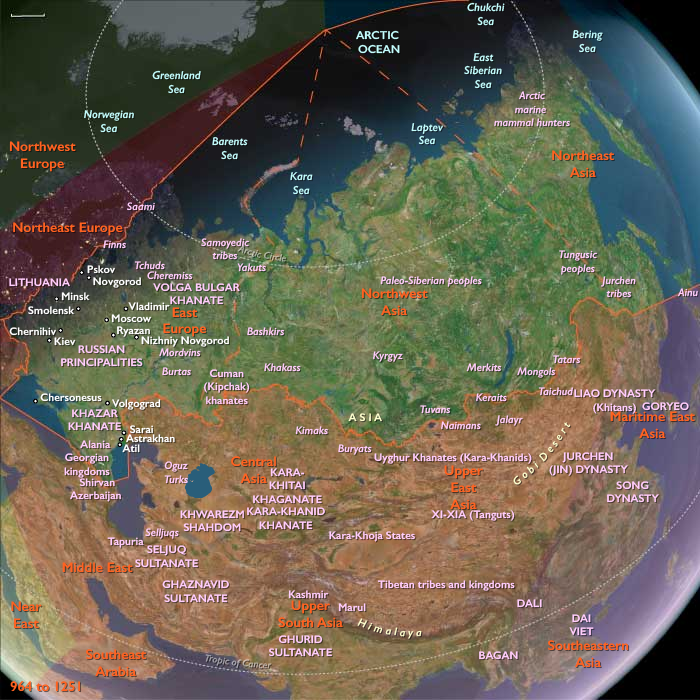
Northeastern Eurasia
View →Subregions
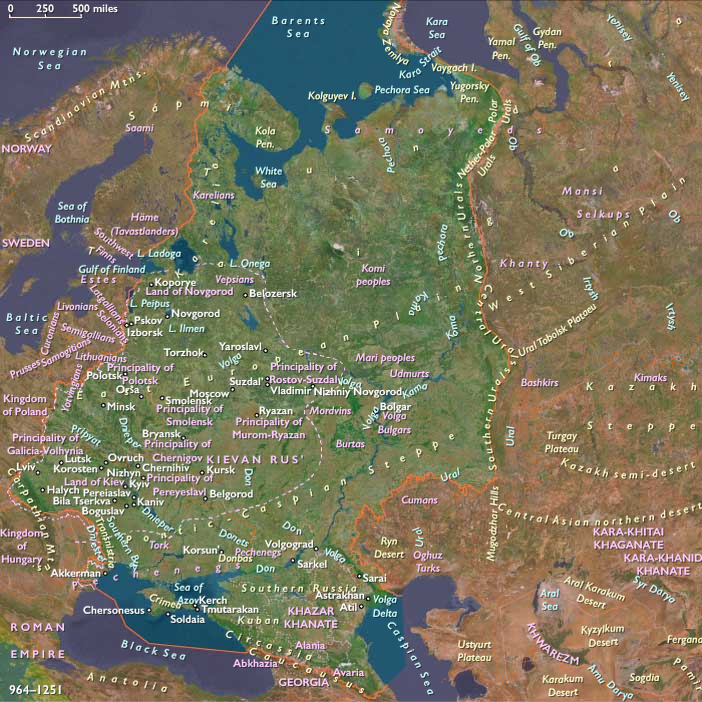
East Europe
View →Related Events
Showing 10 events out of 50 total
Turning inland at Jaffa, …
Coincidentally, a party of Genoese mariners under Guglielmo Embriaco arrive at Jaffa on June 17 in two galleys, and provides the Crusaders with skilled engineers, and perhaps more critically, supplies of timber (cannibalized from the ships) to build siege engines.
The Crusaders also begin to gather wood from Samaria in order to build siege engines.
They are still short on food and water, and by the end of June there is news that a Fatimid army is marching north from Egypt, giving the Crusaders a very strong incentive to make another assault on the city.
Baldwin has rebuilt his army, routing the Egyptian Muslims from Jaffa in 1102 and driving them south.
A contingent of Danish crusaders arrives the following year at Jaffa to assist in its defense.
Al-Ma'mum, the new Vizier of Egypt, organizes a major invasion of Crusader land in 1123.
The Fatimids plan to capture the coastal city of Jaffa.
In this era, the Egyptian armies usually deploy with Sudanese archers on foot, supported by dense formations of Arab and Berber light cavalry.
Unfortunately for the Fatimids, this relatively immobile array provides the Frankish heavy cavalry with an ideal target, resulting in a massacre of the foot-soldiers.
The defeat is decisive.
Except for continued raids from Ascalon until the Siege of Ascalon in 1153, Egypt will cease to be a threat to the Crusader states until the rise of Saladin in 1169.
…Jaffa, and …
The victory at Arsuf enables the crusaders to occupy Joppa but is not a crushing blow to the Muslims.
Saladin is able to regroup his forces, which the crusaders have not pursued for fear of ambushes.
From September 9, the Muslims renew their harassing tactics, and Richard dares not push on to Jerusalem, his ultimate goal.
The Crusader army had proceeded after the Battle of Arsuf to Jaffa, which the Crusaders had taken and fortified on September 7, 1191 Jaffa, they hope, will be the base of operations in a drive to reconquer Jerusalem itself.
Sporadic negotiations between Richard the Lionheart and Saladin had been taken up as the winter of 1191–1192 approached, though without any immediate result.
The crusader army in November of 1191 had advanced inland towards Jerusalem.
Saladin on December 12 had been forced by pressure from his emirs to disband the greater part of his army.
Richard, learning this, had pushed his army forward, spending Christmas at Latrun.
The army then marched to Beit Nuba, only twelve miles from Jerusalem.
Muslim morale in Jerusalem is so low that the arrival of the Crusaders would probably have caused the city to fall quickly.
The weather has been appallingly bad, however cold with heavy rain and hailstorms; this, combined with the fear that the Crusader army, if it besieged Jerusalem, might be trapped by a relieving force, prompts the decision to retreat to the coast.
Richard begins his withdrawal from the Holy Land by July 5, 1192.
Having realized that Jerusalem would not be defensible if it were to be captured, he begins the retreat of crusader forces from hostile territory.
Almost immediately after Richard's withdrawal, Saladin, still smarting from his recent defeat at Arsuf, sees a chance for revenge and, on July 27 lays siege to the town of Jaffa, which had served as a base of operations for Richard during his previous march inland towards Jerusalem.
The defending garrison, although taken by surprise, fights well before the odds against them prove too great.
Saladin's soldiers successfully storm the walls after three days of bloody clashes; only Jaffa's citadel holds out and the remaining Crusaders manage to send word of their plight.
Richard subsequently gathers a small army, including a large contingent of Italian sailors, and hurries south.
Upon seeing Muslim banners flying from the walls, he falsely believes the town to be a lost cause, until a defender swims out to his flagship and informs him of the citadel's dire situation.
Still in his sailor's deck shoes, Richard leaps into the sea and wades through the waves to reach the beach.
The King again shows his personal bravery and martial prowess, leading fifty-four knights, a few hundred infantrymen, and about two thousand Genoese and Pisan crossbowmen into battle.
The Muslim army begins to panic at the sudden offensive by Richard's arriving force, fearing it is but a spearhead of a much larger army coming to relieve Jaffa.
Saladin's men are routed.
Many of the Christian prisoners who had surrendered earlier also seize their arms and resume combat, for their captors are in such disarray that they are unable to stop them.
Saladin's fleeing army spills out of Jaffa and escapes in a disorderly manner; Saladin is unable to regroup his forces until they have retreated more than five miles inland.
Saladin on receiving reports that more of the Franks are coming down from Caesarea opts to launch a counterattack on Jaffa to recapture it before these additional reinforcements can arrive.
Muslim troops on the early morning of August 4 mass around the walled town, concealing themselves in the fields and intending to attack at dawn the next day.
Just before sunrise, however, an Italian soldier out for a stroll discerns the hidden enemy; the sound of horses and glint of armor serving to confirm his suspicions.
The sentries promptly raise the alarm, and Richard quickly assembles his knights, infantry and crossbowmen for battle.
He orders his infantry, including unmounted knights, to form a defensive hedge of spears by kneeling and driving their shields and the shafts of their spears or lances into the ground, with the spearheads pointing towards their opponents.
The crossbowmen stand behind the protective wall of spearmen, working in pairs, one firing while the other loads.
Richard keeps his handful of mounted knights as a reserve in the rear.
The lightly armored Turkish, Egyptian and Bedouin cavalry charge repeatedly until it becomes plain that the Crusaders will not break ranks; the attackers veer away from the spears without coming to blows.
Each Ayyubid attack suffers many losses due to crossbow fire.
The armor of the Christians proves better able to withstand the arrows of the Saracens than the armor of the Saracens can withstand crossbow bolts.
Moreover, the horses of Saladin's nearly all-cavalry force are particularly vulnerable to missile fire.
After a few hours' onslaught, both sides begin to tire.
Saladin's demoralized cavalrymen, having suffered considerably from the barrage of crossbow bolts without having been able to dent the crusaders' defenses, are put to flight by a charge of the knights, only ten to fifteen of whom are mounted, led by the king himself.
While the battle rages, a group of Ayyubid soldiers are able to outflank the crusader army and enter Jaffa.
The Genoese marines who had been entrusted to remain behind and guard the gates offer little resistance before retreating to their ships.
Before the Muslims can exploit their success, however, Richard himself gallops into the town and rallies all of its fighting men.
It has become clear to Saladin by evening that his men have been soundly defeated and he gives the order to withdraw.
Saladin's forces have suffered seven hundred dead and lost fifteen hundred horses; the crusaders have lost only two dead, though many are wounded.
As with many medieval battles, however, the recorded figures for losses may not be entirely reliable.
The Ayyubid forces, leaving their dead on the field, begin the long march back to Jerusalem.
The repulse from Jaffa marks the end of Saladin's counteroffensive.
Both sides are completely exhausted, and Palestine is in a ruinous state.
Richard falls seriously ill soon after the fighting at Jaffa.