
Mediterranean Southwest Europe (2637 – 910 BCE): …
Years: 2637BCE - 910BCE
Mediterranean Southwest Europe (2637 – 910 BCE): Coastal Trade, Mountain Strongholds, and Island Societies
Geographic and Environmental Context
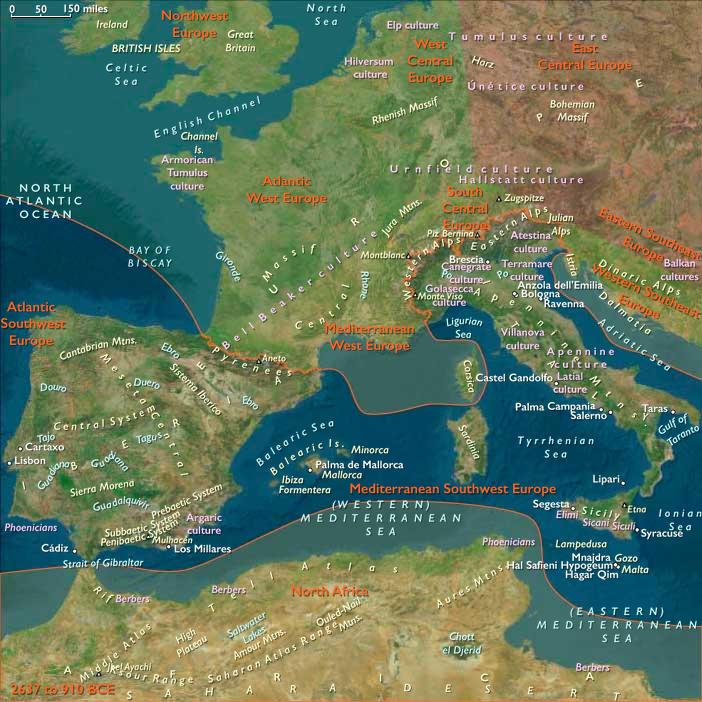
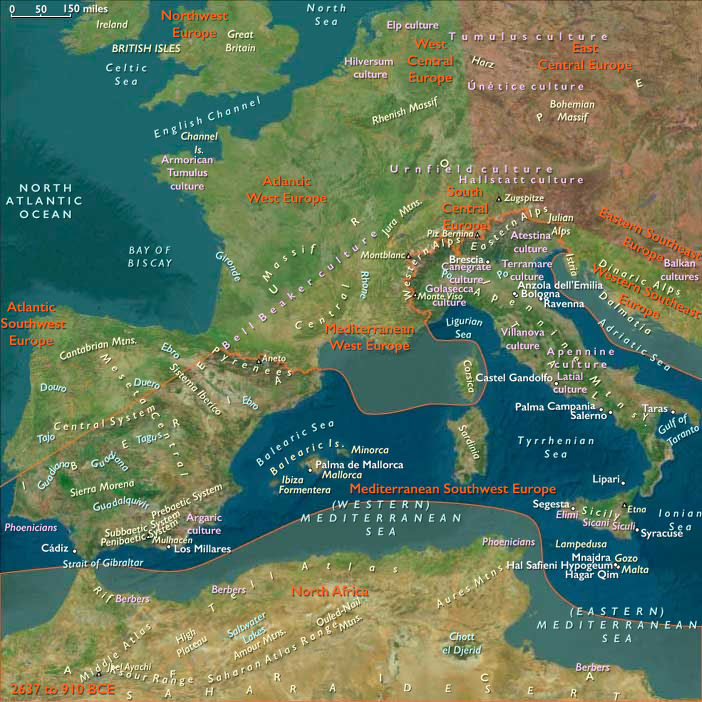
Mediterranean Southwest Europe—including Italy (together with Sardinia and Sicily), Malta, southeastern Spain, and the Balearic Islands—was a region of sharp environmental contrasts. The Apennines ran the length of the Italian peninsula, while the Alps dominated its northern frontier. Southeastern Spain was framed by the Sierra Nevada and the Baetic ranges, and the islands varied from the fertile volcanic landscapes of Sicily to the rugged interiors of Sardinia and the Balearics. The Mediterranean climate—with hot, dry summers and mild, wetter winters—supported a range of agriculture that would form the backbone of early economies.
Agriculture, Herding, and Fishing
By the mid–third millennium BCE, farming communities cultivated wheat, barley, olives, grapes, and legumes, often on terraced hillsides to conserve soil and water. Herding of sheep, goats, and cattle was common, with transhumance practiced in mountainous zones. Along the coasts and on the islands, fishing, shellfish gathering, and the exploitation of marine resources complemented terrestrial food sources, while the Balearics saw the early domestication of goats adapted to the island environment.
Technological and Cultural Developments
The late third millennium BCE marked the expansion of copper and bronze metallurgy. Tools, weapons, and ornaments of metal coexisted with stone implements, reflecting both local traditions and imported technologies. Pottery styles were diverse, from the plain wares of inland Italy to finely decorated ceramics in the Beaker culture zones of southeastern Spain.
Monumental architecture flourished: Malta’s megalithic temples were among the most sophisticated ceremonial complexes in Europe, while Sardinia began constructing its iconic nuraghe towers—fortified stone structures serving as both defensive sites and community symbols.
Maritime Connections and Trade
The region’s position in the central and western Mediterranean made it a hub of maritime exchange. Sardinia’s rich copper resources were traded widely, reaching as far as the Aegean, while obsidian from the Lipari Islands circulated across the Tyrrhenian Sea. The Balearics, though relatively isolated, provided a stepping stone for seafarers moving between the Iberian coast and Italy.
Trade connected the region to North Africa, the Aegean, and the wider Mediterranean, moving metals, textiles, ceramics, wine, and oil.
Cultural and Symbolic Expressions
Burial customs varied: tholos tombs and rock-cut hypogea in Malta and Sicily, megalithic tombs in Sardinia, and stone navetas in the Balearics. Grave goods—ranging from pottery and personal ornaments to weapons—reflected social differentiation and long-distance connections. Artistic motifs, such as spirals, bulls, and marine imagery, tied local beliefs to broader Mediterranean symbolic systems.
Environmental Adaptation and Resilience
Terracing, irrigation, and crop diversification allowed agricultural communities to manage seasonal droughts and make effective use of limited arable land. Coastal settlements integrated fishing and seafaring into their subsistence strategies, creating a flexible economy that could withstand localized crop failures. In mountainous areas, seasonal livestock movement helped maintain pasture health and ensured year-round food supplies.
Transition to the Early First Millennium BCE
By 910 BCE, Mediterranean Southwest Europe was a dynamic blend of mainland agrarian societies and seafaring island cultures. Its mineral wealth, agricultural productivity, and strategic maritime position made it a central player in the western Mediterranean world, laying the foundation for even more complex political and economic systems in the centuries ahead.
Groups
Topics
- Neolithic Europe
- Subboreal Period
- Early Bronze Age III (Near and Middle East)
- Abrolhos Transgression
- Early Bronze Age IV (Near and Middle East)
- 4.2 kiloyear BP aridification event
- Middle Bronze Age I (Near and Middle East)
- Rottnest Transgression
- Younger Subboreal Period
- Iron Age Europe
- Greek colonization, First
Commodoties
- Weapons
- Domestic animals
- Oils, gums, resins, and waxes
- Grains and produce
- Textiles
- Strategic metals
- Beer, wine, and spirits
Subjects
Regions
Subregions
Years: 2637BCE - 910BCE
Groups
Topics
- Neolithic Europe
- Subboreal Period
- Early Bronze Age III (Near and Middle East)
- Abrolhos Transgression
- Early Bronze Age IV (Near and Middle East)
- 4.2 kiloyear BP aridification event
- Middle Bronze Age I (Near and Middle East)
- Rottnest Transgression
- Younger Subboreal Period
- Iron Age Europe
- Greek colonization, First
Commodoties
- Weapons
- Domestic animals
- Oils, gums, resins, and waxes
- Grains and produce
- Textiles
- Strategic metals
- Beer, wine, and spirits
Subjects
Regions
Subregions