…Paphlagonia, partitioning these lands between himself and …
Years: 104BCE - 104BCE
…Paphlagonia, partitioning these lands between himself and …
Locations
People
Groups
Topics
Subjects
Regions
Subregions
Related Events
Filter results
Showing 10 events out of 62894 total
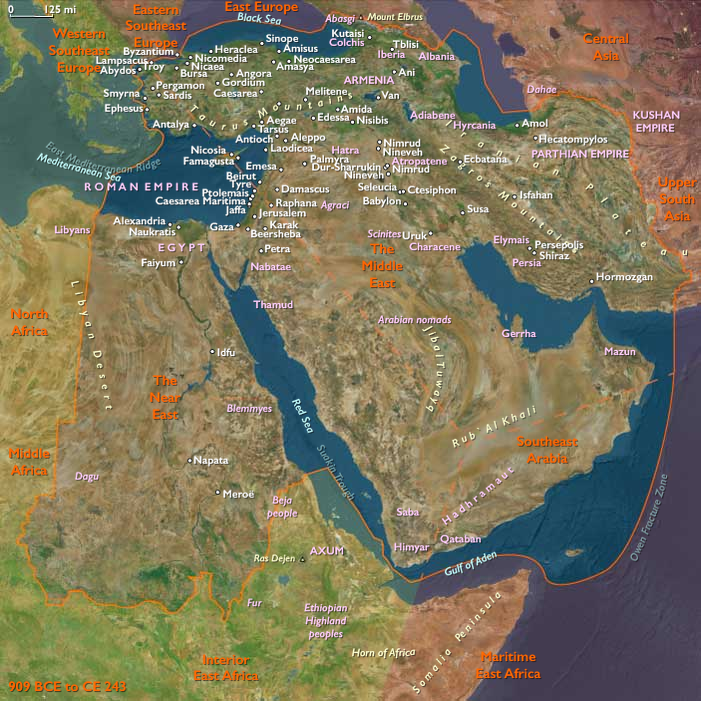
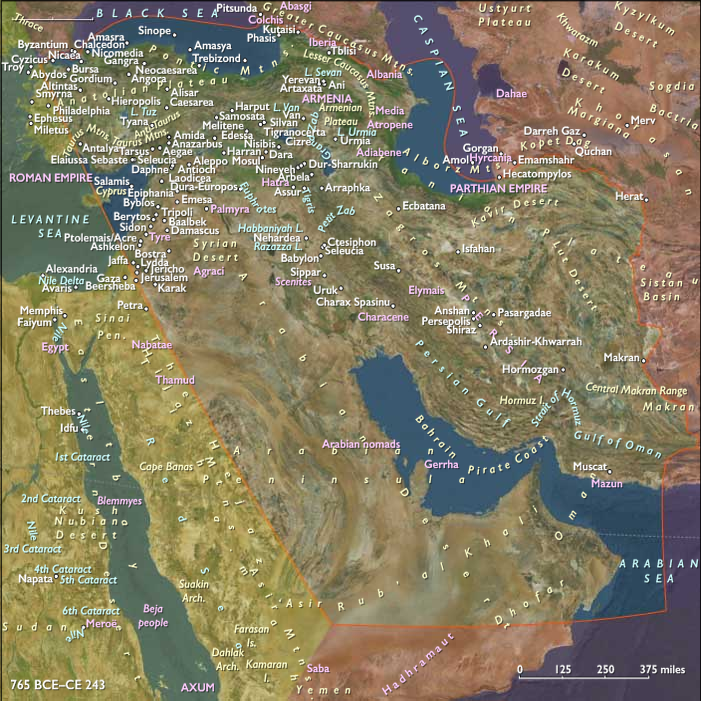
The first wife of Nicomedes III of Bythinia was the Cappadocian Princess Nysa, daughter of the Monarchs Ariarathes VI of Cappadocia and Laodice of Cappadocia.
By Nysa, Nicomedes III has two sons who (Nicomedes IV of Bithynia, Socrates Chrestus and a daughter called Nysa).
Nicomedes III and Nysa are distantly related as they hold lineage from the Seleucid dynasty, the Antipatrid dynasty and the Antigonid dynasty.
When Nicomedes is asked to provide troops for Roman Statesman Gaius Marius’ war on the Cimbri and Teutons in transalpine Gaul in 104 BCE, he turns down the request, declaring: "All those eligible for military service in my kingdom have been robbed by the Roman tax-farmers and sold into slavery".
The royal dominions of Pontus had been considerably diminished after the death of Mithridates V: Paphlagonia had freed itself, and Phrygia had been linked to the Roman province of Asia around 116.
Pontine monarch Mithridates VI, moving carefully to avoid unduly provoking Rome, has, by 104, occupied …
…Galatia and …
…Nicomedes III of Bithynia.
The Hasmonean kingdom of Judaea has attained power and great prosperity under the reign of John Hyrcanus.
The Pharisees, a scholarly sect with popular backing, and the Sadducees, an aristocratic sect that comprises the priesthood, become well-defined religious parties.
Hyrcanus is worldly, agnostic, and urbane in outlook, utterly unlike his grandfather.
In spirit, he has become a Sadducee, an upper-class conservative who accepts only the Written Law as divinely revealed and authoritative.
The first of the Biblical books of Maccabees, a pro-Hasmonean historiography, is written in about the latter part of the second century BCE.
1 Maccabees, originally written in Hebrew by a Jewish author and surviving in a Greek translation contained in the Septuagint, relates the history of the Maccabees from 175 BCE until 134 BCE.
The book is held today as canonical scripture by some Christian churches (including Catholic, Orthodox and Coptic churches), but not by most Protestant groups, who consider it to be an apocryphal book.
In modern-day Judaism, the book is often of great historical interest, but has no official religious status.
Hyrcanus has consolidated the gains of his father and uncles; his reign is to be be the last under which Judaea is a powerful, united state.
The remainder of Hyrcanus' long and disturbed reign over Judaea has been marked by his efforts to punish his enemies, ward off the Syrians, and enlarge Judaea's boundaries.
Although he has struggled in vain to destroy Ptolemy, he has successfully thwarted Syrian incursions by alliance with Rome and conquered the unfriendly neighboring territories of Samaria and Idumaea (Edom).
According to his will, the government of the country after his death is to be placed in the hands of his wife, and his eldest son, Aristobulus, is to receive only the high-priesthood.
Upon the death of Hyrcanus in 104, Aristobulus, with the help of his brother Antigonus, seizes the throne from his mother and jails or kills his other three brothers.
Aristobulus, who actually calls himself Philhellene (a lover of Hellenism), is said to have assumed the title of king (basileus), although on his coins he appears, like Hyrcanus I, as high priest.
Like his father, Aristobulus is a Sadducee who takes actions to erode Jewish identity.
Under Aristobulus’ reign, the name of the Jewish community or counsel of the Jews becomes “Hever ha-Yehhdim” and in the Greek, the “Sanhedrin.” The identity of ‘the community of the Jews’ may have been on his coins, but their title, like his crown, is seen and spoken in Greek terms.

Iturea, the Greek name of a region in the Levant during the Late Hellenistic and early Roman periods, is mentioned only once in the Christian Bible, while in historical sources the name of the people, the Itureans, occurs.
The latter are first mentioned by Eupolemus—as one of the tribes conquered by David—and subsequently by Strabo, Pliny the Elder, Josephus, and others, and they designate Itureans as an Ismaelite people.
Scholars believe that the Itureans were either an Arab or Aramaic people.
They are known to the Romans as a predatory people, and are appreciated by them for their great skill in archery.
According to Josephus, the Iturean kingdom lay north of Galilee, and in 104 BCE Aristobulus I, having defeated the Itureans, annexes a part of their country to Israel, imposing Judaism upon the inhabitants.
The Roman army had until 104 BCE been a well-trained, well-regulated militia of all able-bodied, landowning male citizens.
Because of the destruction of the Roman force at Arausio and the pressure of the impending crisis, Marius is now given the latitude to construct a new army on his own terms.
Jugurtha, brought to Rome in chains, is paraded through the streets in Gaius Marius' Triumph after which his royal robes are removed and his earrings ripped off.
He loses an earlobe in the process.
He is then thrown into the Tullianum, a prison (carcer) located in the Forum Romanum, where he dies of starvation in 104 BCE.
He is survived by his son Oxyntas, who is sent to the town of Venusia, in the Southern Italian region of Basilicata, where he will remain until 89 BCE.
Marius, recruiting for his eventually successful war against the Cimbri in Cisalpine Gaul, requests support from King Nicomedes III of Bithynia.
Additional troops are not supplied due to the claim that contracted Roman tax collectors had enslaved Italians unable to pay their debts.
Marius decrees that any allied/friendly Italian should be released if they are in Roman slavery.
Around eight hundred enslaved Italians are released from Sicily, frustrating many non-Italians who thought they would be released as well, and many of these abandon their masters, incorrectly believing to have been freed.
A rebellion breaks out when they are ordered back to servitude by the Governor.
A enslaved man by the name of Salvius, following in the footsteps of Eunus, fighting for his rights and elected leader of this rebellion, assumes the name Tryphon, from Diodotus Tryphon, a rebel general and Seleucid ruler.
He amasses an army containing thousands of trained and equipped enslaved men, including two thousand cavalry and twenty thousand infantry, and is joined by a Cilician named Athenion and his men from the west of Sicily.
The rebels occupy most of the open countryside and besiege the cities, defeating the first Roman army dispatched against them.
The reduction of Numidia to client status after the Jugurthine War leaves Rome in control of the Maghrib, although Berber tribes continue to control the interior.
At the death of Aristobulus in 103 BCE, his widow, Salome Alexandra, liberates his brother Alexander Jannaeus, who had been held in prison.
Jannaeus succeeds Aristobulus as the Judaean king and high priest; and marries Salome Alexandra, whose brother is Shimon ben Shetach, a leading Pharisee.
After a failed siege against Gaza, Jannaeus strikes a phony league of friendship with the Egyptian co-ruler Ptolemy Lathyrus.
In reality Jannaeus seeks the assistance of Lathyrus’ mother, Cleopatra III, against her son.
When Lathyrus learns of this treachery, he takes out his fury on Judea.
After defeating Jannaeus near the Jordan River, Lathyrus’ soldiers slaughter fleeing Jewish troops.
Afterwards, Lathyrus attacks a small village in Judea with utter malice.
The Egyptian troops strangle women and children.
Then the deceased are cut into pieces, boiled in cauldrons, and eaten as a sacrifice.
This act of cannibalism is used to terrify the Judean people and their military.
After this massacre, Jannaeus is in no position to stop the onslaught of Lathyrus.
However, Cleopatra III, who is probably swayed to support Jannaeus through two Jewish commanders in her military, steps in to prevent Lathyrus from sacking Jerusalem.