Patras, on the northwestern coast of the…
805 CE
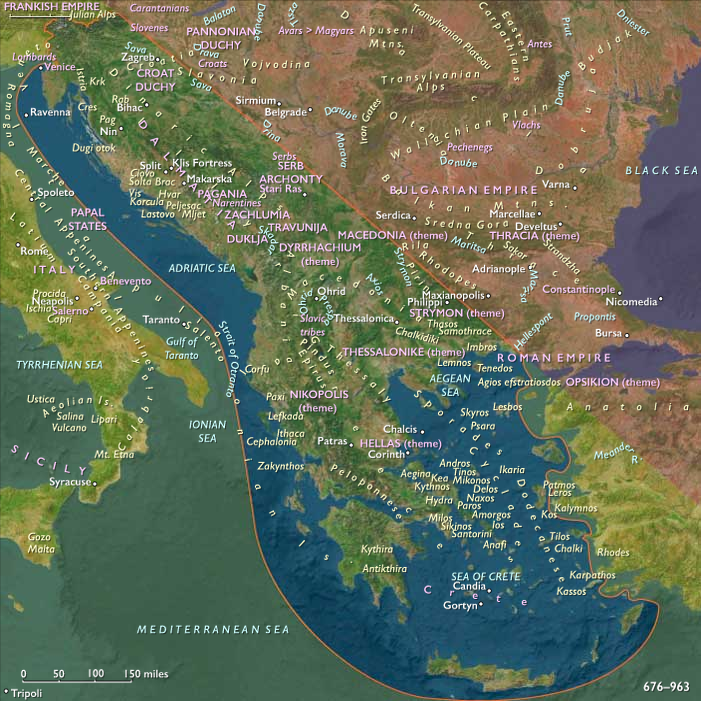
Patras, on the northwestern coast of the Peloponnese, is claimed by the Chronicle of Monemvasia—a work of highly disputed accuracy and chronology, but an essential source for the period—to have been one of the cities abandoned circa 587/8 as a result of the Slavic depredations, its population fleeing to Rhegion in Calabria.
This had been followed until around 804/5 by two hundred and eighteen years of independent Slavic rule in the Peloponnese.
The archaeological record shows Patras to have remained in imperial control throughout the period, although it is possible that part of the population indeed emigrated to Italy.
According to Chapter 49 of the De administrando imperio of Emperor Constantine VII Porphyrogennetos (r. 913–959), the Slavs of the Peloponnese in the reign of Emperor Nikephoros I made war on the Greek population with the aid of "African Saracens", looting the countryside and laying siege to Patras.
The city holds out for a while, but as food begins growing short, the inhabitants give thought to surrendering.
First, however, they dispatch a rider to the direction of Corinth, the seat of the military governor (strategos), to find out whether he is coming to their aid or not.
The envoy had been instructed on his return to give a signal through a flag he carried: if help was on its way, he was to dip the flag, otherwise to hold it erect.
The rider finds out that the strategos is not coming or is delayed—Constantine VII writes that he arrived three days after the siege had ended—but on his return to the city, his horse slips and both he and the flag fall down.
The inhabitants of Patras interpret this as a sign that aid is near, and sally forth against the besieging Slavs, allegedly led by Saint Andrew himself on horseback.
The Slavs panic at the sudden assault and flee, abandoning the siege.
Constantine VII records that the Slavs were thereafter obligated as a punishment, to maintain at their own cost all officials or envoys passing through Patras, relieving the metropolis of this burden.
Constantine VII gives no precise date for the attack, but it has been usually dated to around 805, when the city of Patras was "re-founded" according to the Chronicle of Monemvasia, or to 807, when an Arab ("Saracen") fleet reached southern Greece, although the Arab participation may well be the result of a later interpolation, mixing the real Slavic revolt with subsequent Arab raids.
The Chronicle of Monemvasia on the other hand does not mention any siege of the city.
Instead it records that an Armenian strategos at Corinth named Skleros defeated the Peloponnesian Slavs, and that this victory, in the year 804/5 or 805/6, marked the end of 218 years of Slavic rule in the Peloponnese.
Emperor Nikephoros I is then said to have rebuilt Patras by bringing back the descendants of its original inhabitants from Rhegion, and to have engaged in a large-scale resettlement and Christianization program for the peninsula, bringing in Greek colonists from Italy and Asia Minor.
Nikephoros' resettlement program at least is also confirmed by the chronicler Theophanes the Confessor, who puts it slightly later, in 810/811.
Some scholars have tried to reconcile the conflicting accounts of the Chronicle and the De administrando imperio as implying a first recovery of Patras circa 805 as the result of Skleros' campaign, which was probably concurrent with the establishment of the Peloponnese as a separate theme from Hellas, if this had not been done slightly earlier.
According to this interpretation, the Slavic revolt and attack on Patras followed as a reaction a few years later, between 807 and 811.
Whatever the exact course of events of the early 800s, the failure of the Slavic attack on Patras consolidates the recently reestablished imperial control over the Peloponnese, and Nikephoros I's policies lead to the successful re-Christianization and Hellenization of the peninsula.
The defense of Patras also secures the Empire's main maritime road of communication with Italy and the West, as it opens up the shorter route through the Corinthian Gulf, instead of the longer, more dangerous route around the Peloponnese that is exposed to Arab attacks.
Locations
People
Groups
Topics
Commodities
Subjects
Regions
Southeast Europe
View →Subregions