
Pedro Cabral's fleet, after nearly thirty days …
Years: 1500 - 1500
April
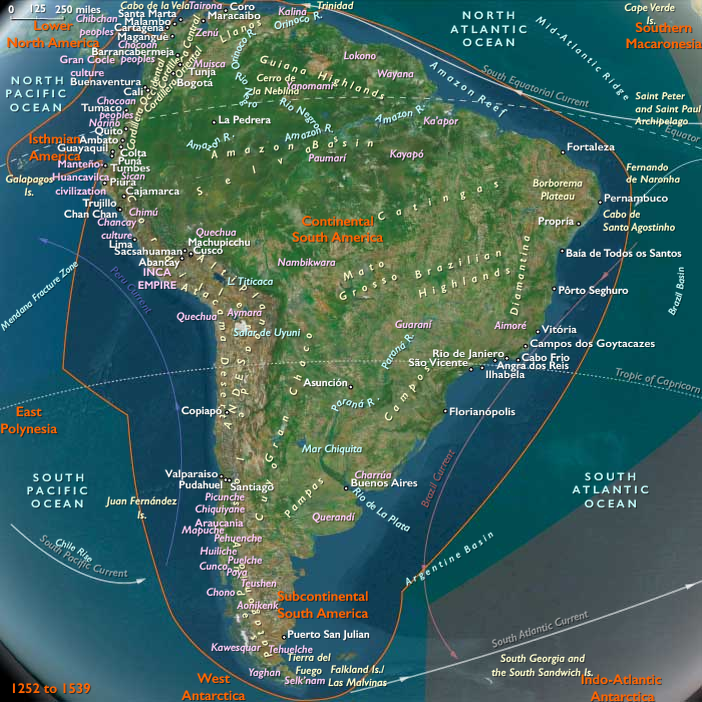
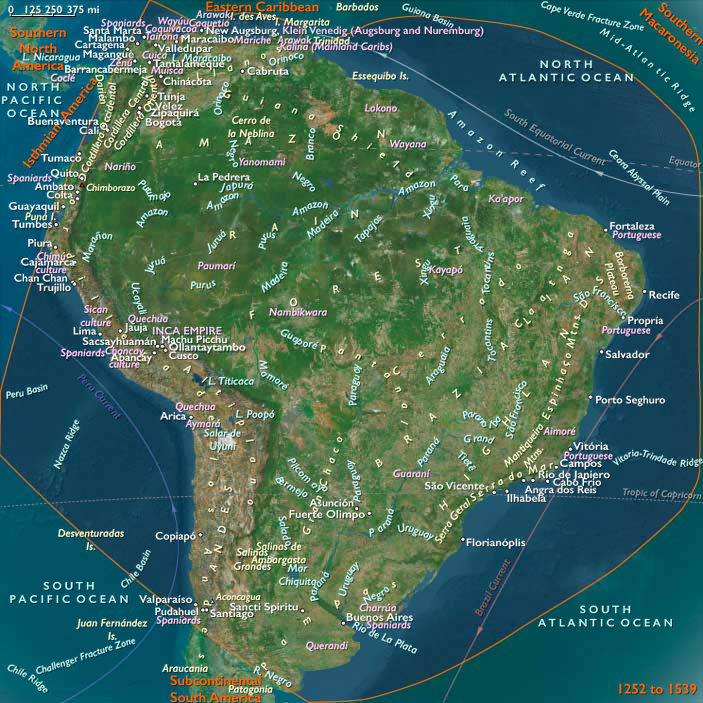
Pedro Cabral's fleet, after nearly thirty days of sailing (forty-four since departure), finds the first indications of nearby land on April 21 and sights the Brazilian coast the following day, seeing the outlines of a hill they name Monte Pascoal, some sixty kilometers south of modern Porto Seguro, Bahia.
The following morning, the armada anchors at the mouth of the Frade river and a group of local Tupiniquim Indians assembles on the beach.
Cabral dispatches a small party, headed by Nicolau Coelho, in a longboat ashore to make first contact.
Coelho tosses his hat in exchange for a feathered headdress, but the surf is too strong for a proper landing and opening of communication, so they return to the ships.
Strong overnight winds on prompt the armada to lift anchor and sail some ten leagues (forty-five kilometers) north, finding harbor behind the reef at Cabrália Bay, just north of Porto Seguro.
The pilot Afonso Lopes goes sounding in a rowboat.
He spies a native canoe, captures the two Indians on board, and brings them back to ship.
The language barrier prevents questioning, but they are fed and given cloth and beads.
The cultural differences are staggering, fed with honey and cake, they spit them out and are deeply surprised with the sight of a chicken.
The next day a party led by Nicolau Coelho and Bartolomeu Dias goes ashore, accompanied by the two natives.
Armed Tupiniquim warily approach the beach, but on a signal from the two natives, lay down their bows, and allow the Portuguese to land and collect water.
A Franciscan friar goes ashore to celebrate the first known Christian mass on the American mainland, curiously watched by some two hundred Tupiniquim Indians.
For much of the week, interaction between the Portuguese and the Tupiniquim gradually increases.
There is a brisk trade in European iron nails, cloth, beads and crucifixes in return for American amulets, spears, parrots and monkeys.
There is only the slightest hint that precious metals might be found in the hinterlands.
Portuguese degredados are assigned to spend the night in Tupiniquim villages, while the remainder of the crews sleep aboard ships.
Locations
People
- Bartolomeu Dias
- Diogo Dias
- Manuel I of Portugal
- Nicolau Coelho
- Pedro Álvares Cabral
- Pêro Escobar
- Pêro da Covilhã
- Vasco da Gama
Groups
- Hinduism
- Arab people
- Indian people
- Nair
- Islam
- Kilwa Sultanate
- Genoa, (Most Serene) Republic of
- Christians, Roman Catholic
- Franciscans, or Order of St. Francis
- Castile, Crown of
- Portugal, Avizan (Joannine) Kingdom of
- Tupiniquim people
- Portuguese Empire
- Mutapa, Kingdom of
- Florence, Republic of
- Portuguese Mozambique
- Brazil, Colonial
Topics
- India, Medieval
- Sub-Saharan Africa, Medieval
- Interaction with Subsaharan Africa, Early European
- Age of Discovery
- Colonization of the Americas, Portuguese
- Colonization of the Americas, Spanish
- Columbian Exchange
- Colonization of Asia, Portuguese
Commodoties
- Fish and game
- Weapons
- Gem materials
- Domestic animals
- Textiles
- Strategic metals
- Slaves
- Sweeteners
- Lumber
- Land
- Spices
- Tobacco
Subjects
- Commerce
- Products
- Symbols
- Watercraft
- Labor and Service
- Exploration
- Faith
- Government
- Custom and Law
- Finance
Regions
Subregions
Related Events
Showing 10 events out of 39978 total
Years: 1500 - 1500
April
Locations
People
- Bartolomeu Dias
- Diogo Dias
- Manuel I of Portugal
- Nicolau Coelho
- Pedro Álvares Cabral
- Pêro Escobar
- Pêro da Covilhã
- Vasco da Gama
Groups
- Hinduism
- Arab people
- Indian people
- Nair
- Islam
- Kilwa Sultanate
- Genoa, (Most Serene) Republic of
- Christians, Roman Catholic
- Franciscans, or Order of St. Francis
- Castile, Crown of
- Portugal, Avizan (Joannine) Kingdom of
- Tupiniquim people
- Portuguese Empire
- Mutapa, Kingdom of
- Florence, Republic of
- Portuguese Mozambique
- Brazil, Colonial
Topics
- India, Medieval
- Sub-Saharan Africa, Medieval
- Interaction with Subsaharan Africa, Early European
- Age of Discovery
- Colonization of the Americas, Portuguese
- Colonization of the Americas, Spanish
- Columbian Exchange
- Colonization of Asia, Portuguese
Commodoties
- Fish and game
- Weapons
- Gem materials
- Domestic animals
- Textiles
- Strategic metals
- Slaves
- Sweeteners
- Lumber
- Land
- Spices
- Tobacco
Subjects
- Commerce
- Products
- Symbols
- Watercraft
- Labor and Service
- Exploration
- Faith
- Government
- Custom and Law
- Finance
Regions
Subregions