Event
Subcontinental South America (1252–1395 CE): Mature Indigenous…
Subcontinental South America (1252–1395 CE): Mature Indigenous Landscapes of Forest, Steppe, and Sea
Geographic and Environmental Context
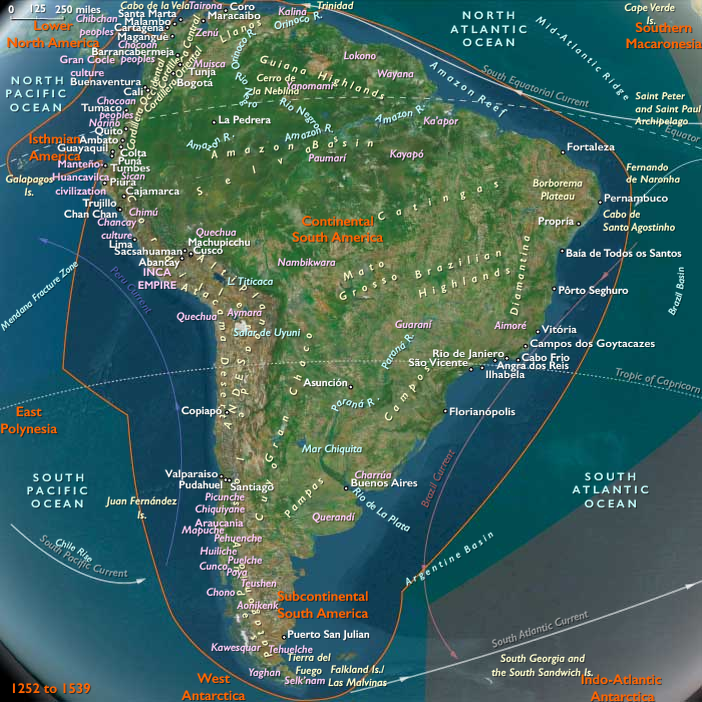
During the later medieval centuries, Subcontinental South America remained environmentally fragmented but socially well occupied. South-central Chile contained interconnected river, lake, forest, and agricultural landscapes. The eastern Andes descended into open Patagonian steppe, while western Patagonia broke into fjords and islands. Tierra del Fuego divided between northern grasslands and heavily indented southern maritime environments.
Cooler or stormier intervals affected individual districts differently, but southern societies were already adapted to considerable climatic variability.
Societies and Political Development
El Vergel communities continued to develop in Araucanía, while older local traditions persisted farther south. Settlement and exchange were sufficiently established that the region was approaching the social landscape later encountered by Europeans, although it remained inappropriate to describe it as a unified Mapuche polity.
Kin-based communities interacted through marriage, exchange, shared resource zones, and local alliances rather than centralized government.
Patagonian hunters maintained extensive seasonal territories, while maritime communities of the western archipelagos and Tierra del Fuego continued long-established canoe traditions. Terrestrial hunters occupied the open Fuegian north.
Productive Landscape and Economy
South-central Chilean communities combined household horticulture with forests, rivers, lakes, and coastal resources. Maize and potatoes were cultivated where conditions favored them, while fishing, gathering, hunting, and stored foods diversified subsistence.
In Patagonia, guanaco remained the indispensable foundation of terrestrial life. Across the channels, shellfish, fish, seals, seabirds, kelp-zone resources, and occasional stranded cetaceans sustained maritime communities.
The Falkland/Malvinas Islands and Juan Fernández remained without securely demonstrated permanent human communities.
Movement and Interaction Corridors
Andean passes connected south-central Chile to the steppe, while river systems tied interior communities to coastal and lake environments. Patagonian trails connected hunting territories, water sources, and stone-resource areas.
Canoe routes through Chiloé and the western archipelagos created a vast maritime corridor extending toward Magallanes and Tierra del Fuego.
Technology and Material Culture
El Vergel ceramics, woodworking, agricultural implements, fishing equipment, and limited metalworking reflected the increasingly diverse productive system of south-central Chile.
Patagonian technologies remained optimized for mobility, including hunting weapons, hide working, and portable shelters. Maritime peoples relied on canoes, harpoons, bone tools, baskets, and clothing adapted to cold, wet conditions.
Religion and Cultural Expression
Ritual life cannot be reconstructed with the specificity of later historical accounts, but communities across the region inhabited culturally meaningful landscapes. Rivers, forests, mountains, game animals, coastlines, weather, and ancestral places carried social as well as economic significance.
The later Selk’nam Hain, Mapuche ngillatun, and other historically recorded traditions should be understood as products of deep regional histories, not institutions that can be dated precisely to this century.
Adaptation and Resilience
The great strength of the subregion remained ecological diversity. Agricultural communities retained access to forests and waterways; mobile hunters used extensive territories; maritime groups maintained many alternative camps and resource zones.
No single system dominated the whole far south.
Legacy of the Age
By 1395, Subcontinental South America contained mature Indigenous regional systems rather than an undeveloped frontier. Araucanía supported increasingly established horticultural communities; Patagonia was structured by mobile hunting networks; the western channels and Tierra del Fuego sustained enduring maritime and terrestrial lifeways. These landscapes would confront external intrusion only in the following age.

-
{# Image navigates to the detail page; the magnifying-glass chip is the only Fancybox lightbox trigger (kept a separate sibling — anchors can't nest). #}
 The Ends of the Earth
World
-
{# Image navigates to the detail page; the magnifying-glass chip is the only Fancybox lightbox trigger (kept a separate sibling — anchors can't nest). #}
 South America
Region
-
{# Image navigates to the detail page; the magnifying-glass chip is the only Fancybox lightbox trigger (kept a separate sibling — anchors can't nest). #}
 Subcontinental South America
Subregion