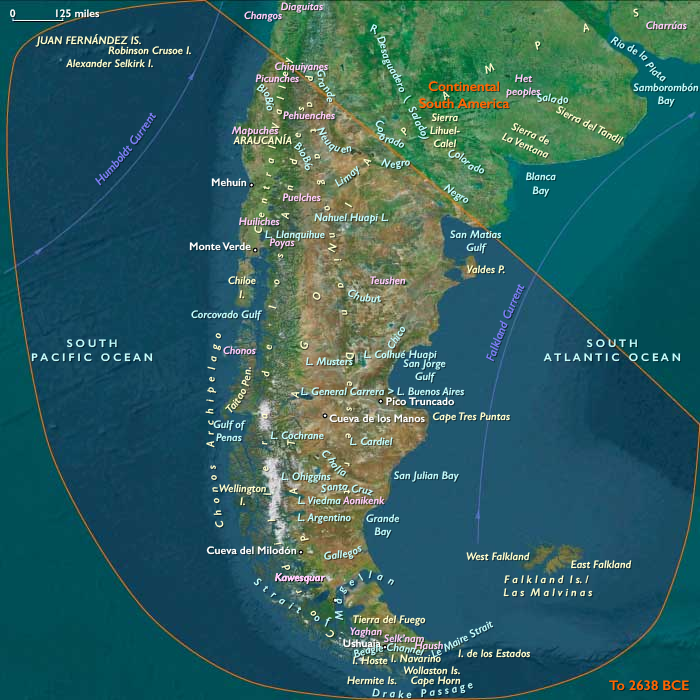
South America Minor (49,293–28,578 BCE) South America…
49293 BCE to 28578 BCE
South America Minor (49,293–28,578 BCE)
South America Minor includes southern Chile (incl. Central Valley), southern Argentina (Patagonia south of the Río Negro/Río Grande), Tierra del Fuego, Falkland/Malvinas, Juan Fernández.
Anchors: Patagonian steppe, Andean icefields, Strait of Magellan–Beagle Channel, Fuegian archipelago, Pacific fjords, Atlantic shelf banks.
Geographic & Environmental Context
-
Cordilleran ice sheets dominated the southern Andes; outlet glaciers sculpted fjords and moraines.
-
Patagonian steppe: cold, windy; periglacial dunes/loess.
-
Sea-level lowstand exposed broad Atlantic shelves and expanded Magellan–Beagle shorelines.
Climate & Environmental Shifts
-
LGM: strong westerlies, low temperatures, aridity inland; permafrost/seasonal frost common on steppe.
Subsistence & Settlement
-
Human occupation in this early window is unlikely; robust evidence appears much later (>14.5 ka at Monte Verde to the north).
-
Productive kelp highway ecologies existed (shellfish, pinnipeds, seabirds), but sustained use likely post-LGM.
Technology & Material Culture — N/A (pre-human).
Movement & Interaction Corridors — N/A (pre-human).
Cultural & Symbolic Expressions — N/A.
Environmental Adaptation & Resilience
-
Ecological scaffolding (kelp forests, shelf banks, guanaco steppe) set the later human adaptive palette.
Transition
-
Deglaciation and shelf flooding will open fjord/archipelago routes, enabling the well-documented Holocene maritime foragers of the southern cone.
Images

South America Minor in the Upper Paleolithic
Regions
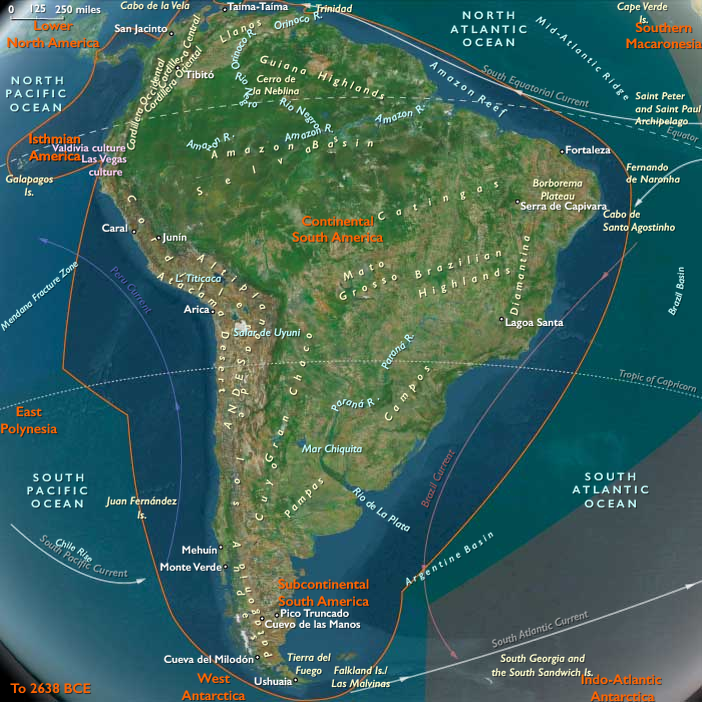
South America
View →Subregions