Event
Subcontinental South America (4,365–2,638 BCE): Steppe Hunters,…
Subcontinental South America (4,365–2,638 BCE): Steppe Hunters, Maritime Adaptation, and Southern Island Frontiers
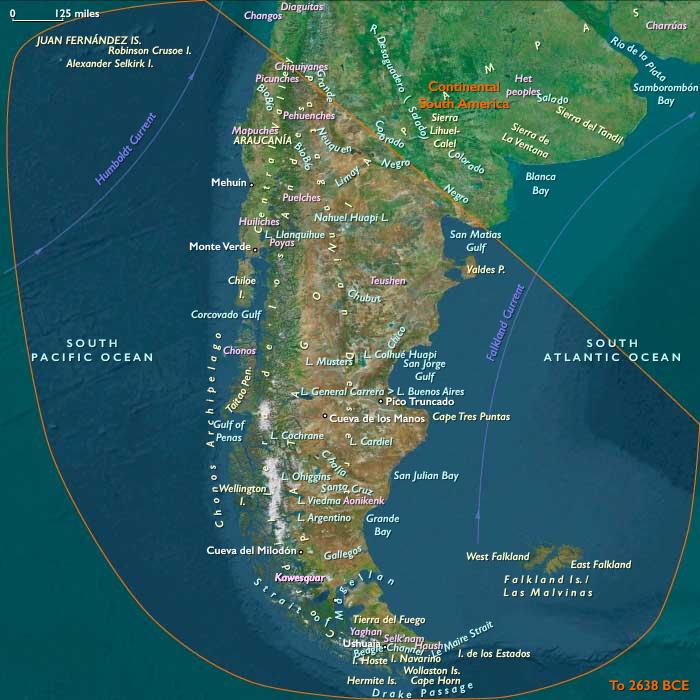
Subcontinental South America included Araucanía and adjoining south-central Chile; Argentine Patagonia south of the Río Negro; Chilean Patagonia and its Pacific fjords; the Strait of Magellan; Tierra del Fuego and the surrounding Fuegian archipelagos; the Falkland Islands; and the Juan Fernández Islands.
The region ranged from the temperate forests, lakes, rivers, and volcanic uplands of Araucanía, through the dry Patagonian steppe and southern Andean foothills, to the forested coasts and island channels of southern Chile and Tierra del Fuego. Beyond the continental margin lay the remote Falkland and Juan Fernández archipelagos.
The epoch ran from 4,365 BCE through 2,638 BCE, inclusive. Counting both 4,365 BCE and 2,638 BCE as part of the epoch gives a span of 1,728 labeled BCE years.
At the opening, terrestrial hunter-gatherers had already occupied Patagonia and Tierra del Fuego for thousands of years. Guanaco hunting remained fundamental across the steppe, supplemented by plants, birds, smaller animals, freshwater resources, and locally available coastal foods.
At the same time, specialized maritime lifeways were becoming firmly established in the far south. Along the Beagle Channel and neighboring Fuegian waterways, communities combined seals, fish, shellfish, seabirds, and terrestrial resources with sophisticated bone harpoons and watercraft.
The epoch therefore spans the coexistence of long-established steppe hunting traditions with an increasingly specialized maritime adaptation in the southern archipelagos.
Araucanía and South-Central Chile
Across Araucanía and adjoining south-central Chile, communities occupied temperate forest, lake, river, wetland, volcanic, and Pacific coastal environments.
Hunting, fishing, shellfish collecting, plant gathering, and use of forest resources could be combined within relatively short distances. Rivers and lakes provided important inland routes, while coastal and island occupations added marine resources.
Some offshore islands were used during portions of this epoch, but occupation was not necessarily continuous. Individual islands could experience periods of settlement, abandonment, and renewed use.
Araucanía therefore formed a distinct forest–river–coastal world rather than simply the northern extension of the Fuegian maritime tradition.
The Patagonian Steppe
Across Patagonia south of the Río Negro, guanaco remained the central large terrestrial prey.
Communities moved among river valleys, springs, lakes, sheltered basins, volcanic plateaus, and seasonal hunting grounds. Water availability strongly influenced travel and settlement in the drier interior.
Stone projectile points, scrapers, knives, and grinding implements formed the durable portion of a broader technology that also included wooden shafts, hides, sinew, cordage, baskets, and shelters.
Guanaco supplied meat, hides, sinew, bone, and other materials, while seeds, fruits, roots, geophytes, waterfowl, and smaller animals broadened the subsistence base.
Mobility followed familiar landscapes. Springs, river crossings, hunting grounds, rock shelters, and stone sources could be revisited over generations.
The Patagonian Coasts and Chilean Fjordlands
The Atlantic Patagonian coast and Pacific fjordlands of southern Chile offered very different coastal settings.
Along the Atlantic, communities combined shellfish, marine mammals, fish, seabirds, and coastal plants with resources drawn from the neighboring steppe. Shell middens accumulated at some repeatedly used shoreline locations.
On the Pacific side, mountains, forests, islands, and deep inlets created a more enclosed and fragmented landscape.
Coastal occupations did not necessarily represent permanent fishing settlements. In many districts, shorelines formed one component of wider seasonal territories.
Tierra del Fuego
Tierra del Fuego contained two contrasting ecological zones.
In the north, open steppe supported terrestrial hunting economies closely related to those of continental Patagonia. Guanaco dominated large-game hunting, while wetlands, water sources, and sheltered camps helped structure movement.
In the south, forested shores and island waterways supported increasingly specialized marine economies.
The distinction between northern and southern Tierra del Fuego was therefore ecological as much as geographic: the north remained tied to the steppe, while the south became increasingly oriented toward coastal and marine resources.
The Beagle Channel and Fuegian Maritime World
The Beagle Channel and adjoining Fuegian archipelagos provide the clearest evidence for specialized maritime adaptation during this epoch.
By the opening centuries, coastal communities were already combining marine and terrestrial resources. Seals were particularly important, while fish, shellfish, seabirds, guanaco, and gathered plants added diversity.
Bone harpoons, including detachable and multibarbed forms, reveal specialized marine hunting techniques. Stone tools, cordage, wooden shafts, containers, clothing, fire-making equipment, and watercraft completed the technological system.
Canoes made it possible to move among islands, opposing shores, marine hunting grounds, and repeatedly used camps.
Shell middens accumulated at favored shoreline locations and preserve food remains, hearth debris, stone tools, bone implements, and traces of occupation.
These communities were mobile rather than permanently village-based. Small groups could circulate through known territories while returning repeatedly to productive places.
During the later part of the epoch, some maritime economies broadened further as fish and birds became increasingly important alongside seals and shellfish.
The Strait of Magellan and Southern Channels
The Strait of Magellan formed a zone of contact between steppe and maritime lifeways.
Terrestrial hunters used the surrounding grasslands, while coastal groups exploited nearby marine environments. Their territories could overlap without becoming identical.
The southern and western channels were occupied unevenly. Some areas became integrated into maritime ranges earlier than others, while more remote islands remained only intermittently used.
The strait therefore acted less as a cultural boundary than as a meeting zone between different adaptations.
Shell Middens and Repeated Places
Shell middens became one of the most visible archaeological signatures of southern coastal communities.
They accumulated through repeated habitation, food processing, tool manufacture, and disposal. In some places they also contained burials or other activities of social significance.
They should not generally be treated as monumental cemeteries. Their importance lay in the way repeated occupation gradually turned certain coastal locations into enduring landmarks within remembered landscapes.
Technology and Material Culture
Regional technologies reflected contrasting environments.
Across the steppe, projectile points, scrapers, cutting tools, hide-working equipment, wooden shafts, sinew, and portable shelters supported mobile hunting.
Along the coasts, nets, lines, bone points, shell tools, baskets, containers, and cordage became increasingly important.
In the far south, specialized harpoons and watercraft distinguished the maritime adaptation from terrestrial hunting systems.
Pigments also formed part of material life. Red, yellow, black, and other mineral colors could be used on bodies, hides, objects, rock surfaces, and in mortuary settings.
Rock art traditions were already established in parts of Patagonia, but individual motifs cannot securely be read as literal records of myths, sea journeys, or specific hunting rites.
Exchange and Contact
Stone from distinctive sources, pigments, shell, hides, bone, and ornaments sometimes moved beyond their immediate source areas.
These materials probably circulated through visiting, kinship, marriage, gift exchange, seasonal aggregation, and repeated encounters between neighboring groups.
Contact between coast and interior was especially likely where valleys, passes, or accessible shorelines brought different ecological zones close together.
Such movement linked communities without creating a single integrated southern trade system.
Climate and Environmental Variability
The epoch lay within the Middle Holocene, when southern South America experienced substantial regional climatic variability.
Changes in the position and strength of the Southern Westerly Winds affected rainfall, storminess, forests, glaciers, and marine conditions differently on the wet Pacific side and the dry Patagonian steppe.
By this period, forests were established across much of southern Tierra del Fuego, while northern districts remained open steppe.
Shorelines also continued to adjust to postglacial sea-level change, and some earlier coastal sites may now lie submerged.
Communities responded through mobility, knowledge of reliable water and shelter, and flexible use of terrestrial and marine resources.
The Falkland Islands
The Falkland Islands lack secure archaeological evidence for permanent human settlement during this epoch.
Prehistoric charcoal has raised the possibility of occasional human visits before European arrival, but the evidence remains ambiguous.
Without associated settlement sites or artifacts, rare visitation cannot yet be distinguished confidently from natural fire.
The safest reconstruction therefore treats the islands as without secure occupation, while leaving open the possibility of occasional prehistoric landfall.
Juan Fernández
The Juan Fernández Islands remained uninhabited throughout the epoch.
Their great distance from the Chilean mainland placed them beyond the securely documented ranges of contemporary South American voyagers.
The archipelago remained an isolated volcanic ecosystem of endemic forest, steep ridges, seabirds, marine mammals, and productive surrounding waters.
Human settlement belongs to the historical period, thousands of years after the HistoryAtlas endpoint.
Legacy of the Age
By 2,638 BCE, after 1,728 inclusive years beginning with 4,365 BCE, Subcontinental South America contained several contrasting hunter-gatherer worlds.
Across Patagonia south of the Río Negro and northern Tierra del Fuego, mobile terrestrial communities maintained long-established lifeways centered strongly on guanaco.
Across the Beagle Channel and parts of the Fuegian archipelagos, specialized maritime societies had become firmly established, combining watercraft, bone harpoons, marine hunting, fishing, shellfish gathering, and repeated coastal occupation.
Araucanía and south-central Chile followed their own forest, river, coast, and island trajectory, while the Falklands remained without secure settlement and Juan Fernández remained uninhabited.
The epoch therefore ended with a strongly differentiated southern world: steppe hunters, mixed coastal foragers, and specialized maritime communities occupying neighboring but ecologically distinct landscapes.

-
{# Image navigates to the detail page; the magnifying-glass chip is the only Fancybox lightbox trigger (kept a separate sibling — anchors can't nest). #}
 The Ends of the Earth
World
-
{# Image navigates to the detail page; the magnifying-glass chip is the only Fancybox lightbox trigger (kept a separate sibling — anchors can't nest). #}
 South America
Region
-
{# Image navigates to the detail page; the magnifying-glass chip is the only Fancybox lightbox trigger (kept a separate sibling — anchors can't nest). #}
 Subcontinental South America
Subregion