
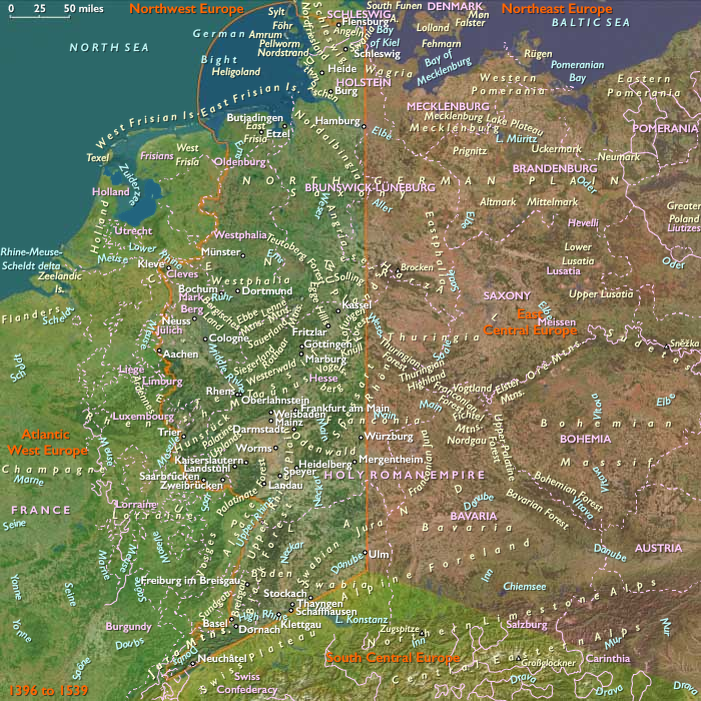
Philip introduces the Reformation into Hesse, founding…
1527 CE
Philip introduces the Reformation into Hesse, founding Marburg, the world’s first Protestant university, in 1527.
People
Groups
Subjects
Regions

Central Europe
View →Subregions
West Central Europe
View →Related Events
No active filters.
Showing 10 events out of 38304 total
The Confederation of Shan States, led by the Shans of Mohnyin, attack the Burmese kingdom of Ava in 1527, killing its king and capturing and sacking the city.
Most of Ava’s citizens flee to Toungoo to the south.
The Shans install as king Prince Thohanbwa, who presides over a period of terrible devastation, with Buddhist monks immolated, temples looted, and libraries destroyed.
Prome is in alliance with the Confederation: therefore, …
…only the tiny Taungoo in the southeastern corner, east of the Bago Yoma mountain range, remains as the last holdout of independent Bamar people.
The Confederation's failure to snuff out Taungoo will soon prove costly.
The Reformation in Sweden is launched by the Swedish parliament when King Gustav, at the diet of Vasteras in 1527, achieves control over the landed wealth of the bishops.
This strengthens the crown, and becomes the first step toward the establishment of a Lutheran state church.
Economic crisis had occurred after the Swedish war of liberation because of the trade monopoly the king had granted the Hanseatic Lübeck in exchange for their support in recapturing the capital during the war.
The discontent had been used by two Catholic priests, former Bishop Peder Jakobsson of Västerås, a follower of Sten Sture the Younger, and Knut Mickelsson, who opposed the inclinations of Lutheranism which the king had displayed as early as 1524, who have stirred up the emotions against the king and for the Sture family in the province.
In the spring of 1525, the Dalecarlians had held a meeting and written a letter in which they complained of the foreign bailiffs and the imprisonment of Sten Sture's widow Christina Gyllenstierna, and stated that they would renounce their fealty unless their demands were met.
They had reportedly contacted Søren Norby, who had offered Christina marriage.
The had king managed to subdue the discontent by promising to meet their demands in May 1525, and the leaders fled to Norway.
Extradited in 1526, they are executed on the breaking wheel in February 1527.
The continuing discontent over the economic crisis, a new tax to Lübeck and the Swedish Reformation, which is launched in this year, sparks the second rebellion in Dalarna, centered around the so-called Daljunkern (The Youngster from Dalarna), who had came from Norway claiming to be Nils Stensson Sture, son of Sten Sture the Younger and Christina Gyllenstierna.
This results in a feud between the Dalecarlian parishes, which are divided between their loyalties toward the king and the Sture family.
The king callsrepresentatives of the rebels to negotiations in Uppsala in May 1527, and keeps ongoing contacts with them.
The Daljunkern leaves for Norway, but continues to support the rebels from there.
David Reubeni, joining once more with Solomon Molcho, travels with streaming banner to Bologna and Ratisbon (Regensburg) to meet the Emperor Charles V. Reubeni offers Charles V the alliance of Jews of the East against the Ottoman Empire.
In Ratisbon, Reubeni and Molcho meet Josel of Rosheim, who warns them against arousing the suspicions of the emperor.
Josel is worried about raising issues of the Jews in the empire.
When Reubeni and Molcho persist, officials put them in chains and take them to the emperor in Mantua, where both Molcho and Reubeni will be examined by inquisitors.
The former will be condemned to burning at the stake in 1530.
Reubeni will be taken to Spain and assigned to the Inquisition at Llerena.
As late as 1535 he will still be confined in a prison there.
Nothing more will be heard of him.
He will probably die here, as Herculano reported that "a Jew who came from India (sic) to Portugal" was burned at an auto da fé at Évora in 1541.
Another source said Reubeni died in Llerena, Spain, after 1535.
Melanchthon assists Luther in university and school reforms and, in 1527, in organizing the visitation program to regulate the evangelical territorial churches.
Huber’s numerous drawings, such as the View of Feldkirch, executed in 1527 when he is in his early forties, demonstrate his personal, direct observation of natural surroundings.
His drawings are copied from an early date; his landscapes in particular bear a deal of resemblance to similar works by Albrecht Altdorfer.
He influences his contemporary, the draftsman Augustin Hirschvogel.
Barthel Beham, who is particularly influenced by Durer's later works, settles in Catholic Munich in about 1527 to work for the Bavarian dukes William IV and Louis X. Bartel’s “Portrait of Chancellor Leonhard von Eyck,” painted in 1527 with Bartel’s characteristically vigorous realism, displays the strong influence of Italian art.
Whie here, his exceptional talent will establish him as one of Germany's principal portrait painters, favored by distinguished patrons such as Emperor Charles V.
Dürer works on numerous theoretical treatises, including one on the art of fortifications.
He explicitly states medieval theories of the city form in his idealized fortified capital of a kingdom in Etliche Underricht zu Befestigung der Stett, Schlosz und Flecken (“Guide to the Fortification of City, Castle, and Town”).
Published in 1527, the work’s rigid spatial organization groups classes by social status and segregates such noxious buildings as slaughterhouses, tanneries, and ironworks.
In all his theoretical works, in order to communicate his theories in the German language rather than in Latin, Dürer uses graphic expressions based on a vernacular, craftsmen's language.
For example, 'Schneckenlinie' ('snail-line') is his term for a spiral form.
Thus, Dürer contributes to the expansion in German prose that Martin Luther had begun with his translation of the Bible.
Now internationally celebrated for his woodcuts, engravings, and paintings, he also creates many drawings and watercolor studies of landscapes, animals, and people that reveal the constantly searching, inquisitive quality of his mind.
The complex symbolism in Dürer’s work reflects the artist’s concerns for theoretical matters, scholarly and literary pursuits, and anxieties caused by the turmoil of the beginnings of the Reformation.