
Philip's is the poorest share of his…
31 CE
Philip's is the poorest share of his father Herod's inheritance, but he rules it well.
Having few Jewish subjects, he pursues a policy of Hellenization.
His coins bear the Emperor's image, and he rebuilds a town, Bethsaida, on the northern shore of the Sea of Galilee), renaming it Julias in honor of Livia, the wife of Augustus Near the source of the Jordan, he founds another town and allows it a large degree of self-government, on the Greek pattern.
Locations
Groups
Commodities
Subjects
Regions
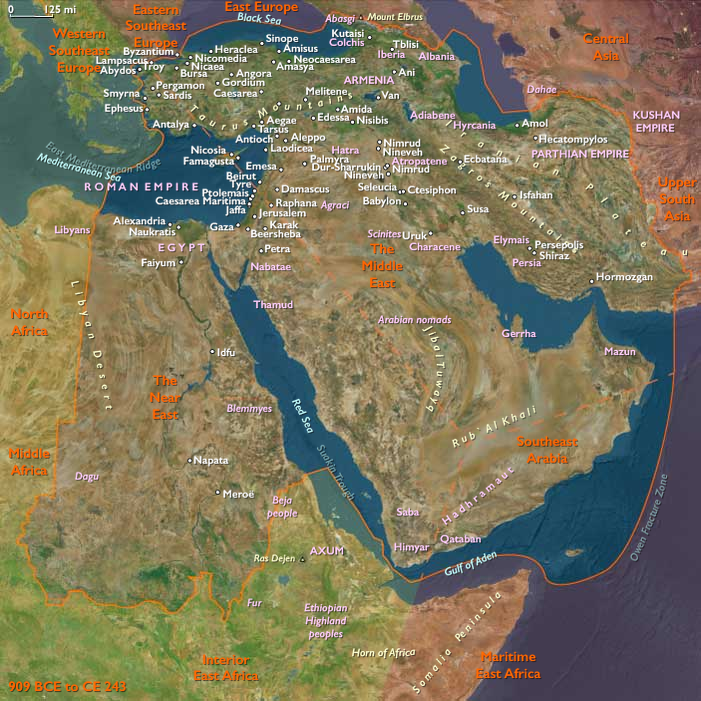
The Near and Middle East
View →Subregions
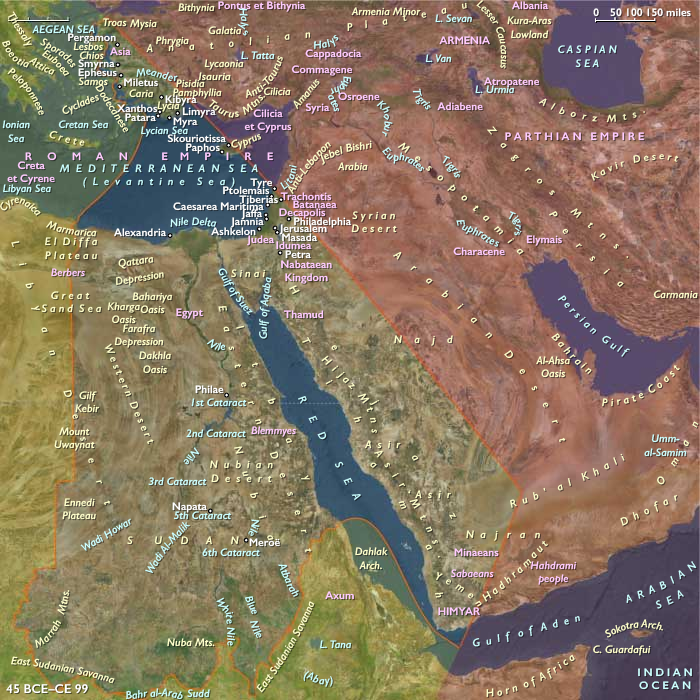
Near East
View →Related Events
No active filters.
Showing 10 events out of 61892 total
The extremist Zealots occasionally resort to violence and assassination against the Romans and their Jewish supporters, according to the historian Josephus; hence, they are called Sicarii (from the Greek for "dagger men").
The surname of Judas Iscariot, one of Jesus’ twelve disciples, may indicate that he was a member.
Another of the Twelve, Simon (called the Zealot by Luke and called the Cananaean—Aramaic for "zealot"—by Matthew and Mark), may originally have belonged to the Zealots or still be a member.
Jesus is often depicted in modern imagery, with red (or, at least, “auburn”) hair, but since there are no contemporary descriptions of him, no one can say.
It is possible that his erstwhile disciple, Judas, may have been red-haired, if there is any basis to the the nineteenth-century term “Judas-haired”, an epithet directed against redheads.
The Apostles, as the disciples become known after Jesus’ crucifixion, had reportedly witnessed Jesus’ ascension into heaven and the outpouring of the Holy Spirit on the faithful community at Pentecost.
The Gospels assert that Jesus had challenged and commissioned the men to spread the message about Jesus as Messiah and to continue the work he has begun.
The devoted but skeptical Thomas—called Didymus ("twin")—refuses to believe in the testimony of the other apostles concerning the resurrection of Jesus until he sees the wounds of the resurrected Christ himself (according to John 20:24, 25, 26-29).
Thomas (according to early fourth century writer Eusebius of Caesarea) becomes a missionary to Parthia and later (according to the third century "Acts of Thomas,") founds the church of the Malabar Christians in Madras.
Jesus’ brother James was not (according to the later Gospels of Matthew and John) a follower of Jesus during his early ministry. (The New Testament lists James—later identified as Saint James the Lesser—as first among the "brothers of Jesus," a relationship often posited as that of stepbrothers or cousins.)
James had become a believer after the resurrected Christ appeared to him (according to Paul, in I Corinthians 15:7), and is regarded as an apostle (according to Paul, in Galatians 1:19).
John (whom many people believe is the "beloved disciple" referred to in the fourth Gospel, attributed to John) plays (according to Acts 1:13, 8:14) a prominent role in the early church.
Bartholomew, whose name means "son of Tolmai" and is frequently identified (John 1) with Nathanael, is (according to tradition) martyred in Armenia.
Matthew, the tax collector called by Jesus (Mark and Luke give his name as Levi) goes on to write (according to tradition) the Gospel of Matthew.
John’s brother James, (later known as Saint James the Greater) is (according to Acts 12) martyred under Herod Agrippa I; his bones are taken to Spain (according to legend) and interred at a shrine at Santiago de Compostela.
Little is recorded of another disciple, Thaddeus (mentioned in Mark and Matthew and often identified with the Jude, or Judas, son of James, in Luke 6:16).
Matthias (according to Acts 1:15-26) is the apostle chosen by lot to replace Judas; he later preaches, according to one tradition, in Ethiopia.
Sejanus holds the consulship with Tiberius in absentia in 31, receives the long-sought permission from Tiberius to marry Drusus’s widow Livilla and begins his play for power in earnest.
In the same year, the Emperor receives evidence from Antonia Minor, his sister-in-law, that Sejanus plans to overthrow him.
Precisely what happened is difficult to determine, but Sejanus seems to have covertly attempted to court those families who were tied to the Julians, and attempted to ingratiate himself with the Julian family line with an eye towards placing himself, as an adopted Julian, in the position of Princeps, or as a possible regent.
Livilla is later implicated in this plot, and is revealed to have been Sejanus's lover for a number of years, possibly even before the birth of the twins, who some (including Tiberius) suspect Sejanus to have fathered.
The plot seems to have involved the two of them overthrowing Tiberius, with the support of the Julians, and either assuming the Principate themselves, or serving as regent to the young Tiberius Gemellus or possibly even Gaius Caligula.
Those who stand in his way are tried for treason and swiftly dealt with.
Sejanus is summoned in early October to a meeting of the Senate, where a letter from Tiberius is read condemning Sejanus and ordering his immediate execution.
Sejanus is tried, dragged off to prison,and he and several of his colleagues are executed within the week.
As commander of the Praetorian Guard, he is replaced by Naevius Sutorius Macro, who, according to Tacitus, had been active in discrediting Sejanus and in directing the subsequent purge against his family and followers, with most of Sejanus' family (including his children) and followers sharing his fate.
Sejanus' former wife Apicata, on hearing of the death of her children, addresses a letter to Tiberius, accusing Sejanus and Livilla of having poisoned Drusus; she then commits suicide.
Drusus' cupbearer Lygdus and Livilla's physician Eudemus are questioned and under torture confirm Apicata's accusation.
Livilla dies shortly afterwards, either being killed or by suicide.
According to Cassius Dio, Tiberius handed Livilla over to her mother, Antonia Minor, who locked her up in a room and starved her to death.
Tacitus claims that more treason trials followed and that whereas Tiberius had been hesitant to act at the outset of his reign, now, towards the end of his life, he seemed to do so without compunction.
Hardest hit were those families with political ties to the Julians.
Even the imperial magistracy was hit, as any and all who had associated with Sejanus or could in some way be tied to his schemes were summarily tried and executed, their properties seized by the state (in a similar way, in the few years after Valeria Messalina's death, Agrippina the Younger removed anyone she considered loyal to Messalina's memory, much in the same way that Sejanus's followers were executed).
Several modern historians have challenged Tacitus' portrayal of a tyrannical, vengeful emperor.
The prominent ancient historian Edward Togo Salmon notes: "In the whole twenty two years of Tiberius' reign, not more than fifty-two persons were accused of treason, of whom almost half escaped conviction, while the four innocent people to be condemned fell victims to the excessive zeal of the Senate, not to the Emperor's tyranny".
(A history of the Roman world from 30 B.C.
to A.D. 138 (1944; rev.
ed.
1963, 1968; p. 183) One of the few surviving sources contemporary with the rule of Tiberius comes from Velleius Paterculus, who served under Tiberius for eight years (from CE 4) in Germany and Pannonia as praefect of cavalry and legatus.
Paterculus' Compendium of Roman History spans a period from the fall of Troy to the death of Livia in CE 29.
His text on Tiberius lavishes praise on both the emperor and Sejanus.
How much of this is due to genuine admiration or prudence remains an open question, but it has been conjectured that he was put to death in CE 31 as a friend of Sejanus.
Rumors abound as to what exactly he Tiberius us doing in Capri.
Suetonius records lurid tales of sexual perversity and cruelty, and most of all his paranoia.
While heavily sensationalized, Suetonius' stories at least paint a picture of how Tiberius was perceived by the Roman people, and what his impact on the Principate was during his twenty-three years of rule.
Gaius Caesar, as a boy of just two or three, had accompanied his father, Germanicus, the nephew and adopted son of Tiberius, on campaigns in the north of Germania.
The soldiers, amused that Gaius was dressed in a miniature soldier's uniform, including boots and armor, soon gave Gaius his nickname Caligula, meaning "little (soldier's) boot" in Latin, after the small boots he wore as part of his uniform.
Gaius, though, reportedly grew to dislike this nickname.
Suetonius claims that Germanicus was poisoned in Syria by an agent of Tiberius, who viewed Germanicus as a political rival.
After the death of his father, Caligula lived with his mother until her relations with Tiberius deteriorated.After the banishment of Agrippina and Caligula's brother, Nero, when adolescent Caligula had been sent to live first with his great-grandmother (and Tiberius's mother) Livia.
Following Livia's death, he had been sent to live with his grandmother Antonia.
Suetonius writes that after the banishment of his mother and brothers, Caligula and his sisters were nothing more than prisoners of Tiberius under the close watch of soldiers.
To the surprise of many, Caligula is spared by Tiberius: in 31, Caligula is remanded to the personal care of the emperor on Capri, where he is to live for the next six years.
The affair with Sejanus and the final years of treason trials have permanently damaged Tiberius' image and reputation.
After Sejanus's fall, Tiberius' withdrawal from Rome is complete; the empire continues to run under the inertia of the bureaucracy established by Augustus, rather than through the leadership of the Princeps.
Suetonius records that he became paranoid, and spent a great deal of time brooding over the death of his son.
A shortage of grain in 32 leads to public protests in Rome.
Meanwhile, during this period a short invasion by Parthia, incursions by tribes from Dacia and from across the Rhine by several Germanic tribes occur.
Wei's small independent regime, after some initial successes, eventually collapses under overwhelming force and is reduced severely.
Wei dies in 33 and is succeeded by his son Wei Chun.
Shuoning's capital Luomen (in modern Tianshui, Gansu) falls in winter 34, and Wei Chun surrenders.
Agrippina, in prison at Pandataria, protests violently.
On one occasion, Tiberius had ordered a guard to flog her, during which punishment she loses an eye.
Refusing to eat, Agrippina is force-fed but later starves herself to death, expiring on October 17, 33 CE.
Tacitus, however, leaves open the possibility that she was deprived of nourishment while in prison and her death was not voluntary.
After her death, Tiberius slanders her name and has the senate declare that her birth date was a date of bad omen.
Together with Caligula, Germanicus’s eighteen-year-old daughter, named Julia Agrippina after her mother and known to posterity as Agrippina the younger, has also escaped the purges, as have seventeen-year-old Julia Drusilla, and fifteen-year-old Julia Livilla.
After a dispute with the members of a synagogue of "Roman Freedmen," he is denounced for blasphemy against God and Moses (Acts 6:11) and speaking against the Temple and the Law.
Stephen is tried before the Sanhedrin around 34-35.
His defense is presented as accusing the Jews of persecuting the prophets who had spoken out against the sins of the nation: "Which one of the Prophets did your fathers not persecute, and they killed the ones who prophesied the coming of the Just One, of whom now, too, you have become betrayers and murderers." (7:52)
While on trial, he experiences a theophany in which he sees both God the Father and God the Son: "Behold, I see the heavens opened, and the Son of man standing on the right hand of God." (Acts 7:56)
This vision of Christ standing differs from other Scripture, which indicates Jesus sits at the right hand of God—perhaps inferring that Christ stood in honor of Stephen whose martyrdom was near.
He is condemned and stoned to death by an infuriated mob, which is encouraged by Saul of Tarsus, later to be known as Saint Paul the Apostle.
Paul, after his own conversion to Christianity, makes reference to witnessing Stephen's martyrdom in his writings.
Philip, late in his reign, had married Salome, the daughter of Herodias, who the Gospels paint as her mother's tool in securing from Herod Antipas the execution of John the Baptist.
The most peaceable of the three inheritors of Herod's throne, Philip rules the northern third of the former Judean kingdom until his death in CE 34, after which the Romans add his territory to the province of Syria.
Little has been done to either secure or indicate how Tiberius’s succession is to take place; the Julians and their supporters had fallen to the wrath of Sejanus, and his own sons and immediate family are dead.
Two of the candidates are either Caligula, the sole surviving son of Germanicus, or his own grandson, Tiberius Gemellus.
According to historians, Caligula was an excellent natural actor and, recognizing danger, hid all his resentment towards Tiberius.
An observer said of Caligula, "Never was there a better servant or a worse master!"
Suetonius, The Lives of Twelve Caesars, Life of Caligula 10).
After he became Emperor, Caligula claimed to have planned to kill Tiberius with a dagger in order to avenge his mother and brother: however, having brought the weapon into Tiberius's bedroom he did not kill the Emperor but instead threw the dagger down on the floor.
Supposedly Tiberius knew of this but never dared to do anything about it.
Suetonius claims that Caligula was already cruel and vicious: he writes that, when Tiberius brought Caligula to Capri, his purpose was to allow Caligula to live in order that he "...prove the ruin of himself and of all men, and that he was rearing a viper for the Roman People and a Phaëton for the world."
(The Lives of Twelve Caesars, Life of Caligula 11) However, only a halfhearted attempt at the end of his Tiberius' life is made to make Caligula a quaestor, in 33, and thus give him some credibility as a possible successor, while Gemellus himself is still only a teenager and thus completely unsuitable for some years to come.
Caligula wild hold this honorary quaestorship until his rise to Emperor.
Caligula was briefly married to Junia Claudilla in 33, though she dies in childbirth in 34.
Caligula spends time befriending the Praetorian Prefect, Naevius Sutorius Macro, an important ally.
Macro speaks well of Caligula to Tiberius, attempting to quell any ill will or suspicion the emperor felt towards Caligula.
As prefect, Macro wields considerable influence.
According to Suetonius, Macro gained further favor by turning a blind eye to his wife Eunia's affair with Caligula around this time.