North Polynesia (2,637–910 BCE): The Unreached Volcanic…
2637 BCE to 910 BCE
North Polynesia (2,637–910 BCE): The Unreached Volcanic Archipelago
Geographic and Environmental Context
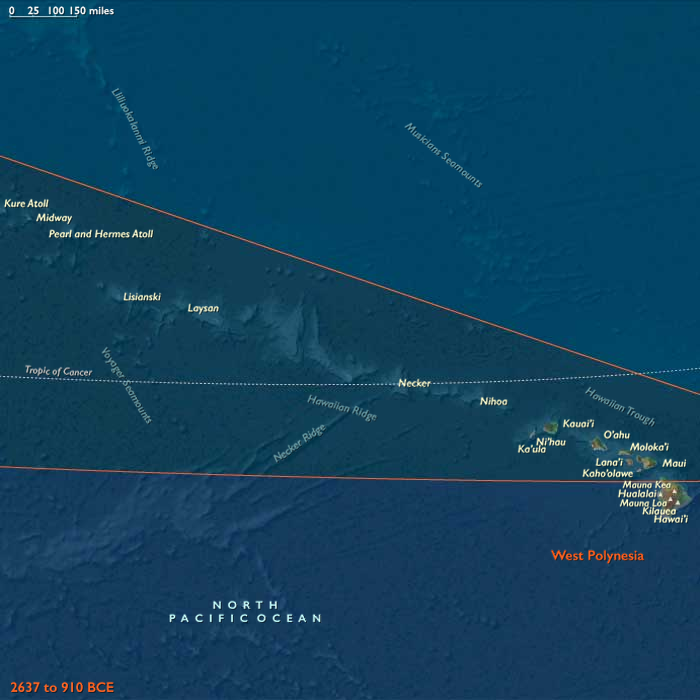
North Polynesia encompasses the Hawaiian Archipelago, including the high volcanic islands of Hawaiʻi, Maui Nui, Oʻahu, Kauaʻi, Molokaʻi, Lānaʻi, Kahoʻolawe, Niʻihau, and the smaller islands and atolls extending northwestward toward Midway.
Anchors: Hawaiʻi Island volcanoes, Maui Nui remnants, windward rainforest valleys, leeward dry coasts, Northwestern Hawaiian atolls, Midway.
Climate & Environmental Shifts
Holocene climatic stability persisted across the central North Pacific.
Trade winds delivered predictable rainfall to windward slopes, supporting extensive native forests of ʻōhiʻa, koa, loulu palms, and diverse understory communities. Leeward coasts remained seasonally dry, while summit environments hosted alpine and subalpine ecosystems unique within Polynesia.
Coral reefs, lagoons, seabird colonies, and nearshore fisheries functioned in equilibrium, unaffected by human exploitation.
Ecology & Landscape Systems
The Hawaiian chain represented one of the most isolated large archipelagos on Earth.
Its ecosystems were characterized by:
- extensive seabird nesting grounds
- intact coastal strand communities
- native forest canopies extending from shoreline to uplands
- freshwater stream systems descending from volcanic interiors
- reef–lagoon–open ocean ecological integration
Large colonies of albatrosses, petrels, shearwaters, terns, and other seabirds transported marine nutrients inland, creating strong links between oceanic and terrestrial ecosystems.
Human Presence
No permanent human settlement existed.
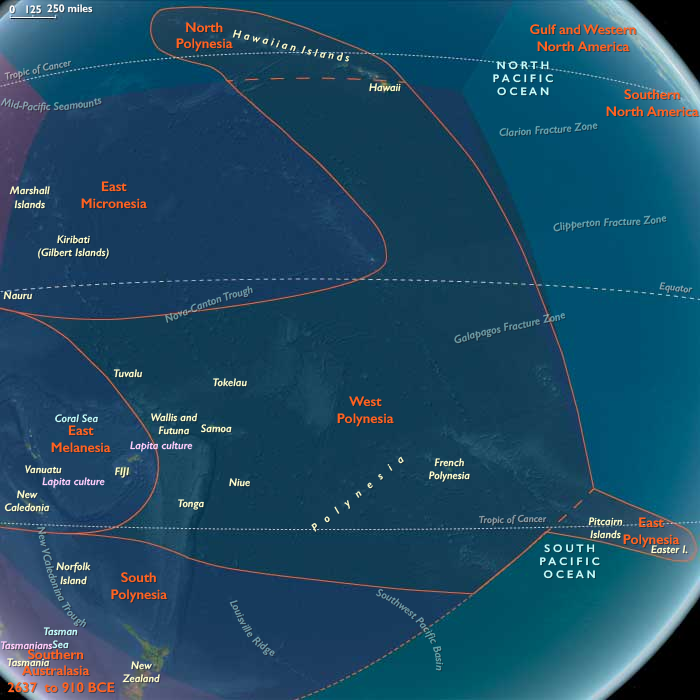
Although Lapita-descended navigators were establishing societies in Tonga and Samoa, Hawaiʻi remained beyond the eastern and northern frontier of regular voyaging.
The islands were therefore among the largest habitable landmasses on Earth still untouched by human occupation.
No agriculture, villages, domestic animals, landscape burning, or introduced species had yet altered the environment.
Maritime Context
The Hawaiian Islands occupied a critical position within the emerging mental geography of Polynesian exploration.
Although likely unknown in direct experience to most Lapita communities, the wind systems, currents, and celestial pathways that would eventually connect Hawaiʻi to the broader Polynesian world were already operating in recognizable form.
The archipelago thus existed as a future destination embedded within the navigational possibilities of the Pacific rather than within its settled geography.
Environmental Adaptation & Resilience
Isolation produced exceptionally high endemism.
Native birds, insects, plants, and coastal communities evolved without human predation or large terrestrial mammals.
Volcanic renewal, reef growth, storm cycles, and ecological succession governed environmental change, creating dynamic but resilient island systems.
Transition
By 910 BCE, North Polynesia remained entirely outside the settled Polynesian world.
Yet the navigational technologies, voyaging traditions, and maritime cosmologies that would eventually carry settlers to Hawaiʻi were already emerging in the Lapita societies of the southwest Pacific.
The islands therefore stood not as an inhabited cultural landscape but as one of humanity's greatest future destinations—an immense volcanic archipelago awaiting discovery.
Images

North Polynesia in Early Antiquity
Regions
Polynesia
View →Subregions