The restoration of power to the Swiss…
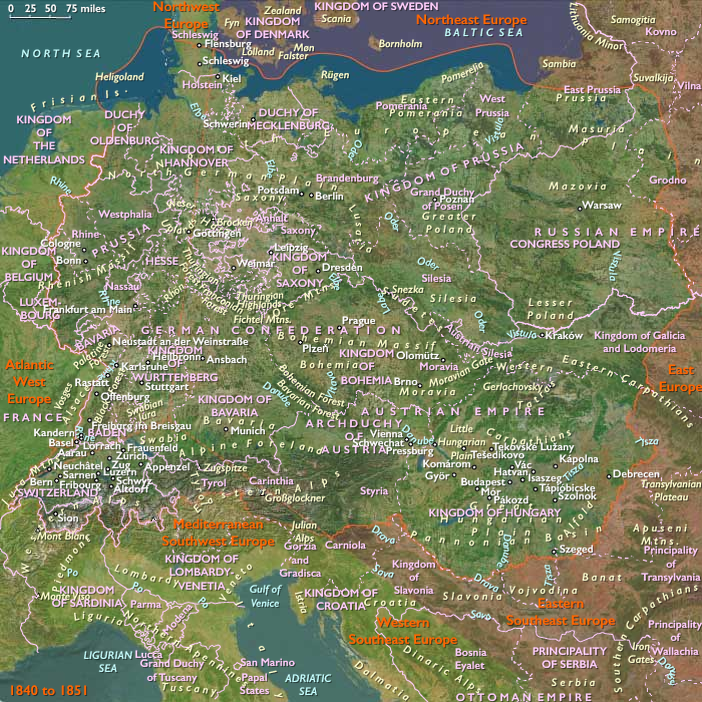
1840 CE to 1851 CE
After a period of unrest with repeated violent clashes, such as the Züriputsch of 1839, civil war (the Sonderbundskrieg) breaks out in 1847 when some Catholic cantons try to set up a separate alliance (the Sonderbund).
The war lasts for less than a month, causing fewer than one hundred casualties, most of which are through friendly fire.
Yet however minor the Sonderbundskrieg appears compared with other European riots and wars in the nineteenth century, it nevertheless has a major impact on both the psychology and the society of the Swiss and of Switzerland.
The war convinces most Swiss of the need for unity and strength towards its European neighbors.
Swiss people from all strata of society, whether Catholic or Protestant, from the liberal or conservative current, realize that the cantons will profit more if their economic and religious interests are merged.
Thus, while the rest of Europe sees revolutionary uprisings, the Swiss draw up a constitution that provides for a federal layout, much of it inspired by the American example.
This constitution provides for a central authority while leaving the cantons the right to self-government on local issues.
Giving credit to those who favor the power of the cantons (the Sonderbund Kantone), the national assembly is divided between an upper house (the Council of States, two representatives per canton) and a lower house (the National Council, with representatives elected from across the country).
Referendums are made mandatory for any amendment of this constitution.
This new constitution also brings a legal end to nobility in Switzerland.
A system of single weights and measures is introduced and in 1850 the Swiss franc becomes the Swiss single currency.
Locations
Topics
Regions
Central Europe
View →Subregions