Most Polish historians will agree that the…
November 1793 CE
In the realm of the military, the Poles had had reasonable chances to defend the Vistula river line, and thereby exhaust the Russian invading forces.
From the political perspective, demonstrating a willingness to fight on could possibly have persuaded the partitioning powers that their plan was too costly.
King Poniatowski's hopes that the capitulation would allow an acceptable diplomatic solution to be worked out are soon dashed.
With new deputies bribed or intimidated by the Russian troops, a new session of parliament, known as the Grodno Sejm, takes place in autumn 1793.
On November 23, 1793, the Sejm concludes its deliberations under duress, annulling the constitution and acceding to the Second Partition.
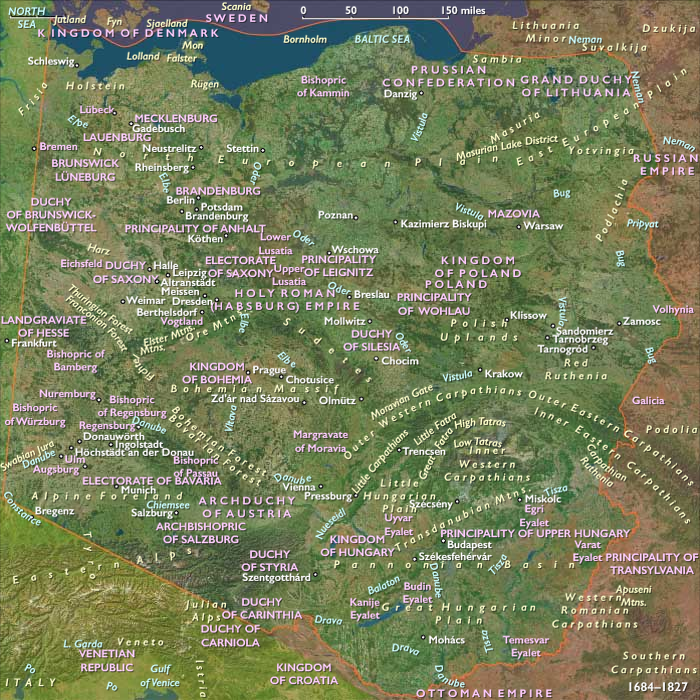
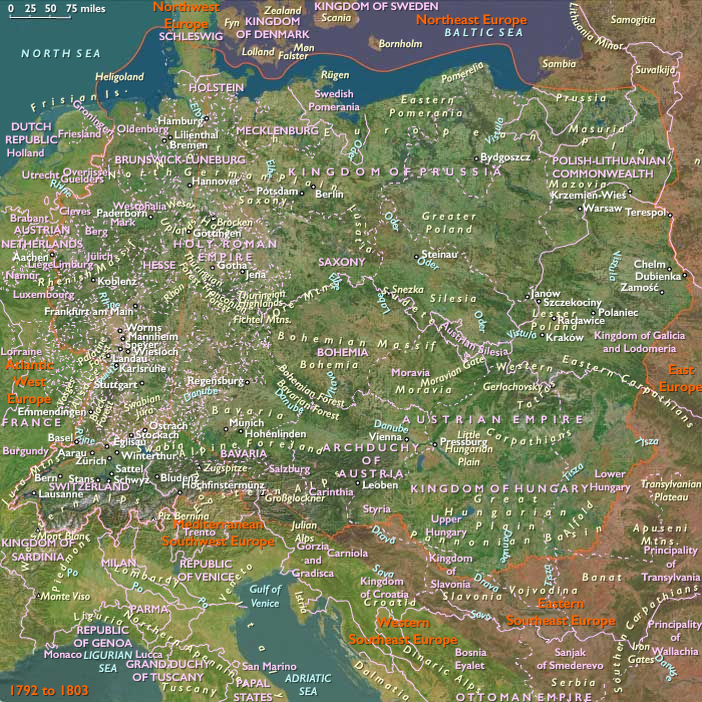
Russia takes a quarter-million square kilometers (ninety-seven thousand square miles), while Prussia takes fifty-eight thousand square kilometers (twenty-two thousand square miles) of the Commonwealth's territory.
This event reduces Poland's population to only one-third of what it was before the First Partition.
The rump state is garrisoned by Russian troops and its independence is strongly curtailed.
This outcome comes also as a surprise to most of the Targowica Confederates, who had wished only to restore the status quo ante bellum (the Commonwealth's magnate-favoring Golden Freedoms) and had expected that the overthrow of the 3 May Constitution would achieve that end, and nothing more.
Locations
People
Groups
Subjects
Regions
Central Europe
View →Subregions