
The first modern novel in Japan, Futabatei…
1887 CE
The first modern novel in Japan, Futabatei Shimei's Ukigumo (The Drifting Cloud), is published in two sections in 1887 and 1888, the novel only contains four characters, prioritizing the development of characters over plot.
The novel contains criticism of growing materialism in the Japanese society.
Locations
Subjects
Regions
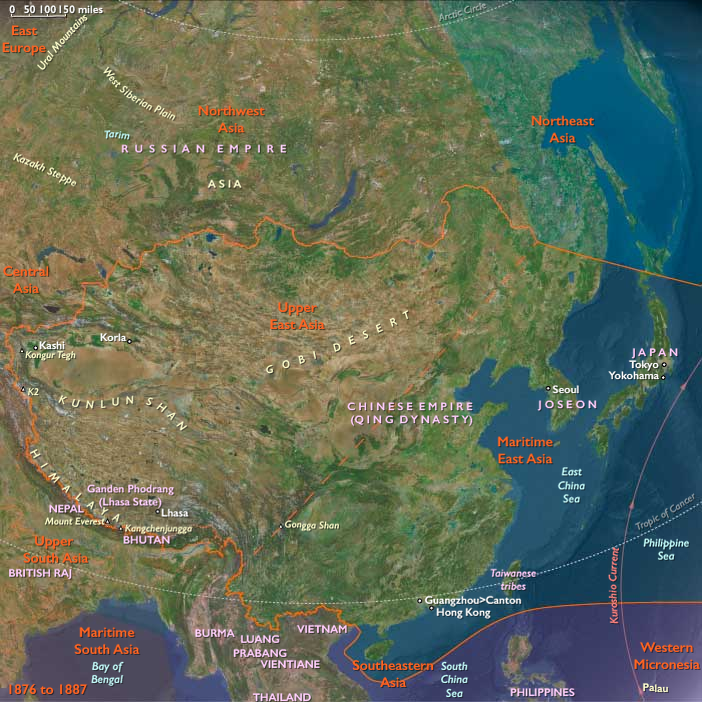
East Asia
View →Subregions
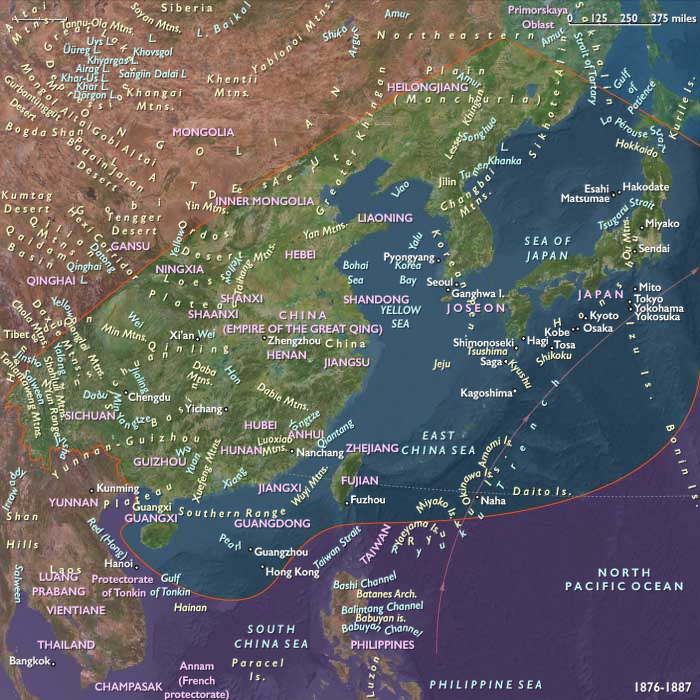
Maritime East Asia
View →Related Events
Showing 10 events out of 126 total
Vietnam's independence has been gradually eroded by France—aided by large Catholic collaborator militias—in a series of military conquests between 1859 and 1885, after which the entire country becomes part of French Indochina, formed in October 1887 from Annam, Tonkin, Cochinchina (which together form modern Vietnam) and the Kingdom of Cambodia.
The French administration imposes significant political and cultural changes on Vietnamese society.
A Western-style system of modern education is developed, and Roman Catholicism is propagated widely in Vietnamese society.
Most of the French settlers in Indochina are concentrated in Cochinchina—the southern third of Vietnam—based around the city of Saigon.
Siam's princes and other conservatives had successfully resisted the reform agenda of the young Rama V, but as the older generation was replaced by younger and western-educated princes, resistance had faded.
The king can always argue that the only alternative is foreign rule.
He has found powerful allies in his brothers Prince Chakkraphat, whom he has made finance minister, Prince Damrong, who has organized interior government and education, and his brother-in-law Prince Devrawongse, who will serve as foreign minister for thirty-eight ears.
Devrawongse visits Europe in 1887, to study government systems.
On his recommendation, the king establishes a Cabinet government, an audit office, and an education department.
The semiautonomous status of Chiang Mai is ended and the army is reorganized and modernized.
The Haw, armed with modern repeating rifles and Birmingham-manufactured ammunition, while many are skilled in guerrilla warfare, use demoralizing tactics such as mutilating captives, employ punji stakes, and make surprise night attacks.
Magic is still believed in and is resorted to by both sides.
Hora (astrologers) accompanying the Siamese troops determine that 10 o'clock on the morning of February 22, 1885, is the most auspicious time to begin the assault.
At the predetermined time, a gun is fired and the attacking forces begin their advance against the Haw stronghold, a well-defended stockade four hundred meters long by two hundred wide, surrounded by bamboo and watched over by seven towers each about twelvemeters high.
The Thai and Laotian troops advance in companies of fifty men, each under the White Elephant flag of Siam, and establish themselves behind a temporary palisade one hundred meters from the Haw fort.
The attacking forces are armed with Armstrong six-pounder (two and a half inch/sixty-four millimeter) guns, but these apparently lack ammunition.
McCarthy noted that most of the firing seemed to come from the Haw watchtowers and, despite Thai and Lao courage and almost reckless indifference to injury, "considerable execution" was caused to them.
The Haw, on the other hand, remain relatively unscathed.
At two o'clock in the afternoon, the Thais suffer a further setback when their commander-in-chief, Phraya Raj, is injured by a shot "weighing about two pounds, which glanced off the post of a Chinese joss house where he was standing and struck him in the leg."
The attack on the Haw stockade eventually has to be given up.
Subsequently, McCarthy makes inquiries into the origins and purpose of the Haw invaders.
He concludes that the Governor of Yunnan had sent them into the region to harass the French.
This may have been true of the Black Flags in Tonkin, but there is no direct indication of official Chinese involvement in Laos.
The Haw will continue their depredations until the mid-1890s, when a combination of Siamese and ultimately French pressure forces them to retreat to China.
The incumbent resident general in Cambodia complains to Paris in 1897 that Norodom is no longer capable of ruling and receives permission to assume the king's authority to issue decrees, collect taxes, and appoint royal officials.
Norodom and his successors are left with hollow, figurehead roles as head of state and as patron of the Buddhist religion.
The colonial bureaucracy expands rapidly.
French nationals naturally hold the highest positions, but even on the lower rungs of the bureaucracy Cambodians find few opportunities because the colonial government prefers to hire Vietnamese.
Rizal retains, to the very end, a faith in the decency of Spanish "men of honor," which makes it difficult for him to accept the revolutionary course of the Katipunan.
Revolution had broken out in Cuba in February 1895, and Rizal applies to the governor to be sent to that yellow fever-infested island as an army doctor, believing that it is the only way he can keep his word to the governor and yet get out of his exile.
His request is granted, and he is preparing to leave for Cuba when the Katipunan revolt breaks out in August 1896.
An informer had tipped off a Spanish friar about the society's existence, and Bonifacio, his hand forced, proclaims the revolution, attacking Spanish military installations on August 29, 1896.
Rizal is allowed to leave Manila on a Spanish steamship.
The governor, however, apparently forced by reactionary elements, orders Rizal 's arrest en route, and he is sent back to Manila to be tried by a military court as an accomplice of the insurrection.
Rizal, under a new governor, who apparently had been sponsored as a hard-line candidate by the religious orders, is brought before a military court on fabricated charges of involvement with the Katipunan.
The events of 1872 repeat themselves.
A brief trial is held on December 26 and—with little chance to defend himself—Rizal is found guilty and sentenced to death.
On December 30, 1896, he is brought out to the Luneta and executed by a firing squad.
The Filipino troops, armed with old rifles and bolos and carrying anting-anting (magical charms), are no match for American troops in open combat, but they are formidable opponents in guerrilla warfare.
For General Ewell S. Otis, commander of the United States forces, who had been appointed military governor of the Philippines, the conflict begins auspiciously with the expulsion of the rebels from Manila and its suburbs by late February and the capture of Malolos, the revolutionary capital, on March 31, 1899.
Aguinaldo and his government escape, however, establishing a new capital at San Isidro in Nueva Ecija Province.
The Filipino cause suffers a number of reverses.
The attempts of Mabini and his successor as president of Aguinaldo 's cabinet, Pedro Paterno, to negotiate an armistice in May 1899 ends in failure because Otis insists on unconditional surrender.
Hostilities break out on the night of February 4, 1899, after two American privates on patrol kill three Filipino soldiers in a suburb of Manila.
Thus begins a war that will last for more than two years.
Some one hundred and twenty-six thousand American soldiers will be committed to the conflict; four thousand two hundred and thirty-four American and sixteen thousand Filipino soldiers, part of a nationwide guerrilla movement of indeterminate numbers, will die.
Treaty negotiations are initiated between Spanish and American representatives in Paris in late September 1898.
The Treaty of Paris is signed on December 10.
Among its conditions is the cession of the Philippines, Guam, and Puerto Rico to the United States (Cuba is granted its independence); in return, the United States will pay Spain the sum of US$20 million.
The nature of this payment is rather difficult to define; it is paid neither to purchase Spanish territories nor as a war indemnity.
In the words of historian Leon Wolff , "It was . . . a gift. Spain accepted it. Quite irrelevantly she handed us the Philippines. No question of honor or conquest was involved. The Filipino people had nothing to say about it, although their rebellion was thrown in (so to speak) free of charge."
The Treaty of Paris arouses anger among Filipinos.
Reacting to the US$20 million sum paid to Spain, La Independencia (Independence), a newspaper published in Manila by a revolutionary, General Antonio Luna, states that "people are not to be bought and sold like horses and houses. If the aim has been to abolish the traffic in Negroes because it meant the sale of persons, why is there still maintained the sale of countries with inhabitants?"
Tension and ill feelings are growing between the American troops in Manila and the insurgents surrounding the capital.
In addition to Manila, Iloilo, the main port on the island of Panay, also is a pressure point.
The Revolutionary Government of the Visayas is proclaimed there on November 17, 1898, and an American force stands poised to capture the city.
Upon the announcement of the treaty, the radicals, Mabini and Luna, prepare or war, and provisional articles are added to the constitution giving President Aguinaldo dictatorial powers in times of emergency.
President William McKinley issues a proclamation on December 21, 1898, declaring United States policy to be one of "benevolent assimilation" in which "the mild sway of justice and right" will be substituted for "arbitrary rule."
When this proclamation is published in the islands on January 4, 1899, references to "American sovereignty" having been prudently deleted, Aguinaldo issues his own proclamation that condemns "violent and aggressive seizure" by the United States and threatened war.
American observers traveling in Luzon comment that the areas controlled by the republic seem peaceful and well governed.
The Malolos congress has set up schools, a military academy, and the Literary University of the Philippines.
Government finances are organized, and new currency is issued.
The army and navy are established on a regular basis, having regional commands.
The accomplishments of the Filipino government, however, count for little in the eyes of the great powers as the transfer of the islands from Spanish to United States rule is arranged in the closing months of 1898.