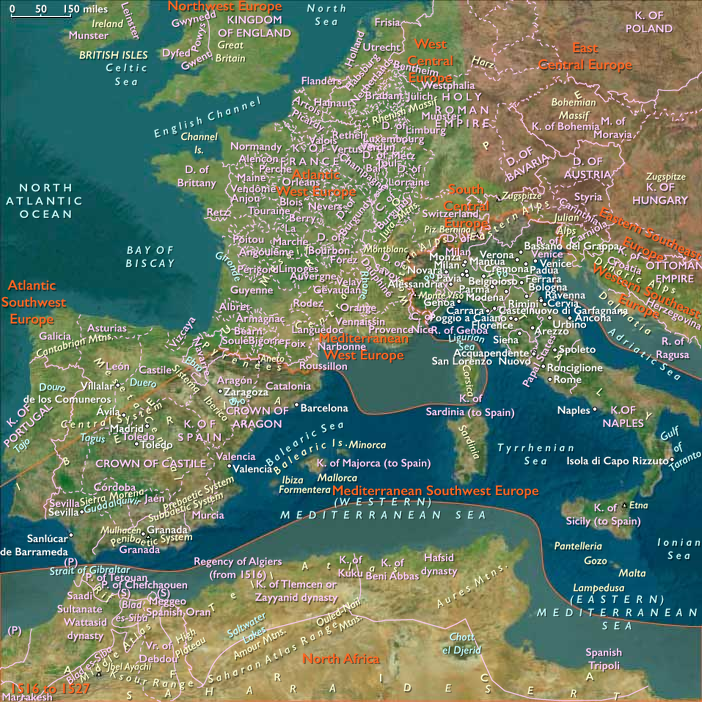
Queen Isabella had withdrawn the authority granted…
August 1524 CE
Queen Isabella had withdrawn the authority granted to Christopher Columbus and the first conquistadors, and established direct royal control.
The evolving structure of colonial government will not be fully formed until the third quarter of the sixteenth century; however, the Catholic Monarchs (Isabella and Ferdinand) had designated Juan Rodríguez de Fonseca to study the problems related to the colonization process arising from tyrannical behavior of Governor Christopher Columbus and his misgovernment of Natives and settlers.
Rodríguez de Fonseca had effectively become minister for the Indies and laid the foundations for the creation of a colonial bureaucracy.
He presides over a council, which contains a number of members of the Council of Castile (Consejo de Castilla), and forms a Junta de Indias of about eight councilors.
Upon Ferdinand’s death in 1516, Rodríguez de Fonseca has continued his work under the new sovereign, King Charles I.
He does not enjoy, however, the same confidence he had under the previous monarchs.
He had rounded off his career by sponsoring and organizing the epic voyage of Ferdinand Magellan, the first one to circumnavigate the globe.
Over his long career, Rodríguez de Fonseca has inevitably made many enemies, most notably the Dominican bishop, Bartolomé de las Casas, known as the Protector of the Indians, who has denounced him for his indifference to the cruelties that Spanish settlers inflicted on the native population of the new lands.
He also clashed with Hernán Cortés, conqueror of Mexico, which led to Cortes' removal from office in 1523.
Emperor Charles V was already using the term "Council of the Indies" in 1519.
The Council of the Indies is formally created on August 1, 1524.
The king is informed weekly, and sometimes daily, of decisions reached by the Council, which comes to exercise supreme authority over the Indies at the local level and over the Casa de Contratación founded in 1503 at Seville as a customs storehouse for the Indies.
Civil suits of sufficient importance can be appealed from an audiencia in the New World to the Council, functioning as a court of last resort.
Locations
Groups
Commodities
Subjects
Regions
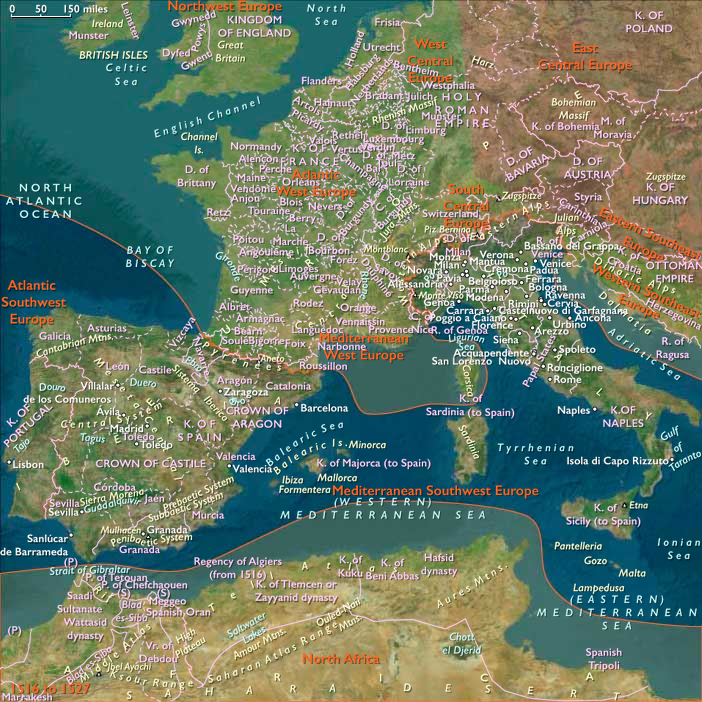
Southwest Europe
View →Subregions