
Event
A mechanical semaphore line for rapid long-distance…
A mechanical semaphore line for rapid long-distance communication had been demonstrated on March 2, 1791, by Claude Chappe in Paris.
Chappe, born in Brûlon, Sarthe, France, the grandson of a French baron, had been raised for church service, but had lost his sinecure during the French Revolution.
He was educated at the Lycée Pierre Corneille in Rouen.
His uncle is the astronomer Jean-Baptiste Chappe d'Auteroche, famed for his observations of the Transit of Venus in 1761 and again in 1769.
The first book Claude read in his youth was his uncle's journal of the 1761 trip, "Voyage en Siberie".
Because of his astronomer uncle, Claude may also have become familiar with the properties of telescopes.
He and his four unemployed brothers had decided to develop a practical system of semaphore relay stations, a task proposed in antiquity, yet never realized.
The Chappes have carried out experiments during the past two years, and on two occasions their apparatus at Place de l'Étoile, Paris had been destroyed by mobs who thought they were communicating with royalist forces.
Claude's brother, Ignace Chappe (1760–1829) is a member of the Legislative Assembly during the French Revolution.
With his help, the Assembly appoints Claude Ingénieur-Télégraphiste in the summer of 1792 and charges him with establishing a line of fifteen stations between Paris and Lille, a distance of two hundred and thirty kilometers (about one hundred and forty-three miles.
It will be used to carry dispatches from the war between France and Austria.
The Chappe brothers had determined by experiment that the angles of a rod are easier to see than the presence or absence of panels.
Their final design has two arms connected by a cross-arm.
Each arm has seven positions, and the cross-arm has four more permitting a 196-combination code.
The arms are from three to thirty feet long, black, and counterweighted, moved by only two handles.
Lamps mounted on the arms prove unsatisfactory for night use.
The relay towers are placed from twelve to twenty-five kilometers (ten to twenty miles) apart. Each tower has a telescope pointing both up and down the relay line.
Chappe first called his invention the "tachygraph", which means fast writer.
A friend suggested a name meaning a far writer, telegraph.
Late in 1792, the first messages are successfully sent between Paris and Lille.
-
{# Image navigates to the detail page; the magnifying-glass chip is the only Fancybox lightbox trigger (kept a separate sibling — anchors can't nest). #}
 The North Atlantic Lands
World
-
{# Image navigates to the detail page; the magnifying-glass chip is the only Fancybox lightbox trigger (kept a separate sibling — anchors can't nest). #}
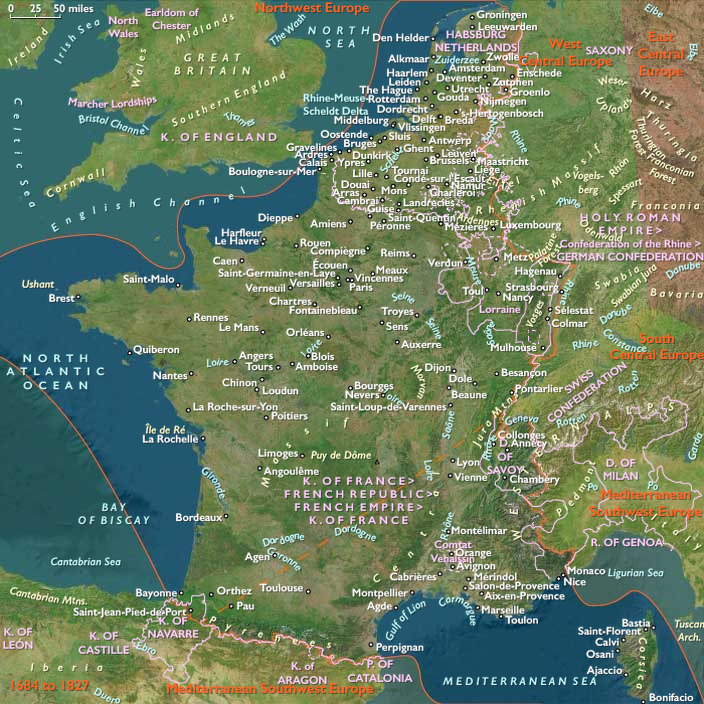 West Europe
Region
-
{# Image navigates to the detail page; the magnifying-glass chip is the only Fancybox lightbox trigger (kept a separate sibling — anchors can't nest). #}
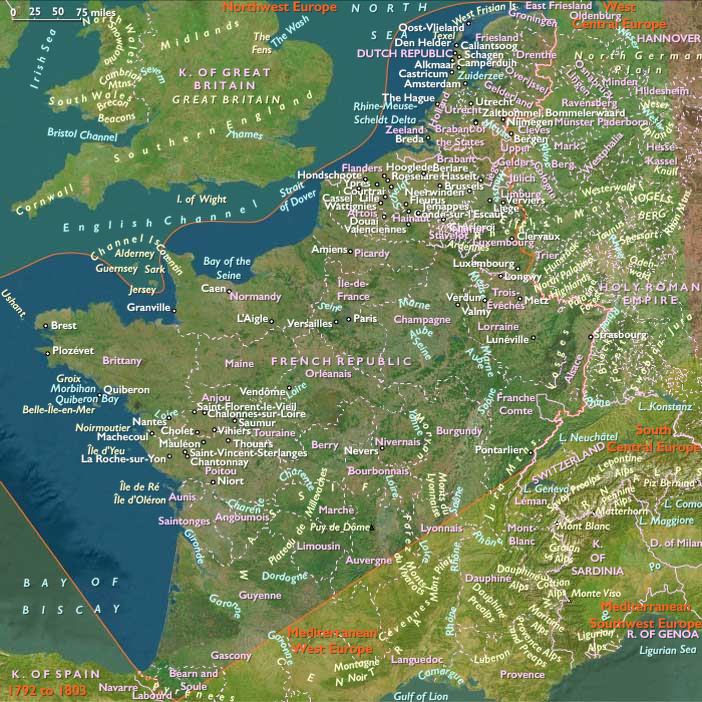 Atlantic West Europe
Subregion
