Raffles feels that under Farquhar the temenggong…
1816 CE to 1827 CE
Raffles feels that under Farquhar the temenggong and the sultan had wielded too much power, receiving one-third of the proceeds from the opium, liquor, and gambling revenues, and demanding presents from the captains of the Asian ships that drop anchor here.
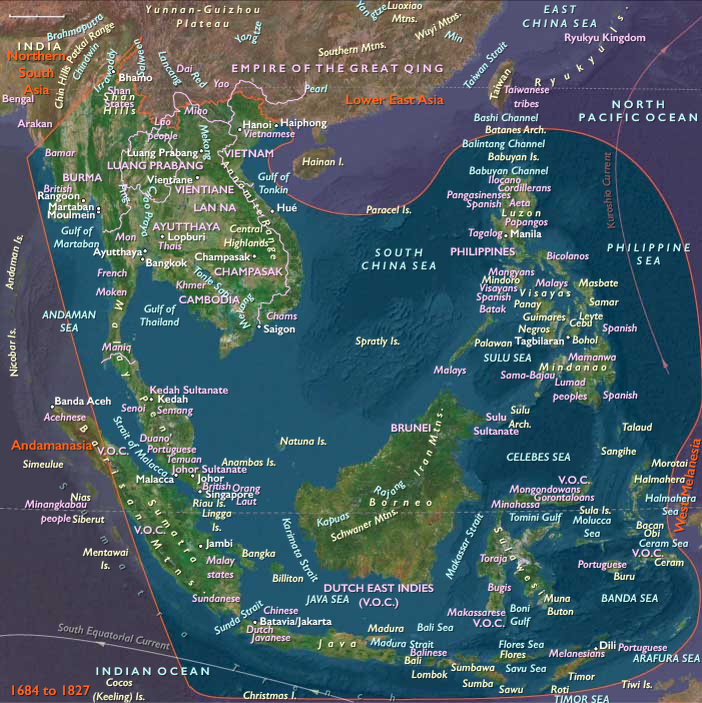
Hussein and the temenggong, however, view Singapore as a thriving entrepôt in the mold of the great port cities of the Malay maritime empires of Srivijaya, Malacca, and Johore.
As rulers of the island, they consider themselves entitled to a share of the power and proceeds of the settlement.
In June 1823, Raffles manages to persuade Hussein and the temenggong to give up their rights to port duties and their share in the other tax revenues in exchange for a pension of Sp$1500 and Sp$800 per month, respectively.
Because the Dutch still contest the British presence in Singapore, Raffles does not dare push the issue further.
On March 17, 1824, however, the Anglo-Dutch Treaty of London is signed, dividing the East Indies into two spheres of influence.
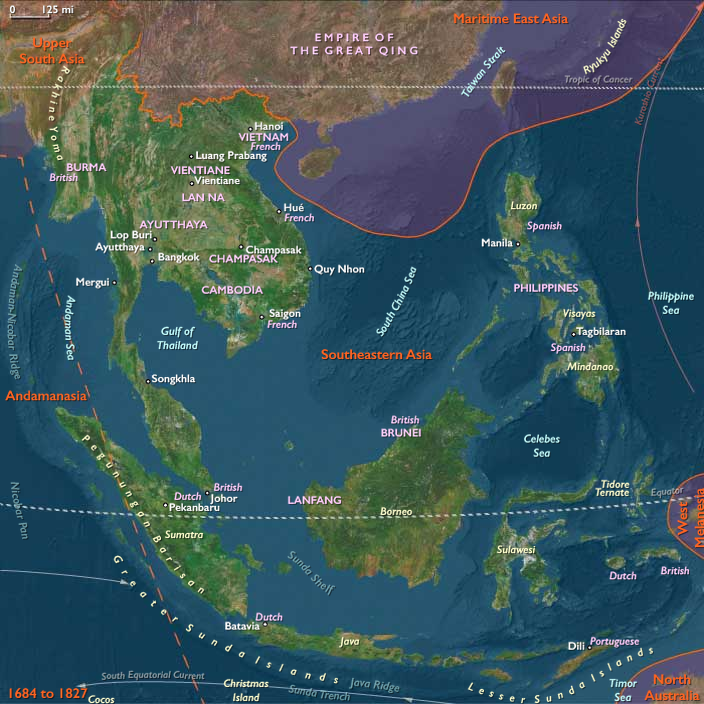
The British will have hegemony north of a line drawn through the Strait of Malacca, and the Dutch will control the area south of the line.
As a result, the Dutch recognize the British claim to Singapore and relinquish power over Malacca in exchange for the British post at Bencoolen.
On August 3, with their claim to Singapore secure, the British negotiate a new treaty with the sultan and the temenggong, by which the Malay rulers are forced to cede Singapore and the neighboring islands to the British East India Company for cash payments and increased pensions.
Under the treaty, the Malay chiefs also agree to help suppress piracy, but the problem is not to be solved for several more decades.
Locations
Groups
Subjects
Regions
Southeast Asia
View →Subregions