
Ramon Llull writes Blanquerna, chronicling the life…
1283 CE
Ramon Llull writes Blanquerna, chronicling the life of its eponymous hero.
The first major work of literature written in Catalan, it is perhaps the first European novel.
Locations
People
Regions
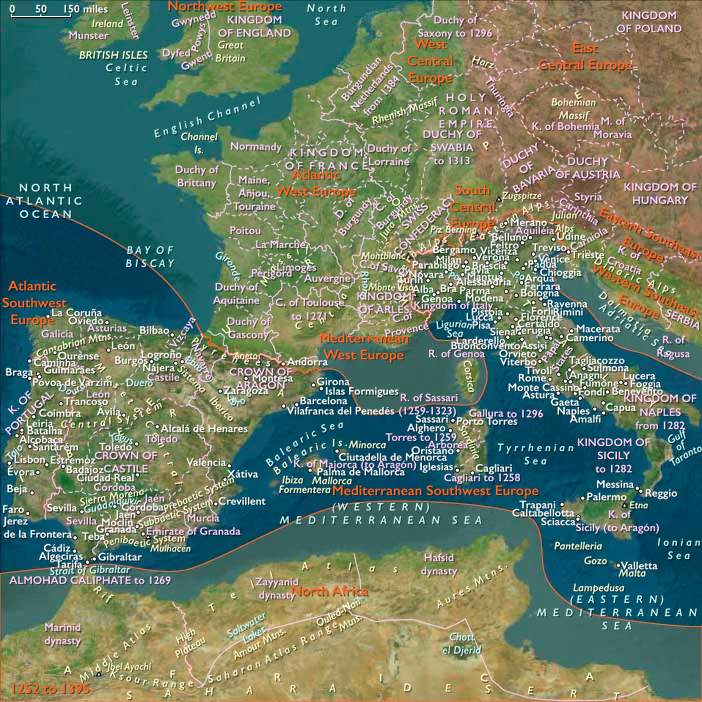
Southwest Europe
View →Subregions
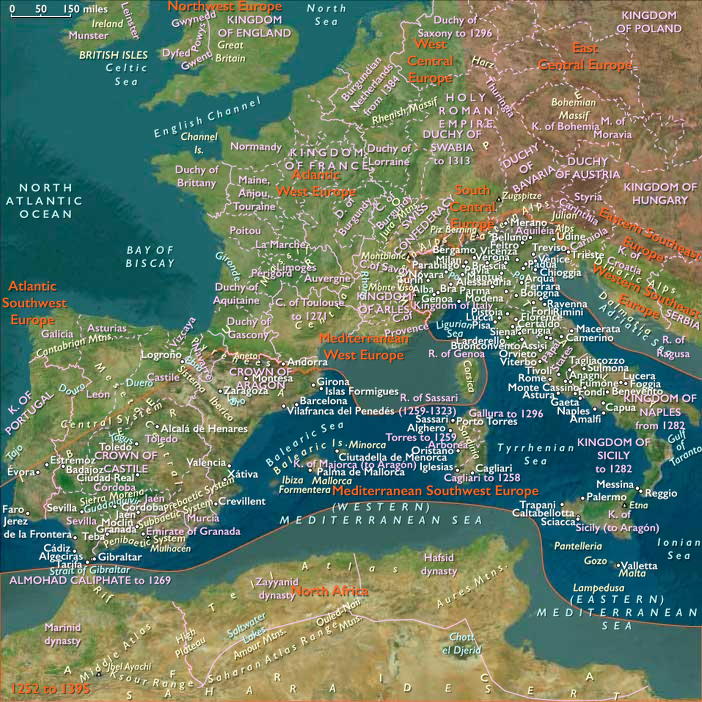
Mediterranean Southwest Europe
View →Related Events
No active filters.
Showing 10 events out of 45499 total
The Mongols follow their victory over the Burmese invaders at the Battle of Ngasaunggyan by stopping another border raid, then, in 1283, invading and crushing the Burmese near Bhamo.
King Jayavarman VIII of the Khmer Empire had imprisoned emissaries of the Mongol generalissimo in Champa.
in 1281, spurring Kublai Khan's Yuan Dynasty to invades in 1283.
Jayavarman VIII decides to pay tribute rather than fight the invasion, buying peace and preserving the empire.
The Thai alphabet is derived from the Old Khmer script, which is a southern Brahmic style of writing derived from the Pallava script was developed under the Pallava dynasty of Southern India around the sixth century CE.
Supposedly, it was created in 1283 by King Ramkhamhaeng, though this has been challenged.
Guiyang, today a prefecture-level city of China, is first constructed as early as 1283 during the Yuan dynasty.
It is originally called Shunyuan, meaning obeying the Yuan (the Mongol rulers).
Daniel, the fourth and youngest son of Prince Alexander Nevsky—famous in the history of the Russian State and the Russian Orthodox Church—and his second wife, Princess Vassa, was born in 1261 in Vladimir, the capital of the Great Vladimir-Suzdal principality.
One of the most junior princes in the House of Rurik, Daniel is thought to have been named after his celebrated relative, Daniel of Galicia.
His father died when he was only two years old.
Of his father's patrimonies, he had received the least valuable, that of Moscow.
When he was a child, the tiny principality was being governed by tiuns (deputies), appointed by his paternal uncle, Grand Prince Yaroslav III.
Daniel has been credited with founding the first Moscow monasteries, dedicated to the Lord's Epiphany and to Saint Daniel.
On the right bank of the Moskva River, at a distance of five miles from the Moscow Kremlin not later than in 1282 he founded the first monastery with the wooden church of St. Daniel-Stylite, which is today the Danilov Monastery.
Conrad von Thierberg the Younger, named Provincial Master of Prussia in 1283, leads a large army into Sudovia, finding little resistance.
The Knight Ludwig von Liebenzell, who had once been a captive of the Sudovians, negotiates the surrender of sixteen hundred Sudovians and their leader Katingerde, who will subsequently be resettled in Samland.
Most of the remaining Sudovians are redistributed to Pogesania and Samland; Skalmantas, who is pardoned and baptized in the Roman Catholic rite, acknowledges the superiority of the Knights; he is allowed to settle at Balga.
Sudovia is left depopulated to become a border wilderness that protects Prussia, Masovia, and Volhynia from the Lithuanians.
The Teutonic Knights have advanced to the Neman (Niemen) River and established firm control over Prussia by 1283, in the process exterminating great numbers of Prussians.
King Rudolph had in December 1282 vested his sons with the Austrian and Styrian duchies, which he had seized for the House of Habsburg from King Ottokar II of Bohemia in 1276.
However, in the Treaty of Rheinfelden on June 1, 1283 Rudolph II has to relinquish his share in favor of his elder brother Albert.
In compensation, his father appoints him "Duke of Swabia”—a largely honorific title, as the former stem duchy had been in long-term disarray after the last Hohenstaufen duke, the underage Conradin, was killed in 1268.
In Swabia, the former Counts of Habsburg only hold various smaller home territories, later summed up as Further Austria, of which Rudolph II will never actually obtain.
The Saxon city of Goslar starts making efforts to redeem its already-issued annuities, a sure indication of financial difficulty and perhaps an early sign of the thirteenth century crisis.
(Munro, John H. (2003).
"The Medieval Origins of the Financial Revolution".
The International History Review 15 (3): 506–562.)
The Bohemian government before Wenceslaus came of age had been handled by Otto IV, Margrave of Brandenburg, who is said to have held Wenceslaus captive in several locations.
Wenceslaus returns to Bohemia in 1283, at the age of twelve.
His mother's second husband, Záviš of Falkenštejn, will rule instead of him for a few years.
Wenceslaus on January 24, 1285, marries Judith of Habsburg, daughter of Rudolf I, to whom he has been betrothed since 1276.