Regional cultural variations in Italy are well…
1197 BCE to 1054 BCE
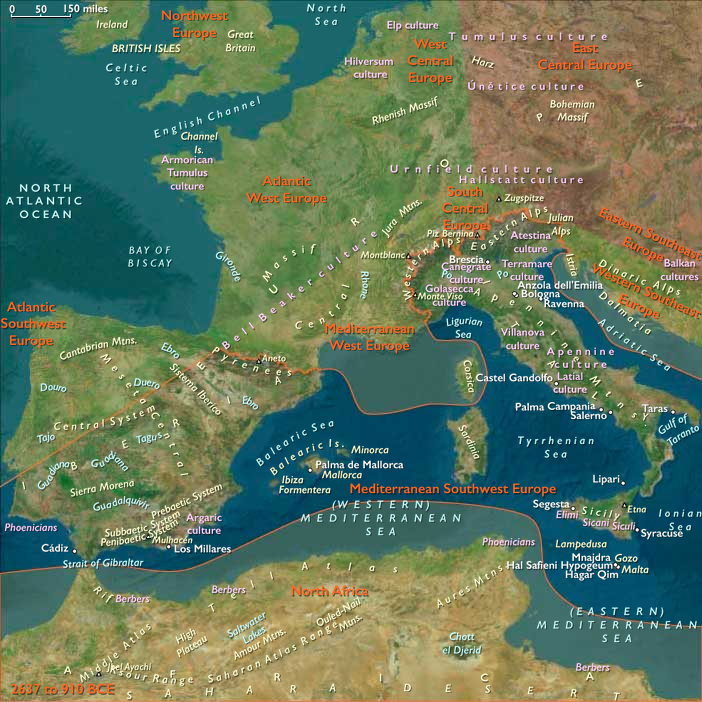
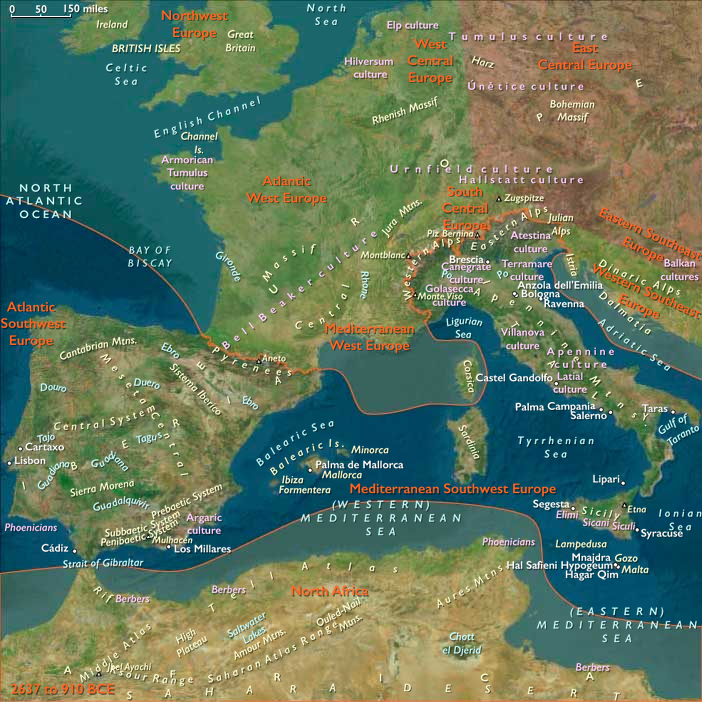
Regional cultural variations in Italy are well established by the time of the introduction of iron by the Villanovan culture, the earliest Iron Age culture of central and northern Italy, abruptly following the Bronze Age Terramare culture in about 1100.
Villanovan cultural origins, but perhaps not all its peoples, may lie in the Eastern Alps, with connections to the Halstatt culture.
The Villanovans practice cremation and bury the ashes of their dead in pottery urns of distinctive double-cone shape.
The first of two phases of Villanovan culture, called proto-Villanovan or Villanovan I, spans the years from 1100 BC to 900 BCE.
Villanovan settlements are generally centered in the Po River valley and Etruria around Bologna—later an important Etruscan center—and areas in Emilia Romagna (at Verucchio) in Tuscany and at Fermi, Lazio.
The two main hypotheses as to the origins of the Etruscan civilization in the Early Iron Age are autochthonous development in situ out of the Villanovan culture and oriental (Anatolian) colonization of Italy.
The classification of the Etruscan language in the Tyrsenian family reflects this ambiguity.
Etruscan is on one hand cognate to the Rhaetic language spoken in the Alps north of Etruria, suggesting autochthonous connections; on the other hand, the Lemnian language found on the "Lemnos stele" is closely related to Etruscan, entailing either Etruscan presence in "Tyrsenian" Lemnos, or "Tyrsenian" expansion westward to Etruria.
Among various recent DNA studies linking the modern Tuscan population to Anatolians, and to the people of Caucasus, where the concentration of the shared y-haplogroup G reaches its greatest presence, particularly among the Ossetians and Georgians, one conducted by geneticist, Alberto Piazza of the University of Turin links the Etruscans to Turkey.
The team compared DNA sequences with those from men in modern Turkey, northern Italy, the Greek island of Lemnos, the Italian islands of Sicily and Sardinia and the southern Balkans.
They found that the genetic sequences of the Tuscan men varied significantly from those of men in surrounding regions in Italy, and that the men from Murlo and Volterra were the most closely related to men from Turkey.
One genetic variant in Murlo in particular is shared only by people from Turkey.
Locations
Topics
Commodities
Subjects
Regions
Southwest Europe
View →Subregions