Roux de Marsilly, a French Huguenot conspirator…
June 1669 CE
Roux de Marsilly, a French Huguenot conspirator against Louis XIV of France, is on June 22, 1669, publicly tortured to death in Paris.
His valet is thought to be one of the strongest candidates to be the Man in the Iron Mask, a prisoner who will be held in a number of jails, including the Bastille and the Fortress of Pinerolo, during the reign of the Sun King.
The identity of this man has been thoroughly discussed and been the subject of many books, mainly because no one ever saw his face, which was hidden by a mask of black velvet cloth.
In his Questions sur l'Encyclopédie (French for "Questions on the Encyclopaedia"), published in 1771, the writer and philosopher Voltaire will claim that the prisoner wore an iron mask and was the older, illegitimate brother of Louis XIV.
What actual facts are known about this prisoner are based mainly on correspondence between his jailer and his superiors in Paris.
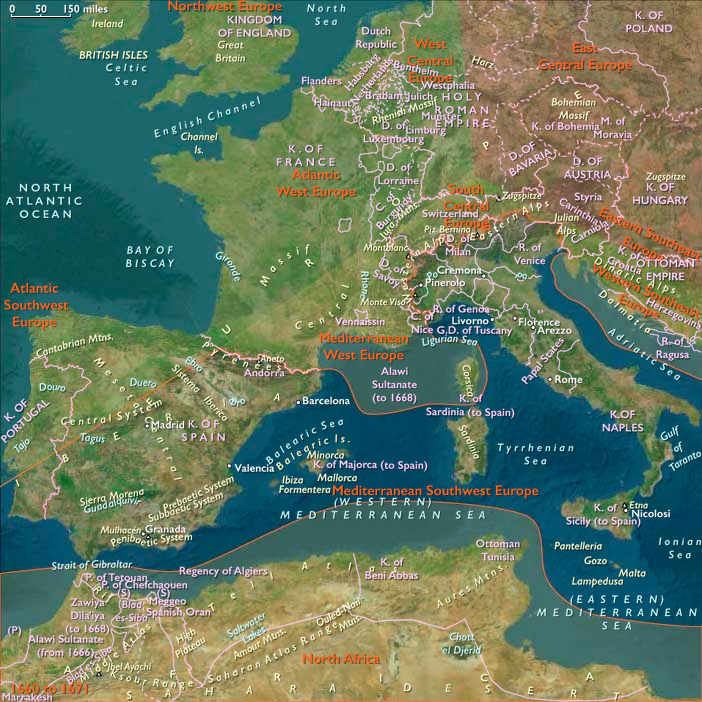
The prison at Pignerol (present Pinerolo, Italy) like the others at which Dauger will be later held, is used for men who are considered an embarrassment to the state and usually only had a handful of prisoners at a time.
Saint-Mars's other prisoners at Pignerol include Count Ercole Antonio Mattioli (or Matthioli), an Italian diplomat who had been kidnapped and jailed for double-crossing the French over the purchase of the important fortress town of Casale on the Italian border.
There is also the jailed former government minister and embezzler Nicolas Fouquet; and the Marquis de Lauzun, who had become engaged to the Duchess of Montpensier, a cousin of the King, without the King's consent.
Fouquet's cell is above that of Lauzun.
The first surviving records of the masked prisoner are from late July 1669, when Louis XIV's minister the Marquis de Louvois sent a letter to Bénigne Dauvergne de Saint-Mars, governor of the prison of Pignerol, then part of France.
In his letter, Louvois informed Saint-Mars that a prisoner named Eustache Dauger was due to arrive in the next month or so.
Louvois instructed Saint-Mars to prepare a cell with multiple doors, one closing upon the other, which were to prevent anyone from the outside listening in.
Saint-Mars himself was to see Dauger only once a day in order to provide food and whatever else he needed.
Dauger was also to be told that if he spoke of anything other than his immediate needs he would be killed, but, according to Louvois, the prisoner should not require much since he was "only a valet".
Historians have noted that the name Eustache Dauger was written in a different handwriting to the rest of the text, suggesting that while a clerk wrote the letter under Louvois's dictation, a third party, very likely the minister himself, added the name afterwards.
The man himself was arrested by Captain Alexandre de Vauroy, garrison commander of Dunkirk, and taken to Pignerol where he arrived in late August.
Evidence has been produced to suggest that the arrest was actually made in Calais and that not even the local governor was informed of the event—Vauroy's absence being explained away by him hunting for Spanish soldiers who had strayed into France via the Spanish Netherlands.
The first rumors of the prisoner's identity (as a Marshal of France) began to circulate at this point.
According to many versions of this legend, the prisoner wore the mask at all times.
It is more probable that he was masked only during transport, such as when he was taken from prison to prison, and when there were outside visitors to the jail.
Locations
Subjects
Regions
Southwest Europe
View →Subregions