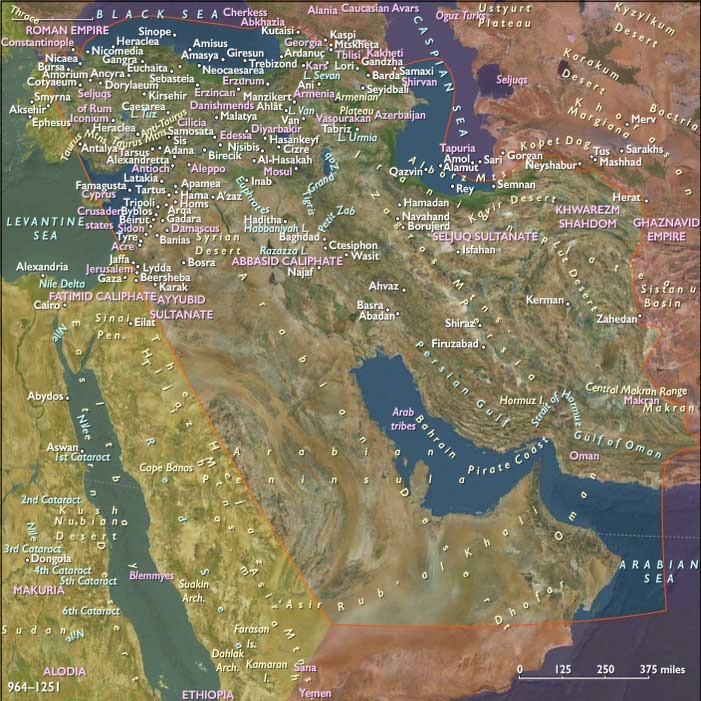
…sack Rafaniya. Hims is not seriously threatened,…
999 CE
…sack Rafaniya.
Hims is not seriously threatened, but a month-long siege of Tripoli in December fails.
Although Basil does not have sufficient forces to drive into Palestine and reclaim Jerusalem, his victories have restored much of Syria to the empire.
No emperor since Heraclius has been able to hold these lands for any length of time, and they will remain possessions of Constantinople for the next seventy-five years.
Groups
Commodities
Subjects
Regions
The Near and Middle East
View →Subregions
Middle East
View →Related Events
Showing 10 events out of 723 total
Central Europe (1108 – 1251 CE): Imperial Reform, Urban Expansion, and the Ostsiedlung
Between 1108 and 1251 CE, Central Europe—the heartland of the Holy Roman Empire and its eastern marches—entered an era of extraordinary growth. The Medieval Warm Period brought demographic expansion and agricultural innovation, while political fragmentation fostered new towns, laws, and civic institutions.
From the Rhineland cathedrals and Alpine passes to the plains of Poland and Hungary, Europe’s central belt fused feudal lordship, ecclesiastical reform, and the eastward movement of settlers into one of the most dynamic transformations of the medieval world.
Geographic and Environmental Context
Central Europe stretched from the Rhine to the Vistula and from the Baltic coast to the Alpine valleys and Pannonian plain, encompassing:
-
The Rhineland heartlands of Cologne, Mainz, and Strasbourg;
-
The Alpine crossroads of Tyrol, Zürich, and Geneva;
-
The eastern plains of Silesia, Poland, Bohemia, Moravia, and Hungary.
This was a continent within a continent—a network of fertile valleys, wooded uplands, and trade arteries defined by the Rhine, Elbe, Oder, Vistula, and Danube. Forest clearance and settlement transformed once-marginal lands into the agrarian and urban centers of late medieval Europe.
Climate and Environmental Shifts
The Medieval Warm Period (c. 950–1250) provided long growing seasons, enabling population growth and the spread of viticulture and grain farming north and east.
Favorable weather encouraged three-field rotation, iron ploughs, and horse collars, which revolutionized yields.
Localized floods along the Rhine and Danube enriched soils even as they reshaped towns and dikes.
The forests of Silesia, the Carpathians, and Bavaria yielded timber, salt, and silver—the mineral backbone of Central Europe’s economy.
Political and Institutional Developments
The Imperial Core:
The Holy Roman Empire, though politically fragmented, remained Europe’s constitutional and spiritual axis.
The Hohenstaufen emperors (1138–1254) sought to balance imperial unity with the autonomy of princes and cities.
Archbishops of Mainz, Trier, and Cologne, as imperial electors, embodied this duality of sacred and secular authority.
East Central Kingdoms:
-
Poland (Piast dynasty): The Testament of Bolesław III (1138) divided the realm among dukes, initiating two centuries of fragmentation. Kraków remained the senior duchy, while Silesia and Pomerania invited German settlers under Magdeburg Law, integrating Poland into the Ostsiedlung.
-
Bohemia and Moravia (Přemyslids): Secured hereditary kingship through the Golden Bull of Sicily (1212); Prague emerged as a royal and cultural capital, with silver mining at Kutná Hora enriching the crown.
-
Hungary (Árpád dynasty): The Golden Bull of 1222 codified noble rights; after the Mongol invasion (1241–42), Béla IV rebuilt the kingdom with stone fortifications and foreign settlers, initiating a second wave of colonization and urbanization.
Alpine and South Central Principalities:
Feudal fragmentation defined the Alps: counts of Tyrol, bishops of Geneva, and abbots of Einsiedeln and St. Gallcontrolled passes and tolls.
Urban communes in Zürich and Geneva asserted autonomy; local assemblies in Alpine valleys laid early foundations for Swiss communal governance.
The Rhineland Electorates:
Cologne, Mainz, and Trier dominated the political and spiritual life of the Empire.
Imperial cities such as Strasbourg, Worms, Speyer, and Basel gained privileges, fostering the growth of guilds, markets, and civic culture.
This west–east continuum—imperial in form, feudal in structure, and civic in aspiration—defined Central Europe’s political pluralism.
Economy and Trade
Agrarian Expansion:
Forest clearance and colonization extended cultivation across Silesia, Brandenburg, Bohemia, and Hungary. Heavy ploughs, crop rotation, and watermills drove rural productivity.
Mining and Industry:
Silver at Kutná Hora and Jihlava, salt at Wieliczka, and iron in the Alps and Swabia financed courts and monasteries.
Cistercian abbeys coordinated land reclamation and proto-industrial production.
Trade and Urban Growth:
-
Rhineland: The Rhine served as Europe’s commercial artery, connecting Cologne, Mainz, Strasbourg, and Basel to Flanders and Italy.
-
Alpine routes: Brenner and St. Gotthard passes moved Italian silk and spices north, returning with German metals and wool.
-
Eastern trade: The Oder–Elbe–Danube corridors linked Kraków, Wrocław, Prague, and Buda to Baltic and Adriatic markets.
German urban law (Magdeburg, Lübeck) standardized administration, embedding civic governance across Central Europe.
Urban and Technological Development
Cities expanded rapidly. Cologne, with over 40,000 inhabitants, ranked among Europe’s largest; Cologne Cathedral(begun 1248) inaugurated the Gothic age north of the Alps.
Stone castles, bridges, and Romanesque monasteries transformed the landscape; later Gothic cathedrals rose in Strasbourg, Prague, and Bamberg.
Watermills and guild industries powered textiles, glassmaking, and metalwork.
The Ostsiedlung infused new technology and law across Slavic lands, blending German civic models with local traditions.
Belief and Symbolism
Catholic Christianity unified the region’s culture and law.
-
The archbishoprics of Gniezno, Esztergom, and Prague became national spiritual centers.
-
The Cistercians, Dominicans, and Franciscans spread reform and education, while monasteries became agents of colonization and literacy.
-
Royal sanctity—seen in cults of St. Elizabeth of Hungary and St. Wenceslaus—legitimized dynastic rule.
Pilgrimage and relic cults (notably the Three Kings of Cologne) bound devotion to geography, turning the Rhine and Danube into sacred corridors.
Movement and Interaction Corridors
-
Rhine River: North–south trade spine from Basel to the North Sea.
-
Danube River: Crossed by the Hungarian plain and Bohemian frontier.
-
Elbe–Oder–Vistula basins: Arteries of the Ostsiedlung and grain export.
-
Alpine passes: Brenner and St. Gotthard linking Italy with Germany and Burgundy.
-
Pilgrimage and crusade routes: Swabian knights joined Crusades; Rhineland ports provisioned Mediterranean fleets.
These routes knit the region into Christendom’s spiritual, commercial, and military systems.
Adaptation and Resilience
-
Multipolar politics—Piast duchies, Přemyslid Bohemia, Árpád Hungary—prevented systemic collapse and encouraged local autonomy.
-
Alpine communes and imperial cities institutionalized cooperation and self-defense.
-
Ecclesiastical reform reinforced continuity amid dynastic change.
-
After the Mongol invasion, Hungary’s reconstruction and the eastward settlement drive demonstrated unparalleled resilience.
Fragmentation became an engine of innovation, not decline.
Long-Term Significance
By 1251 CE, Central Europe stood as the pivot of medieval Christendom:
-
The Empire’s Rhineland heartlands led in urbanization, cathedral culture, and commerce.
-
The Alpine passes bound Italy, Germany, and Burgundy into one economic zone.
-
The eastern kingdoms—Poland, Bohemia, and Hungary—had absorbed German colonists and Western institutions, laying the foundations of modern Central Europe.
Fragmented yet interconnected, the region’s plural order and settlement revolution made it Europe’s engine of transformation and resilience.
East Central Europe (1108 – 1251 CE): Piast Fragmentation, Přemyslid Kingship, Árpád Reforms, and the Ostsiedlung
Geographic and Environmental Context
East Central Europe includes the greater part of Germany east of 10°E, Poland, Czechia (Bohemia and Moravia), Slovakia, and Hungary.
-
A vast corridor of plains and uplands—the Elbe, Oder, Vistula, and Danube basins—connected the Baltic to the Carpathians and the Pannonian Plain.
-
Forest clearance and settlement expansion tied the German imperial east to the kingdoms of Poland, Bohemia, and Hungary.
Climate and Environmental Shifts
-
The Medieval Warm Period favored population growth, higher cereal yields, and the spread of viticulture and orchards into sheltered valleys.
-
Floods and periodic droughts punctuated stability, but improved ploughs and crop rotations spread resilience.
Societies and Political Developments
-
Germany east of 10°E: Fragmented imperial principalities encouraged the founding of towns and the granting of civic laws (e.g., Magdeburg Law), attracting settlers and merchants.
-
Poland (Piast dynasty): The Testament of Bolesław III (1138) divided the realm among dukes, initiating a period of long-lasting fragmentation. Kraków served as the notional senior capital, while Silesia and Pomerania drew intense German colonization.
-
Bohemia and Moravia (Přemyslids): Elevated to hereditary kingship with the Golden Bull of Sicily (1212)under Přemysl Otakar I. Prague and Moravian centers like Brno and Olomouc flourished.
-
Hungary (Árpád dynasty): The Golden Bull of 1222 limited royal power and confirmed noble rights. The Mongol invasion (1241–1242) devastated the kingdom, forcing Béla IV into a massive rebuilding effort with stone castles and settlement incentives.
-
Slovakia (Upper Hungary): Integrated into Hungarian mining and defense networks.
Economy and Trade
-
Agrarian expansion: heavy plough, three-field system, and mass clearances extended farmland.
-
Mining: silver at Jihlava and Kutná Hora; salt at Wieliczka.
-
Trade corridors: Oder–Elbe–Danube routes moved grain, timber, and salt to the Baltic and Rhineland; Kraków, Wrocław, Prague, Pressburg, and Buda–Pest acted as hubs.
-
German urban law (Magdeburg, Lübeck) standardized town governance.
Subsistence and Technology
-
Watermills, collar harnesses, and improved ploughs boosted productivity.
-
Romanesque fortresses and Gothic cathedrals reshaped urban skylines.
-
Castles spread across Hungary and Bohemia, especially after Mongol devastation.
Movement and Interaction Corridors
-
The Ostsiedlung carried German-speaking peasants and artisans into Silesia, Pomerania, Brandenburg, and Bohemia.
-
Cistercian monasteries coordinated land clearance and settlement.
-
Mongol invasion briefly severed Carpathian corridors but reforms re-opened them.
Belief and Symbolism
-
Latin Christianity unified political culture: archbishoprics in Gniezno, Esztergom, and Prague guided ecclesiastical governance.
-
Cistercians, Dominicans, Franciscans spread reform, preaching, and literacy.
-
Cults of royal saints (e.g., St. Elizabeth of Hungary) tied dynastic legitimacy to sanctity.
Adaptation and Resilience
-
Multipolar politics (Piast duchies, Přemyslid Bohemia, Árpád Hungary) created redundancy.
-
Hungary’s reconstruction after the Mongols demonstrated adaptive resilience, with stone fortifications and immigrant resettlement.
-
Town networks spread risk through market integration.
Long-Term Significance
By 1251 CE, East Central Europe had become a densely networked agrarian and urban region: fragmented Piast duchies, a hereditary Bohemian kingdom, and a restructured Hungary coexisted within the framework of German colonization and urban law. This laid the institutional and demographic foundations for its later medieval flowering.
The most dynamic period of Premyslid reign over Bohemia is the thirteenth century.
Emperor Frederick II's preoccupation with Mediterranean affairs and the dynastic struggles known as the Great Interregnum (1254-73) will weaken imperial authority in Central Europe, thus providing opportunities for Premyslid assertiveness.
At the same time, the Mongol invasions (1220-42) absorb the attention of the Bohemian Kingdom's eastern neighbors, the Hungarians and the Poles.
The final phase of Bulgaria's second Balkan dominance is the reign of Kaloian's successor, Ivan Asen II (1218-41).
In this period, culture continues to flourish, but political instability again threatens.
After the death of Ivan Asen II, internal and external political strife intensify.
Sensing weakness, the Tatars begin what will; be sixty years of raids in 1241, the Byzantines retake parts of the Second Bulgarian Empire, and the Magyars again advance.
The Mongols burst forth suddenly from the Eurasian Steppe.
The Empire of Nicaea, aided by the Mongol invasion, reduces both the Latin Empire and the Bulgarian Empire to the status of pawns.
The Sultanate of Rüm and of Seljuq power, fatally weakened by their war against the Khwarezm-Shah dynasty of Iran, also disintegrates, with the Mongols as agent.
The Mongol invasion of Europe in the thirteenth century involves the destruction of East Slavic principalities, such as Kiev and Vladimir, the invasion of the Kingdom of Hungary (in the Battle of Mohi) and the further fragmentation of Poland (in the Battle of Legnica).
The operations are masterminded by General Subutai and commanded by Batu Khan and Kadan, both grandsons of Genghis Khan.
Many of the conquered territories will become part of the Golden Horde empire.
Historians regard the Mongol raids and invasions as some of the deadliest conflicts in human history up through this period.
The power map of the southern and eastern Mediterranean basin becomes divided among four main dominions: Mamluk Egypt, Ayyubid Syria, the Franks of Acre and Syrian Christian beachheads, and the Levantine Christian state of Cilician Armenia.
The Mongols by 1241 have their armies riding westwards as far as the River Oder and the northeastern shore of the Adriatic, and during the Battle of Fariskur they are penetrating deep into all adjoining regions.
The Western Christians and the Cilician Armenians hope to have a grand alliance with the Mongols against the Islamic World.
The Cilician Armenians in 1247 submit to Mongol suzerainty.
Pope Innocent IV, who has fully supported the Seventh Crusade against Egypt, had in the previous year sent his Franciscan emissary Giovanni da Pian del Carpine to the Great Khan of the Mongols in Karakoram to seek an alliance against the Muslims.
He is disappointed by Güyük Khan, who tells him that he and the kings of Europe should submit to the Mongols.
The Mongol Invasion of Poland from late 1240 to 1241 culminates in the Battle of Legnica, where the Mongols defeat an alliance that includes forces from fragmented Poland and members of various Christian military orders, led by Henry II the Pious, the Duke of Silesia.
The first invasion's intention is to secure the flank of the main Mongolian army attacking the Kingdom of Hungary.
The Mongols neutralize any potential help to King Bela from the Poles and the military orders (including the Teutonic knights in Prussia).
The Kingdom of Hungary, for a year after the Mongol invasion (1242), does not exist.
Herman VI, Margrave of Baden, had in 1248 married Gertrude of Austria, the niece of Duke Frederick II, and on the basis of this marriage claims the duchies of Austria and Styria, leaving the rule over Baden to his younger brother Rudolf.
Both the Emperor Frederick II and Margrave Herman VI are deceased by the end of 1250.
The latter having never been accepted by the Austrian nobles, Gertrude and their only son Frederick I, Margrave of Baden, continue their claim.
However, after the death of Emperor, no strong Imperial authority exists to assert his title.
Though he is backed by Pope Innocent IV and anti-king William of Holland, Frederick has been unable to prevail against the mighty Přemyslid king Wenceslaus I of Bohemia and his son Ottokar II, who upon Herman's death in 1250 occupies the Babenberg lands.
Wenceslaus leads a successful invasion of Austria, completed by 1251.
Wenceslaus releases Ottokar II and names him Margrave of Moravia, then has Ottokar proclaimed Duke of Austria and acclaimed by the nobility.
In order to secure dynastic rights to Austria, Wenceslaus has another female Babenberg proclaimed Duchess and betrothed to his son.
Southeast Europe (1252–1395 CE): Empires in Twilight and the Ottoman Advance
From the Danube plains and Thracian valleys to the silver mines of Serbia and the Adriatic ports of Ragusa and Zadar, Southeast Europe in the Lower Late Medieval Age stood at the crossroads of empire and faith. The region’s fractured geography—mountain and river, coast and upland—made it a shifting frontier between Byzantium, the Latin West, and the rising Ottoman realm. Despite dynastic rivalries, plague, and invasion, it remained a mosaic of resilient kingdoms, fortified towns, and monastic enclaves that preserved learning and trade amid the approaching storms of the fifteenth century.
The Byzantine Empire, restored to Constantinople in 1261 after the Latin interlude, never regained its former strength. Civil wars between Andronikos II and Andronikos III in the 1320s, followed by the Kantakouzenos regency in the 1340s, drained resources and invited foreign intervention. In 1354, Ottoman troops crossed the Dardanelles, seizing Gallipoli—a foothold that opened Europe to Turkish conquest. Adrianople (Edirne) fell in 1369, becoming the new Ottoman capital. By 1395, the empire of Constantine and Justinian had shrunk to a ring around Constantinople, hemmed in by Ottoman garrisons and dependent on precarious alliances.
To the north, the Second Bulgarian Empire, which had peaked under Ivan Asen II a century earlier, disintegrated under Mongol, Tatar, and Hungarian pressure. By the late fourteenth century Bulgaria was divided between Tarnovounder Ivan Shishman and Vidin under Ivan Sratsimir, each alternating submission and defiance toward their Ottoman overlords. The Danube corridor, once a defensive line of empire, became the staging ground for Ottoman crossings and for the rise of two new principalities—Wallachia and Moldavia—that would later stand as northern bulwarks of resistance.
In Serbia, the house of Nemanjić achieved its zenith under Stefan Dušan (r. 1331–1355), whose armies swept through Macedonia, Epirus, and Thessaly. Crowned Emperor of Serbs and Greeks in 1346, Dušan codified his rule in the famous Law Code, blending Byzantine legalism with Slavic custom. Silver from the mines of Novo Brdo and Rudnik underwrote a cosmopolitan court that rivaled Constantinople. Yet after Dušan’s death, centrifugal noble rivalries—Mrnjavčević, Lazarević, and others—splintered the realm. In 1389, Prince Lazar fell at Kosovo Polje, a battle that entered legend as both tragedy and prophecy, marking Serbia’s submission to the Ottoman tide.
Farther north and east, Wallachia under Basarab I secured independence after victory over Hungary at Posada (1330), while Moldavia under Bogdan I (r. 1359–1365) consolidated between the Carpathians and the Dniester. These Danubian principalities balanced Hungarian, Tatar, and Ottoman pressures with deft diplomacy. Their fortified monasteries, tax reforms, and silver mines fostered stability, and by the end of the fourteenth century they emerged as self-conscious Christian states, heirs to the fading Byzantine and Bulgarian traditions.
In Bosnia, Ban Tvrtko I (r. 1353–1391) expanded his realm from the Drina to the Adriatic, adopting the royal crown in 1377 and reaching the peak of Bosnian power. The silver mines of Srebrenica enriched both the royal treasury and the flourishing Ragusan (Dubrovnik) merchant republic, whose fleets carried Balkan ores, wax, and hides across the Adriatic in exchange for salt, textiles, and luxury goods. Ragusa’s Statute of 1272, refined through the fourteenth century, established consuls from Alexandria to Constantinople, making it the Adriatic’s nimblest trading power.
Along the Dalmatian and Greek coasts, a patchwork of Latin and Slavic communes mediated between Venice, Hungary, and local lords. The Treaty of Zadar (1358) freed much of Dalmatia from Venetian control, allowing Ragusa to flourish under nominal Hungarian suzerainty. Venetian and Genoese ships still dominated the Black Sea and Aegean, however, maintaining the maritime arteries that fed Balkan mines and Byzantine ports. Inland, the Habsburgs extended authority over Carniola, Styria, and Slovenia, linking Central Europe to the Adriatic, while the Peloponnesian and Epirote lands of Greece remained fragmented among Latin duchies and Orthodox despots, increasingly threatened by Ottoman raids.
Agriculture across Thrace and the Danube basin adjusted to shorter growing seasons under the early Little Ice Age. Wheat, barley, and millet alternated with vineyards and transhumant herding. Serbian and Transylvanian silver mines supplied coinage that circulated with Venetian ducats and Ragusan dinars, fueling mercenary service and urban construction. Towns like Tarnovo, Skopje, Belgrade, and Novo Brdo were ringed by stone walls and towers, symbols of both wealth and insecurity. Black Death epidemics in 1348–1350 ravaged coastal cities and mining colonies but recovery was swift where silver and salt revenues flowed.
Faith and art anchored the region through political upheaval. Orthodoxy remained the unifying faith from Constantinople to Moldavia, its monastic centers—Rila, Dečani, Peć, and Mount Athos—preserving literature, fresco painting, and translation. Catholic communes in Dalmatia and Ragusa maintained Latin liturgy and notarial culture, while Bosnia’s distinctive Church of Bosnia, tinged with dualist and reformist ideas, endured despite crusading denunciations. New mosques appeared in Gallipoli and Adrianople as Ottoman garrisons settled in Thrace, introducing Islam to the European continent.
Adaptation came through networks rather than empires. When coastal trade faltered, merchants rerouted goods through inland passes; when mines flooded or armies advanced, communes and monasteries absorbed displaced labor. The Balkan economy’s redundancy—silver, salt, and livestock complemented by Adriatic and Black Sea access—allowed survival amid political collapse. Frontier diplomacy in Wallachia and Moldavia, monastic resilience in Serbia and Bulgaria, and commercial pragmatism in Ragusa and Dalmatia all testified to societies skilled at weathering change.
By 1395 CE, Southeast Europe had become a frontier of empire and a crucible of continuity. Byzantium lingered only in name, Bulgaria lay divided and vassal, Serbia had reached and lost its imperial height, and Bosnia shone briefly under Tvrtko’s crown. Yet Wallachia and Moldavia stood firm, and Ragusa’s independence proved that trade could survive where kingdoms fell. Across Thrace and Macedonia, Ottoman banners now rose above captured citadels, signaling the dawn of a new order. Even so, the monasteries of the Balkans and the communes of the Adriatic preserved the languages, laws, and faiths of an older world—ensuring that the region’s cultural continuity outlived its medieval empires.
Eastern Southeast Europe (1252 – 1395 CE): Byzantium’s Twilight, Serbian Zenith, and Bulgarian Decline
Geographic and Environmental Context
Eastern Southeast Europe includes Turkey-in-Europe, Thrace in Greece, all of Bulgaria except its southwest, modern-day Moldova and Romania, northeastern Serbia, northeastern Croatia, and extreme northeastern Bosnia and Herzegovina.
-
Anchors: the Danube corridor, the Thracian plain (Adrianople/Edirne), the Haemus (Balkan) mountains, and the Black Sea coast.
-
This subregion was the interface between Byzantium, rising Balkan kingdoms, nomadic steppe powers, and later the Ottomans.
Climate and Environmental Shifts
-
With the onset of the Little Ice Age (~1300), winters lengthened and summers cooled; agriculture in Thrace and the Danube plain faced shorter growing seasons.
-
Pastoralism and mixed farming buffered risk; Black Sea grain and fish routes underpinned urban subsistence.
Societies and Political Developments
-
Byzantine Empire (1259–1453 context):
-
The Empire of Nicaea retook Constantinople in 1261, restoring the Byzantine Empire.
-
From the late 13th century, civil wars (Andronikos II vs. III, 1320s; Kantakouzenos regency, 1340s) eroded stability.
-
Ottoman Turks crossed into Europe in 1354 (Gallipoli), capturing Adrianople (Edirne) in 1369; by 1395, most of Thrace was Ottoman.
-
-
Second Bulgarian Empire:
-
Zenith under Tsar Ivan Asen II (r. 1218–1241) faded; fragmentation marked the later 13th century.
-
Mongol–Tatar suzerainty from the Golden Horde in the late 13th century; frequent shifts of overlordship.
-
By the late 14th century Bulgaria was divided: Vidin under Ivan Sratsimir, Tarnovo under Ivan Shishman—both vassals or foes of the Ottomans.
-
-
Serbia (Nemanjid & Dušan’s Empire):
-
Serbia expanded spectacularly under Stefan Dušan (r. 1331–1355), who conquered Macedonia, Epirus, Thessaly, and Albania, and crowned himself “Emperor of Serbs and Greeks” (1346).
-
After his death, fragmentation and noble rivalries (Mrnjavčević, Lazarević) weakened unity; Prince Lazar fell at Kosovo Polje (1389) against the Ottomans.
-
-
Wallachia & Moldavia:
-
Wallachia emerged in the 14th century; Basarab I (r. 1310–1352) secured autonomy after victory at Posada (1330).
-
Moldavia consolidated under Bogdan I (r. 1359–1365), later under Petru I and Roman I.
-
Both principalities defended autonomy against Hungarian, Tatar, and Ottoman encroachment.
-
-
Croatia & Bosnia (northeastern margins):
-
Northeastern Croatia tied to Hungary; Bosnia expanded under Ban Tvrtko I (r. 1353–1391), reaching the Adriatic and asserting a royal crown in 1377.
-
Economy and Trade
-
Agriculture: mixed grain (wheat, barley, millet) in Thrace and the Danube basin; viticulture in Macedonia; sheep and cattle herding widespread.
-
Mines: Serbia’s silver mines (Novo Brdo, Rudnik) funded Dušan’s empire; Transylvanian and Moldavian mines fed Hungarian and Balkan coinage.
-
Trade routes:
-
Danube corridor moved grain, salt, and livestock north–south.
-
Via Egnatia linked Constantinople to Adriatic ports; Black Sea ports (Varna, Constanța) tied to Genoese and Venetian merchants.
-
Ragusan merchants (Dubrovnik) served Serbian and Bosnian markets.
-
-
Coinage: Venetian ducats, Serbian dinars, and Byzantine hyperpyra circulated; Ragusan silver coinage prominent in Balkan markets.
Subsistence and Technology
-
Farming: ox-drawn ploughs, vineyards, terrace farming in hills.
-
Mining technology: shaft mines with timbering; water mills and bellows for ore refining.
-
Fortifications: walled towns (Tarnovo, Belgrade, Skopje); stone castles defended noble domains.
-
Shipping: galleys of Genoa and Venice dominated Black Sea–Aegean routes.
Movement and Interaction Corridors
-
Danube–Black Sea axis: arteries of Bulgarian, Wallachian, and Moldavian commerce.
-
Via Egnatia: lifeline for Byzantine–Serbian exchanges; also corridor of Ottoman advance.
-
Adriatic–Ragusa trade web: integrated Balkan mines and markets into Mediterranean circuits.
-
Steppe routes: Tatars projected power across Moldavia and Bulgaria, exacting tribute in the 13th–14th centuries.
Belief and Symbolism
-
Orthodoxy: the core faith of Byzantium, Bulgaria, Serbia, Wallachia, Moldavia; monasteries like Rila, Dečani, and Mount Athos flourished with fresco cycles and Slavic translations.
-
Latin Christianity: Hungarian, Ragusan, and crusading presence along frontiers.
-
Heresy and reform: Bogomil and dualist traditions lingered in Bulgaria and Bosnia, often suppressed but influencing local piety.
-
Islam: Ottoman advance introduced mosques, garrisons, and Muslim settlers into Thrace by the late 14th century.
Adaptation and Resilience
-
Frontier states: Wallachia and Moldavia balanced Hungarian, Tatar, and Ottoman pressures with flexible diplomacy.
-
Mining economies: Serbian silver and Balkan salt underpinned coinage and mercenary service even amid political fragmentation.
-
Ecclesiastical resilience: Orthodox monasteries stabilized culture through translation, art, and agriculture.
-
Urban redundancy: Genoese and Venetian trade shifted between Black Sea, Adriatic, and overland routes when wars disrupted one corridor.
Long-Term Significance
By 1395, Eastern Southeast Europe was a contested frontier:
-
Byzantium shrank to Constantinople and environs, menaced by the Ottomans.
-
Serbia had reached imperial heights under Dušan but fractured by Kosovo (1389).
-
Bulgaria was divided and vassal to the Ottomans.
-
Wallachia and Moldavia stood as rising principalities, soon to become bulwarks of resistance.
-
Ottoman expansion across the Balkans set the stage for 15th-century domination, while Orthodox monasticism preserved cultural and spiritual continuity.