Very little is known about the societies…
820 CE to 963 CE
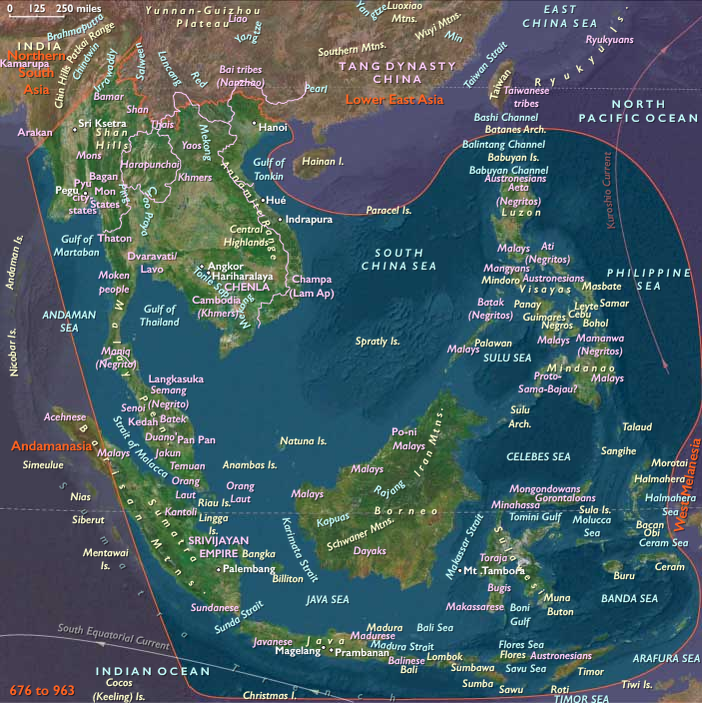
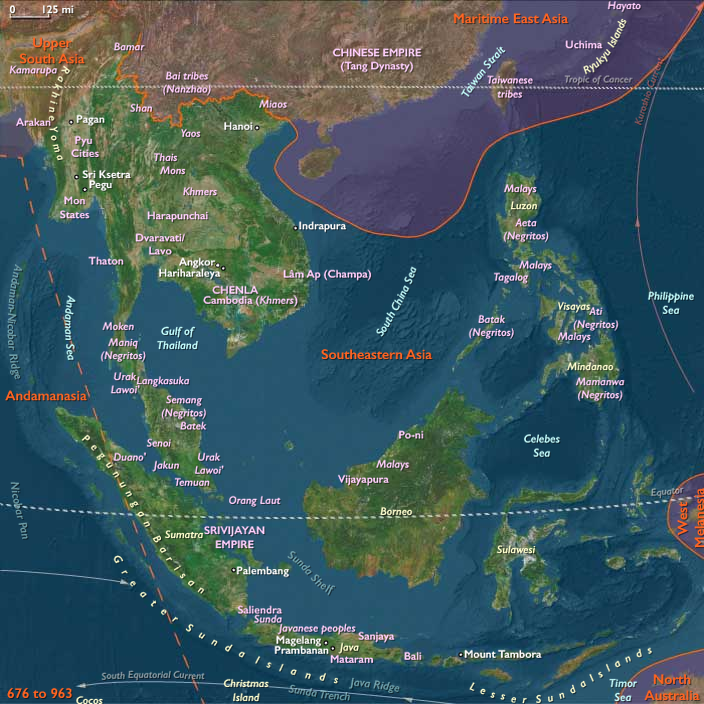
Very little is known about the societies of Srivijaya and Mataram, and most of what is written is based on conjecture.
With the exception of the religious structures on Java, these societies are constructed of perishable materials that will not survive the centuries of destructive climate and insects.
There are no remains of either palaces or ordinary houses, for example, and we must rely on rare finds of jewelry and other fine metalworking (such as the famous Wonosobo hoard, found near Prambanan in 1991), and on the stone reliefs on the Borobudur and a handful of other structures, to attempt to guess what these societies may have been like. (The vast majority of these remains are Javanese.)
A striking characteristic of both Srivijaya and Mataram in this period is that neither—and none of their smaller rivals—appear to have developed settlements recognizable as urban from either Western or Asian traditions.
On the whole, despite evidence of socioeconomic well-being and cultural sophistication, institutionally Srivijaya and Mataram remain essentially webs of clanship and patronage, chieftainships carried to their highest and most expansive level.
Locations
Groups
Subjects
Regions
Southeast Asia
View →Subregions