
William Dunbar first appears in the historical…
1503 CE
William Dunbar first appears in the historical record in 1474 as a new student or determinant of the Faculty of Arts at the University of St. Andrews.
Since the customary age for entering a Scottish university at this time is fourteen, a birth-date of 1459 or 1460 has been assumed.
At St Andrews, he had in 1477 obtained a bachelor's degree and in 1479 a master's.
Details from his later life suggest that he was ordained as a priest at some point, but the date is unknown.
Dunbar in 1491 and 1492 had accompanied an embassy to Denmark and France in an unknown capacity.
He participated in 1501 and 1502 in an embassy to England in the staff of Andrew Forman, Bishop of Moray.
The poet has been employed from 1500 at the court of King James in a role for which he receives an annual pension.
His duties are not recorded; he is referred to only as a servitour or servant; but it is to this period that the bulk of his poetry can be dated.
Intending most of his poems to be read aloud at court, in, he writes The Thrissil and the Rois, an allegory containing sparkling description and elaborate diction in the Middle Scots language, commemorating the marriage of Margaret of England, daughter of Henry VII, to James IV in 1503.
He begins work on another allegory, “The Dance of the Seven Deadly Sins.”
King James, an energetic patron of the arts and education, encourages such diverse endeavors as alchemy, architecture, and printing.
People
Regions
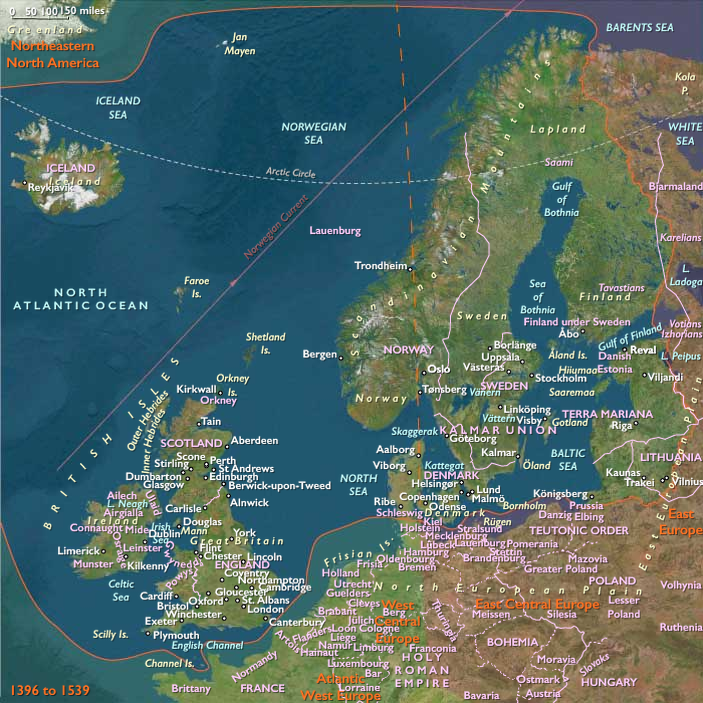
North Europe
View →Subregions
