Sickingen feels safe at Landstuhl, as his…
May 1523 CE
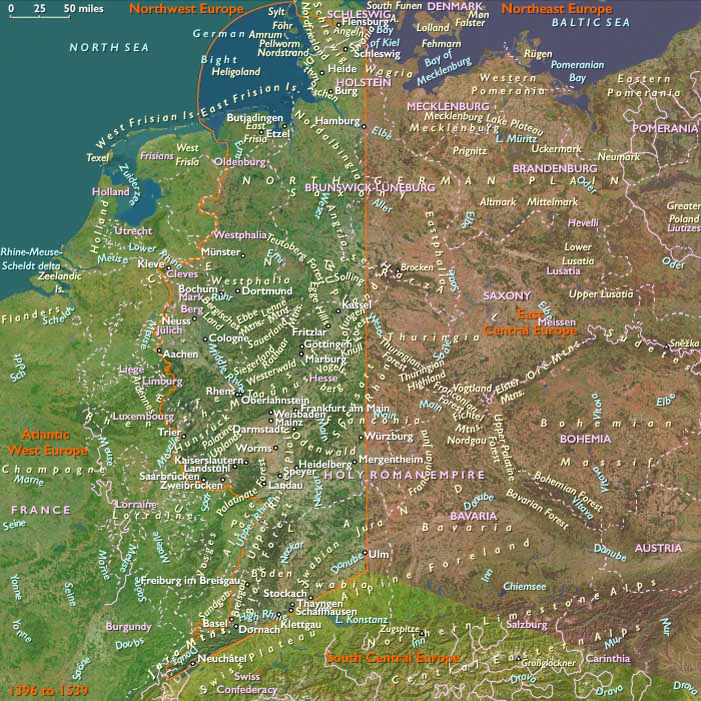
Sickingen feels safe at Landstuhl, as his castle here is reckoned to be one of the strongest castles in Germany.
Richard of Trier, Philip of Hesse, and Louis V of Palatine decide to move against him, and having obtained help from the Swabian League, march on Burg Nanstein.
Sickingen fully expects to last at least four months, by which time reinforcements will arrive to rescue him.
This attack is one of the first occasions on which artillery is used, and within a week, breaches are soon made in an otherwise impregnable fortress.
Sickingen refuses to negotiate, and during the siege is seriously wounded.
Sickingen is on May 6, 1523, forced to capitulate to the three princes, and on the following day he dies.
With his death, knighthood as a significant force in Central Europe dies also.
He is buried at Landstuhl, and in 1889 a splendid monument will be raised at Ebernburg to his memory and to that of Hutten.
Most of the Revolt's significant supporters have their castles confiscated.
The Archbishop of Mainz is even fined for his suspected complicity in the plot.
The knights are now generally bankrupt as a result of the Revolt's inability to change their situation in the face of increasing inflation, declining agriculture, increased demands by the princes and the inability to live by legal ‘highway robbery’.
Most knights therefore live as petty feudal masters, making a living by taxing their peasants hard.
They have no real independence now, and those that do rise above their status do so by acting as competent managers, priests and generals for the Princes.
A few, such as Florian Geyer, refuse to give in, and will assist the peasants in their own rebellion a few years later.
The widespread refusal to pay church tithes during the Revolt will spread to the peasant classes subsequently, and inspire them to refuse to pay the tithe, which is one of the factors leading to the Peasants' Revolt.
Thus either the government of the province will have to deal with the corrupt institutions, or the peasants will take this into their own hands and plunder them.
Locations
Groups
Commodities
Subjects
Regions
Central Europe
View →Subregions