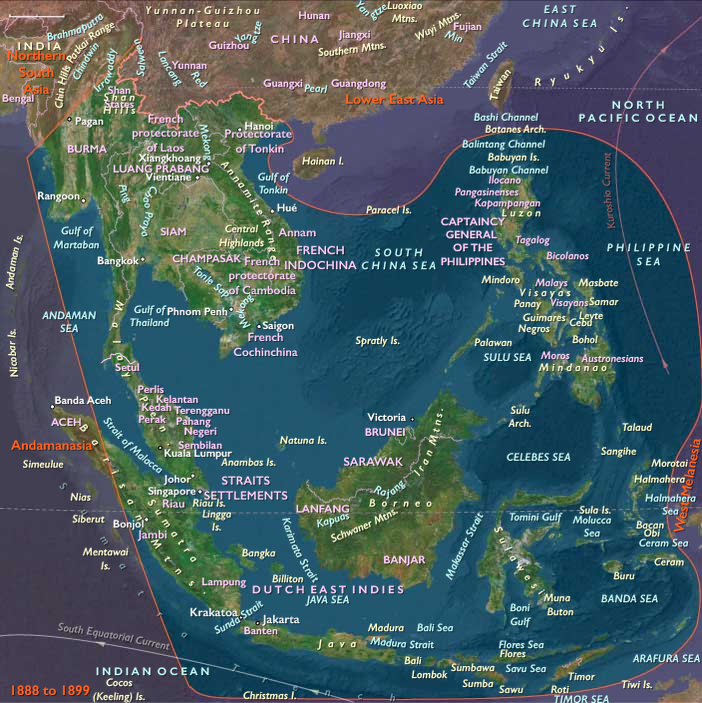
China's ruling Qing dynasty begins to take…
1888 CE to 1899 CE
China's ruling Qing dynasty begins to take an interest in the Nanyang Chinese in the latter part of the nineteenth century, and seeks to attract their loyalty and wealth to the service of the homeland.
Chinese consulates are established in Singapore, Malaya, the Dutch East Indies, and other parts of the Nanyang.
Hoo Ah Kay had been appointed Singapore's first consul in 1877.
He and his successors work diligently to strengthen the cultural ties of the Singapore Chinese to China by establishing a cultural club, a debating society, Singapore's first Chinese-language newspaper (Lot Pau), and various Chinese-language schools, in which the medium of instruction is Chinese.
One of the most important functions of the consul, however, is to raise money for flood and famine relief in China and for the general support of the Qing government.
With the upheaval in China following the Hundred Days' Reform Movement in 1898, and its suppression by the Qing conservatives, the Singapore Chinese and their pocketbooks are wooed by reformists, royalists, and revolutionaries alike.
Sun Yat-sen will found a Singapore branch of the Tongmeng Hui, the forerunner of the Guomindang (Kuomintang—Chinese Nationalist Party), in 1906.
Not until the successful Wuchang Uprising of October 10, 1911, however, will Sun receive the enthusiastic support of Singapore Chinese.
Locations
People
Groups
Regions
Southeast Asia
View →Subregions