
The early history of the west Saharan …
Years: 676 - 819
The early history of the west Saharan region is largely unknown.
There are some written accounts by medieval Arab traders and explorers who reach the important caravan trading centers and Sudanic kingdoms of eastern Mauritania, but the major sources of pre-European history are oral history, legends, and archaeological evidence.
These sources indicate that during the millennia preceding the Christian Era, the Sahara was a more habitable region than it is today and supported a flourishing culture.
In the area that is now Mauritania, the Bafour, a proto-Berber people, whose descendants may be the coastal Imraguen fishermen, are hunters, pastoralists, and fishermen.
Valley cultivators, who may have been black ancestors of the riverine Toucouleur and Wolof peoples, lived alongside the Bafour.
Climatic changes, and perhaps overgrazing and overcultivation as well, lead to a gradual desiccation of the Sahara and the southward movement of these peoples.
In the third and fourth centuries CE, this southward migration had been intensified by the arrival of Berber groups from the north who were searching for pasturage or fleeing political anarchy and war.
The wide-ranging activities of these turbulent Berber warriors were made possible by the introduction of the camel to the Sahara in this period.
This first wave of Berber invaders had subjugated and made vassals of those Bafour who did not flee south.
Other Berber groups follow in the seventh and eighth centuries, themselves fleeing in large numbers before the Arab conquerors of the Maghreb.
Groups
- Arab people
- Berber people (also called Amazigh people or Imazighen, "free men", singular Amazigh)
- Bafour
- Imraguen people
Topics
Commodoties
Subjects
Regions
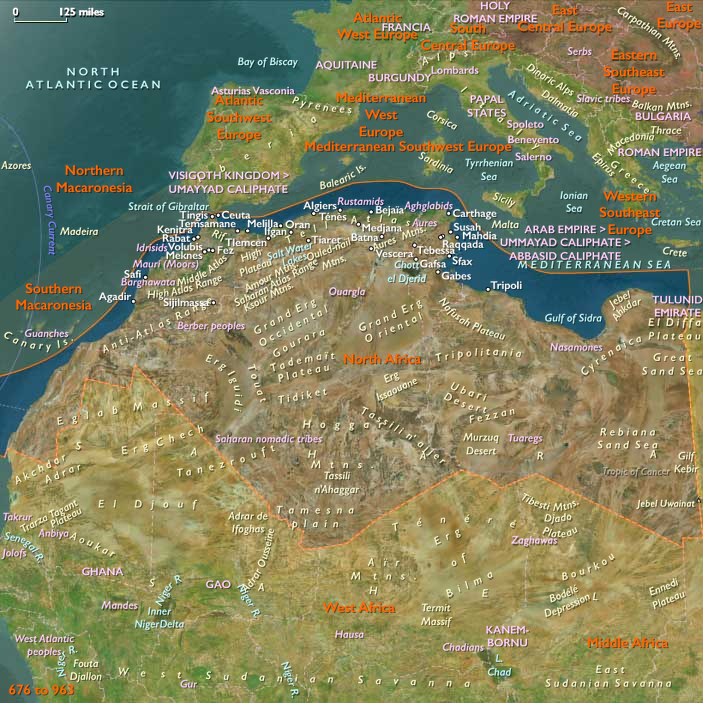
Subregions
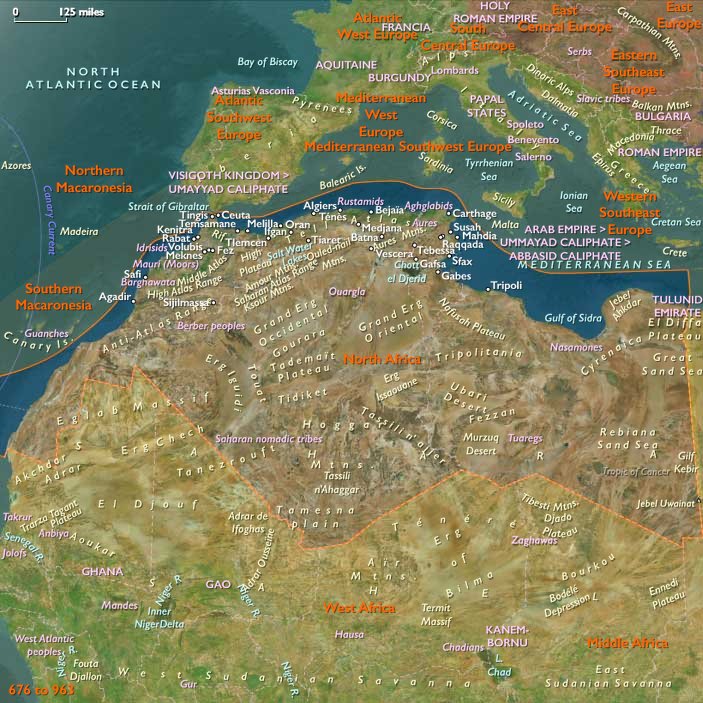
Years: 676 - 819
Groups
- Arab people
- Berber people (also called Amazigh people or Imazighen, "free men", singular Amazigh)
- Bafour
- Imraguen people
Topics
Commodoties
Subjects
Regions
Subregions