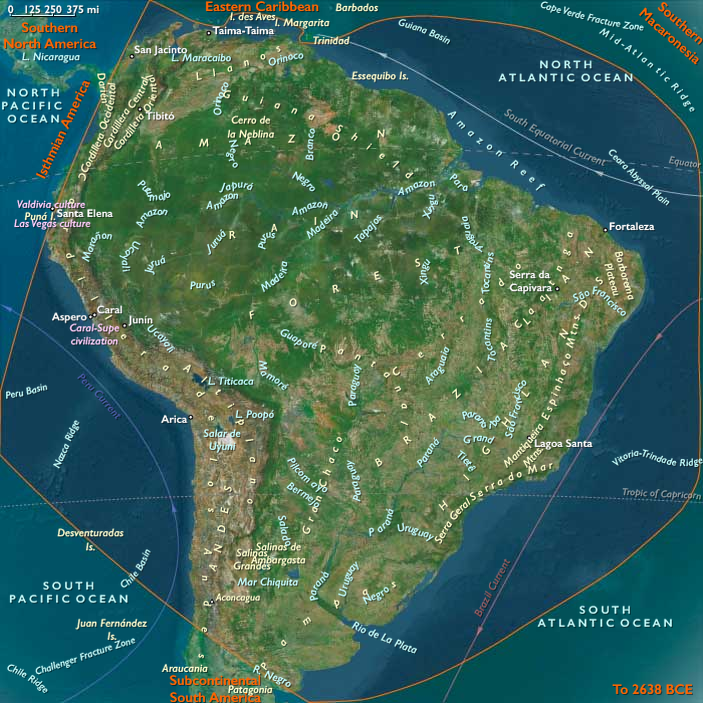
South America Major (49,293–28,578 BCE) South America…
49293 BCE to 28578 BCE
South America Major (49,293–28,578 BCE)
South America Major includes Colombia (except Darién), Venezuela, the Guianas, Brazil, Ecuador (excluding the Capelands), Peru, Bolivia, Paraguay, Uruguay, northern Argentina, northern Chile.
Anchors: Northern Andes (Quito–Cuzco–Titicaca–Altiplano), Amazon Basin (Solimões–Madeira–Xingu–Tapajós–Marajó), Orinoco–Llanos, Atlantic Brazil coastal shelf, Guianas shield, Atacama oases.
Geographic & Environmental Context
-
Andes: extensive glaciation on high cordilleras; puna and páramo belts depressed downslope.
-
Amazon/Guianas: rainforest contracted into riparian and montane refugia, with intervening savanna corridors.
-
Atlantic shelf: sea level ~100 m lower exposed broad coastal plains; estuaries migrated seaward.
-
Atacama/Altiplano: cold, hyper-arid plateaus; oasis springs persistent.
Climate & Environmental Shifts
-
Last Glacial Maximum (LGM): cooler (~3–7 °C lower), drier interiors; stronger seasonality; widespread glaciation in the Central Andes; reduced Amazonian evapotranspiration.
-
Heinrich/D-O oscillations toggled between slightly wetter interstadials (refugia expand) and drier stadials (savannization).
Subsistence & Settlement
-
Human presence before ~30 ka is debated (claims in eastern Brazil and Andean foothills exist but are contested). If present, foragers would have favored riparian refugia, coastal upwelling zones, and montane spring belts.
-
Likeliest robust occupations in the later part of this window: coastal foraging (shellfish, fish, seabirds), riparian hunting (deer, peccary, capybara), and puna/basin small-game procurement.
Technology & Material Culture
-
Late Middle/early Upper Paleolithic flake–blade industries; expedient quartz/quartzite; bone awls/points; ochre pigments.
-
Portable organic technologies (nets, digging sticks) likely but poorly preserved.
Movement & Interaction Corridors
-
Pacific littoral (upwelling coves, dune-sheltered landings), Andean valley strings (springs/rock shelters), Amazonian trunk rivers (Solimões–Madeira–Xingu–Tapajós), Orinoco–Casiquiare links to the Negro–Amazon.
Cultural & Symbolic Expressions
-
If present, ochre and bead use, hearth structuring, and rock-shelter ritual spaces would mirror broader Upper Paleolithic patterns.
Environmental Adaptation & Resilience
-
Refugium strategy: tethering to evergreen gallery forests, springlines, and productive coasts; broad-spectrum aquatic + terrestrial foraging buffered aridity.
Transition
-
As deglaciation accelerates, rainforest corridors re-connect, Andean ice withdraws, and coastal/riverine pathways improve — enabling the unequivocal Late Pleistocene–Early Holocene occupations that follow.
Images

South America Major in the Upper Paleolithic
Commodities
Subjects
Regions
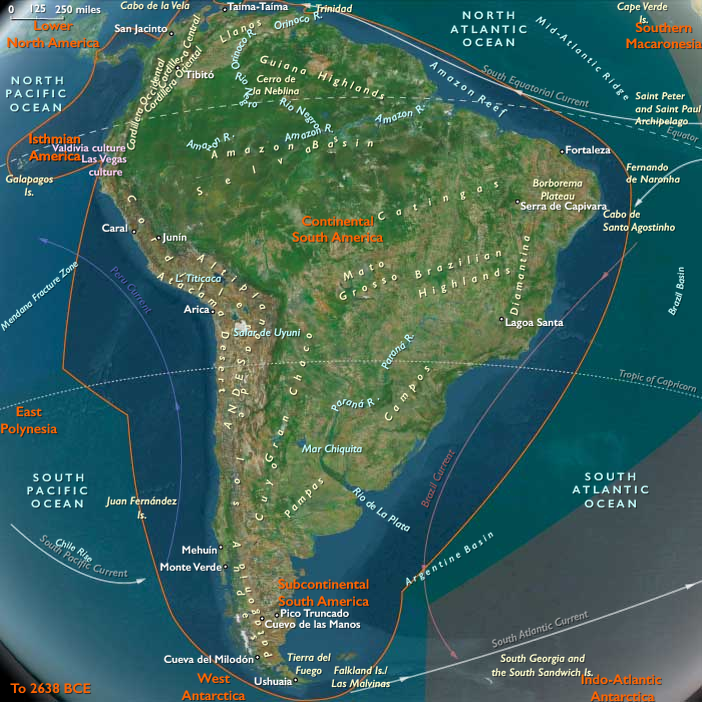
South America
View →Subregions