South America (1252–1395 CE): Chimú Apex and…
1252 CE to 1395 CE
South America (1252–1395 CE): Chimú Apex and the Southern Frontiers
From the monumental walls of Chan Chan to the icy channels of the Beagle, South America in the Lower Late Medieval Age was a continent of converging systems—coastal empires, Andean monarchies, forest chiefdoms, and canoe-nomads—each responding to the climatic pulses of the early Little Ice Age. Between 1252 and 1395 CE, its peoples refined terrace and floodplain agriculture, perfected caravan and canoe trade, and anchored spiritual life in landscapes that joined mountain, river, and sea.
Geography and Climate
The continent’s environments ranged from the equatorial forests of the Amazon and Guianas to the Andean cordilleras and the Patagonian steppe.
After 1300, cooler winters and erratic rains marked the Little Ice Age’s onset.
Highland terraces and waru waru fields in the Andes buffered frost, while black-earth (terra preta) soils of the Amazon renewed fertility through composting and ritual burning.
El Niño cycles battered Peru’s coasts, alternating drought and flood, yet fisheries and irrigation sustained dense populations.
Far south, stronger westerlies and colder seas made the fjords and steppes harsher, but communities adapted through mobility, alliance, and tri-zonal exchange.
Empires of the North and West
Along Peru’s desert coast, the Chimú Empire reached its zenith.
From Tumbez to Huarmey, its lords ruled from Chan Chan, a city of vast adobe compounds organized for tribute, craft production, and ceremony.
Canals irrigated coastal oases; fishermen supplied fishmeal for inland maize fields; weavers produced fine cottons dyed for court and trade.
Silver, copper, and gold flowed from the Andes to Chimú workshops, where artisans forged ornaments dedicated to moon deities and royal ancestors.
In the highlands, the sacred city of Cuzco rose under emerging Inca lineages, its palaces and shrines foreshadowing the imperial order to come.
Lineages of the Ayarmaca and Inca families competed for ritual supremacy, aligning temples with the sun’s path and the sacred peaks of the Apus.
On the northern Andean slopes, the Caranqui, Cayambe, and Quito states fortified their valleys, while in Colombia the Tairona built stone-terraced towns in the Sierra Nevada, their goldwork and cotton textiles sustaining a prestige economy that rivaled the coast.
Each of these polities fused labor organization with cosmology: irrigation canals mirrored celestial grids, and mountains doubled as ancestor-shrines.
Forests and Rivers of the Interior
East of the Andes, the Amazon basin remained a labyrinth of waterways supporting populous agricultural towns.
Communities along the Madeira, Tapajós, and Xingu cultivated manioc and maize in terra preta fields and traded ceramics, feathers, and ritual foods by canoe.
At centers such as Santarém, plazas hosted markets and ceremonies that synchronized planting, fishing, and feast cycles.
Farther north, the Guianas nurtured riverine chiefdoms blending agriculture, shellwork, and forest hunting; to the south, the Guaraní advanced through the Paraná–Uruguay forests, spreading maize and ritual alliances that bound Paraguay, Uruguay, and northern Argentina into a shared linguistic and spiritual zone.
The Southern Highlands and Desert Crossroads
Across Bolivia’s Altiplano, Aymara kingdoms like Lupaqa and Colla managed terraced slopes, camelid herds, and caravan trade.
Their llama trains carried salt, metals, and textiles between lake and coast, linking Titicaca’s ritual centers with the Atacama oases.
In northern Chile and Argentina, caravans exchanged copper and obsidian for maize and coca, sustaining a network of mining towns and pilgrimage roads.
Even at high altitude, ecological complementarity—the vertical archipelago of Andean exchange—balanced extremes of frost and drought.
Peninsular South: Mapuche, Tehuelche, and the Sea Peoples
South of the Río Negro, new social landscapes emerged under cooler, windier skies.
In Araucanía, Mapuche villages intensified inter-lof alliances, with machi shamans mediating rain, healing, and justice.
Agriculture in the valleys—maize, potatoes, and piñón nuts—combined with riverine fishing to sustain dense settlements along the Bío-Bío, Imperial, and Toltén rivers.
Across the Patagonian steppe, Tehuelche hunters formed broad mesa alliances, coordinating guanaco drives, hide trade, and winter migrations.
Along the storm-beaten fjords of Chiloé, Aysén, and Magallanes, canoe-borne peoples—the Kawésqar, Yámana (Yaghan), and Selk’nam (Ona)—perfected maritime foraging.
They navigated the Magellan–Beagle channels in bark canoes patched with hide and bark fiber, guided by ancestral currents and sea spirits.
The Selk’nam Hain initiation dramatized cosmic creation through masked dance, while Yaghan taboos on navigation and hunting honored the balance between humans and sea.
Tri-zonal trade between valley farmers, steppe herders, and channel nomads created a web of exchange linking food, wood, hides, and stories across one of the planet’s most demanding environments.
Beyond them, the Falklands and Juan Fernández islands remained uninhabited refuges for seabirds and seals.
Economy and Exchange
Every ecological belt produced a surplus for trade:
-
Coastal Chimú drew fishmeal, cotton, and metals through tributary labor.
-
Highland and Altiplano caravans carried salt, wool, and silver south and east.
-
Amazonian canoe routes exchanged manioc, ceramics, and feathers for Andean metalwork.
-
Guaraní traders moved maize and forest goods along the Paraná, forming ritual alliances that linked distant communities.
-
Mapuche and Tehuelche brokers traded hides, pigments, and seeds across the mountains; Fuegian channels supplied oil and shell ornaments.
Despite climatic volatility, redundancy in production—coast, mountain, forest, and steppe—maintained stability.
Artisan innovation flourished: Chimú metal-casters, Tairona goldsmiths, Amazon ceramicists, and Mapuche weavers each extended regional styles into distinct aesthetic traditions.
Belief and Symbolism
Religion bound these worlds together through reverence for ancestors and landscape.
Chimú rulers honored the moon and royal ancestors in vast shrines at Chan Chan; the Inca forbears of Cuzco aligned their temples with the sacred peaks.
Tairona worship centered on mountains and rivers as living ancestors.
Amazonian plazas celebrated fertility through collective dance, while Guaraní cosmology envisioned the river as the pathway of the canoe-spirit and the forest as a living kin network.
In the far south, Mapuche machi invoked river and storm spirits; Selk’nam and Yámana ceremonies re-enacted the creation of light and weather through performance.
Across the continent, faith translated ecology into narrative—each mountain, river, and wind a participant in the divine order.
Adaptation and Resilience
South American societies met the challenges of the Little Ice Age through diversification and cooperation.
Terraces, irrigation canals, and raised fields stabilized harvests; wetlands and floodplains served as insurance against drought.
Caravan and canoe networks redistributed food and goods between climatic zones.
Political flexibility—alliances, federations, and ritual exchange—prevented famine and sustained cultural continuity.
Even under colder skies and shifting rivers, production, trade, and faith adapted in tandem.
Long-Term Significance
By 1395 CE, South America had matured into a continent of parallel civilizations.
-
Chimú ruled the Pacific coast through tribute and craft;
-
Cuzco’s Inca lineages consolidated sacred authority in the highlands;
-
Tairona gold and cotton radiated from the Caribbean ranges;
-
Amazonian black-earth towns sustained vibrant agrarian–ritual life;
-
Guaraní communities extended their forest frontiers; and
-
in the far south, Mapuche, Tehuelche, and Fuegian peoples linked valley, steppe, and sea in resilient alliance.
Together they composed one of the most diverse human ecologies on Earth—an integrated world of mountain terraces, rainforest clearings, and storm-beaten channels whose economies and cosmologies remained attuned to the rhythms of climate, river, and ancestry.
Images

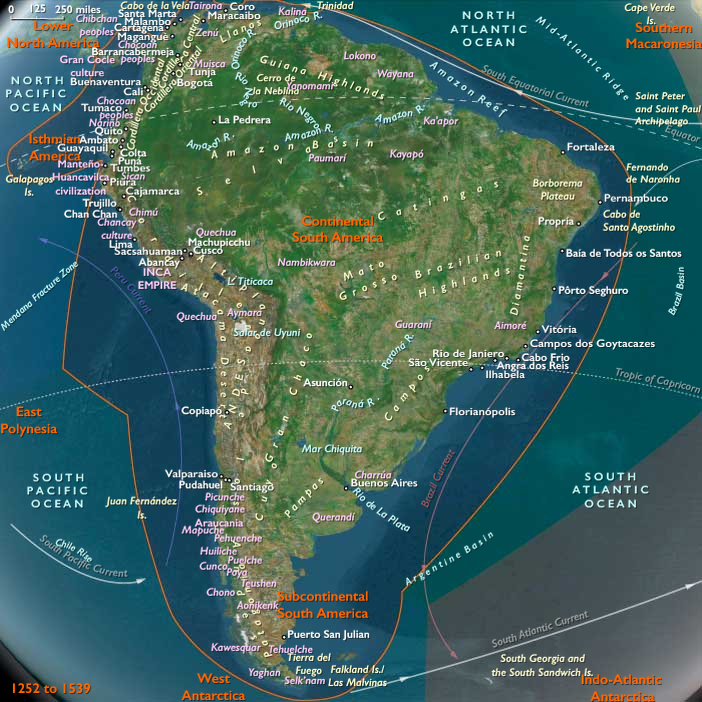
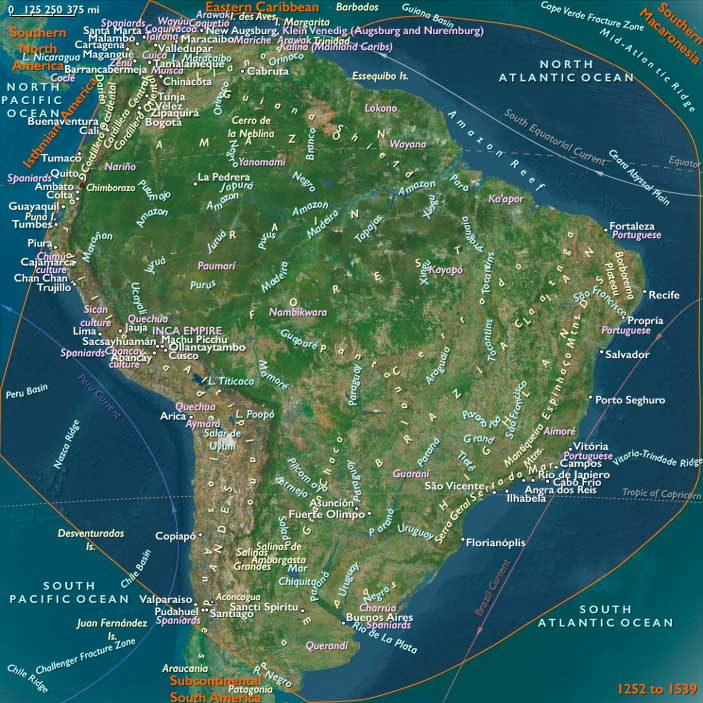
South America (with civilization) ©2024-25 Electric Prism, Inc. All rights reserved.
Commodities
Subjects
Regions