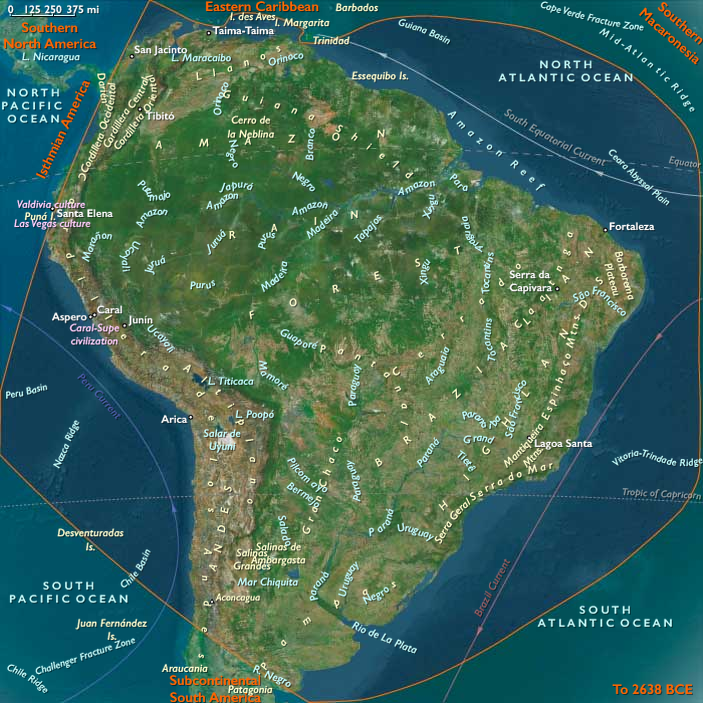
South America (7,821–6,094 BCE): Early Holocene —…
7821 BCE to 6094 BCE
South America (7,821–6,094 BCE): Early Holocene — Rivers & Reefs, Highlands & Hunger-Gathering, Seeds of Tending
Geographic & Environmental Context
In the Early Holocene, South America cohered as two tightly linked arenas:
-
South America Major (north of the Río Negro): the Amazon–Orinoco lowlands with vast levee lakes and flooded forests; the Northern Andes stepping coastward to Pacific coves and estuaries; the Guianas Shield; and the Atlantic Brazil shelf where sandy barriers enclosed lagoon chains.
-
South America Minor (Patagonia–Tierra del Fuego–Falklands–Juan Fernández): the Strait of Magellan–Beagle archipelagos and fjord belts facing kelp-rich seas, mirrored inland by steppe basins and spring-fed oases.
Sea level rose toward near-modern outlines: Pacific embayments and Atlantic lagoons matured; Amazon–Orinoco distributaries broadened; Andean puna stayed cold but predictable; Atacama oases persisted around springs and salars.
Climate & Environmental Shifts
The Holocene Thermal Maximum brought warmer, wetter, and seasonally reliable regimes across most regions:
-
Amazon/Guianas forests expanded; floods became predictable, renewing varzea soils.
-
Pacific upwelling remained strong, powering rich littoral fisheries and seabird rookeries.
-
Atlantic Brazil lagoons stabilized behind growing barrier systems; flood–drought amplitudes moderated.
-
In the far south, westerlies delivered stormier winters but calmer summers—ideal for canoe rounds.
Subsistence & Settlement
A continent-spanning semi-sedentary, water-anchored mosaic took shape:
-
Amazon–Orinoco: levee hamlets exploited fish weirs and seasonal turtle/manatee cycles, paired with palm and fruit intensification (peach palm, açaí, Brazil nut). Villages ringed by refuse and ash began to enrich soils near dwellings.
-
Pacific littoral (Peru/N. Chile): shell-midden villages lived by year-round fishing, intertidal stone traps, and rookery harvests, bartering inland for pigments, stone, and valley starches.
-
Andean highlands & valleys: puna hunts (camelids, rodents) alternated with valley collecting (chenopods, amaranths, tubers); cross-slope circuits stitched coast, valley, and high pasture.
-
Atlantic Brazil: early proto-sambaqui localities coalesced in lagoons and estuaries, feasting on fish/shellfish and curating mortuary areas in growing shell mounds.
-
Southern archipelagos & steppe (Minor): cove hamlets in kelp-edge bays (shellfish, fish, sea mammals; likely intertidal traps); steppe camps ran guanaco drives, rhea egging, waterfowl hunts, and geophyte digs, trading hides and meat coastward.
Technology & Material Culture
Toolkits optimized water, storage, and plant processing:
-
Ground-stone mortars/querns for nuts, seeds, and tubers; baskets and racks for drying fish/fruits; nets, weirs, bone harpoons, barbed hooks, and shell tools.
-
Dugout canoes proliferated on rivers, lagoons, and coves.
-
Early pottery appeared patchily late in the window in some lowland/coastal settings (first for boiling/fermenting and storage).
-
Ochre body paints, seed/shell ornaments, and decorated bone/stone affirmed group identity at feasts and burials.
Movement & Interaction Corridors
Water and altitude composed the continental logistics:
-
Amazon–Orinoco canoe drifts moved people and goods levee-to-levee, with side channels linking oxbows and backwaters; Casiquiare–Negro connections bridged basins.
-
Andean trans-valley paths relayed salt, pigments, fibers, dried fish, tubers, and skins among puna–valley–coast nodes.
-
Atlantic Brazil lagoon chains tied shell villages into exchange circuits of shell beads, pigments, cured fish, and fine stone.
-
In the south, short-haul canoeing/rafting among coves and passes to steppe springs integrated coast and interior.
These braided lanes provided redundancy: when a run failed or a flood came late, another habitat or partner settlement buffered the shortfall.
Cultural & Symbolic Expressions
Communities inscribed ancestry and season into place:
-
Levee cemeteries and sambaqui mortuary zones formalized ties to waterways; shell/feast layers became ancestral terraces.
-
Petroglyphs at water-rocks and harbor boulders marked rights, routes, and mythic events; rock-shelter hearths in highlands punctuated caravan time.
-
Feast cycles keyed to fish/turtle runs and rookery peaks renewed alliances and resource access rules from the forests to the fjords.
Environmental Adaptation & Resilience
Stability rested on storability + multi-ecozone scheduling + incipient niche engineering:
-
Smoked/dried fish and meats, rendered oils, roasted seeds, and palm-fruit pastes bridged lean seasons.
-
Portfolio rounds (river/coast ↔ valley/puna ↔ steppe/cove) hedged against local disturbance.
-
Around Amazonian hamlets, middens, ash, and charcoal began to create anthrosol “islands”—early soil enhancement that prefigured terra preta.
-
Intergroup exchange dispersed risk, while ritual tenure over mounds, landings, and passes limited conflict and over-take.
Long-Term Significance
By 6,094 BCE, South America had crystallized into semi-sedentary river–coast societies with highland hunting rounds and plant-tending seeds in place. Lowland village soils were already trending toward anthropic enrichment; proto-sambaqui polities anchored Atlantic lagoons; Andean verticality—coast–valley–puna—had a working rhythm; southern canoe–steppe exchange knit coves to springs.
These habits—storage, canoe logistics, niche engineering, and feast-based governance of access—formed the durable substrate for later terra preta landscapes, coastal monument traditions, and Andean statecraft that would emerge as Holocene societies intensified their agriculture and exchange.
Commodities
Subjects
Regions