Australasia (2637 – 910 BCE): Ancient Lands,…
2637 BCE to 910 BCE
Australasia (2637 – 910 BCE): Ancient Lands, Living Traditions, and the Empty Frontier Beyond
Regional Overview
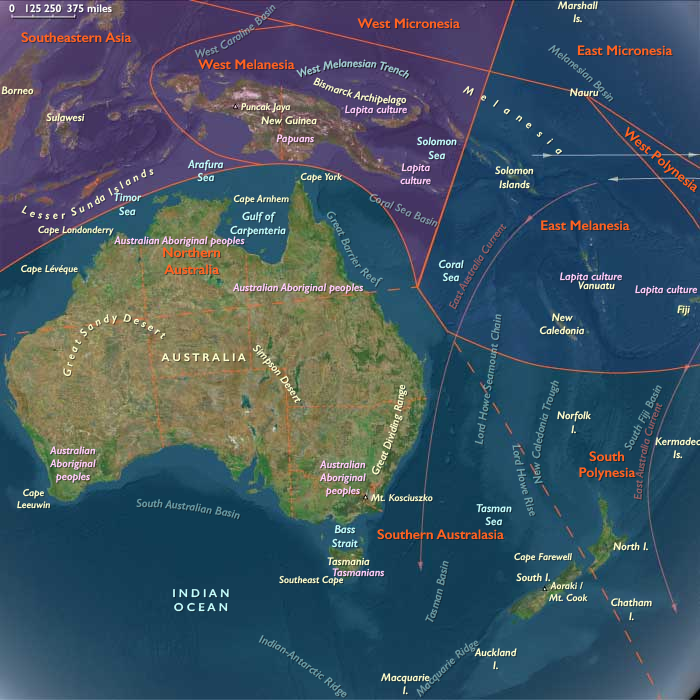
Across the southern third of the planet, Australasia remained a realm of striking contrasts—immemorial human presence in Australia balanced against the still-unpeopled islands of Aotearoa and its arc.
While civilizations elsewhere turned to bronze and iron, this world sustained the world’s oldest continuous lifeways.
From the monsoon coasts of Arnhem Land to Tasmania’s cool forests and the untouched valleys of New Zealand, peoples adapted through song, ceremony, and fire, renewing landscapes rather than transforming them.
The epoch closed with southern Polynesia still pristine, awaiting the later migrations that would complete humanity’s spread across the globe.
Geography and Environment
Australasia spanned northern monsoon tropics, temperate southern woodlands, and the cool maritime islands of the far south.
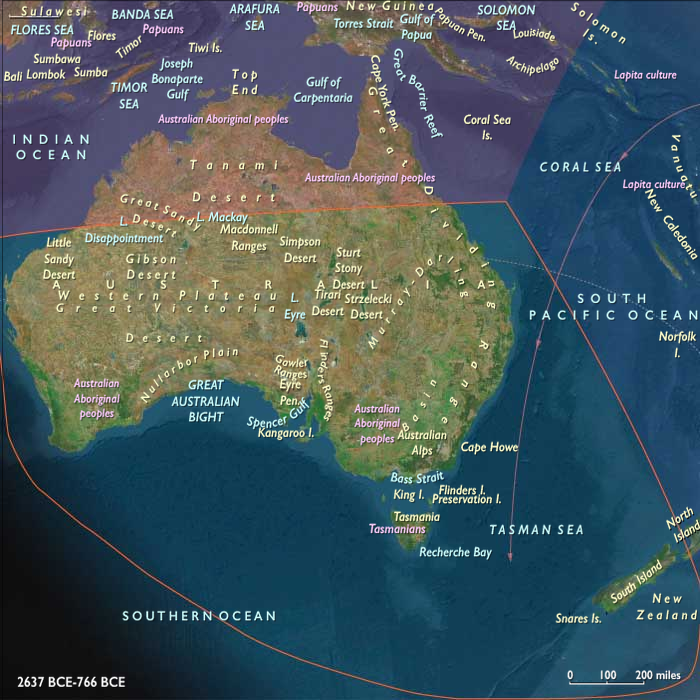
Rivers such as the Murray–Darling carved corridors through inland plains; to the north, the Alligator, Daly, and Mitchell basins pulsed with seasonal floods.
Beyond the continental rim, New Zealand, Norfolk, and the Kermadecs lay as forested volcanic outposts rising from the Tasman and South Pacific seas.
This diversity anchored a web of ecological knowledge—one of the most refined and enduring in human history.
Climate and Environmental Shifts
The epoch fell within the late Holocene’s climatic steadiness.
In northern Australia, alternating wet–dry cycles drove monsoon abundance and dry-season scarcity.
In the south, variable rainfall and periodic droughts shaped mobility and fire regimes, while in the Tasman latitudes, cooler intervals refreshed river and lake systems.
Volcanic pulses—most notably the Taupō–Rotorua tephra sequence in New Zealand—laid fertile foundations for future cultivation.
Societies and Subsistence
Across Australia, societies maintained highly structured, kin-based networks that organized mobility, marriage, and resource rights.
In the north, communities synchronized their movements to the monsoon: fishing and gathering during the floods, hunting and ceremony during the dry.
In the south, Aboriginal peoples moved seasonally between coast and interior, hunting kangaroo and emu, gathering seeds, roots, and shellfish, and shaping grasslands with planned burning.
Tasmanian groups, isolated by rising seas millennia earlier, specialized in seal and shellfish economies.
Far to the southeast, New Zealand and its island arc remained uninhabited, their ecosystems intact—a biological time capsule poised for later Polynesian arrival.
Technology and Material Culture
Australasian tool traditions emphasized stone, bone, and wood refined over tens of millennia.
Ground-edge axes, microlithic points, fishing spears, and fiber nets underpinned daily subsistence.
Bark canoes, rafts, and log boats served both riverine and coastal travel, while fish traps and weirs demonstrated sophisticated aquatic engineering.
Rock art flourished: x-ray and Gwion Gwion figures in the Kimberley, ochre engravings in southern rock shelters, and geometric motifs aligned with Dreaming cosmologies.
These material forms expressed a spiritual economy rather than a technological revolution—innovation through continuity.
Belief and Symbolism
Every landscape feature carried sacred meaning.
Dreamtime law bound people to ancestral beings who had sung the land, waters, and species into existence.
Songlines doubled as oral maps, ensuring that travel, ceremony, and environmental stewardship were one and the same.
Seasonal gatherings reinforced alliances, exchanged ritual knowledge, and renewed social harmony.
In southern regions, painted shelters and engravings recorded mythic episodes, linking cosmology directly to place.
Environmental Adaptation and Resilience
Australasian societies exemplified resilience through mobility and ecological design.
Fire-stick farming maintained open swards for game and promoted edible plants.
Complex calendars tracked flowering, migration, and rainfall cycles with precision equal to any agricultural almanac.
Food preservation—drying fish, smoking meat, grinding seed cakes—smoothed the rhythm between plenty and scarcity.
This dynamic equilibrium allowed human presence to persist with minimal ecological disruption across climates ranging from tropical wetlands to alpine tundra.
Regional Synthesis and Long-Term Significance
By 910 BCE, Australasia embodied two extremes of the human story:
-
On the vast continent, Aboriginal civilizations had perfected sustainable coexistence through ceremony, kinship, and fire.
-
Beyond its coasts, South Polynesia’s arc—New Zealand, Chathams, Norfolk, and the Kermadecs—remained pristine, untouched yet already signaled within the larger Pacific network of voyaging innovation.
Together they illustrate the continuity and balance that define the Australasian world: a continent of deep time and an oceanic frontier of imminent discovery—where cultural permanence met the last horizon of exploration.
Regions