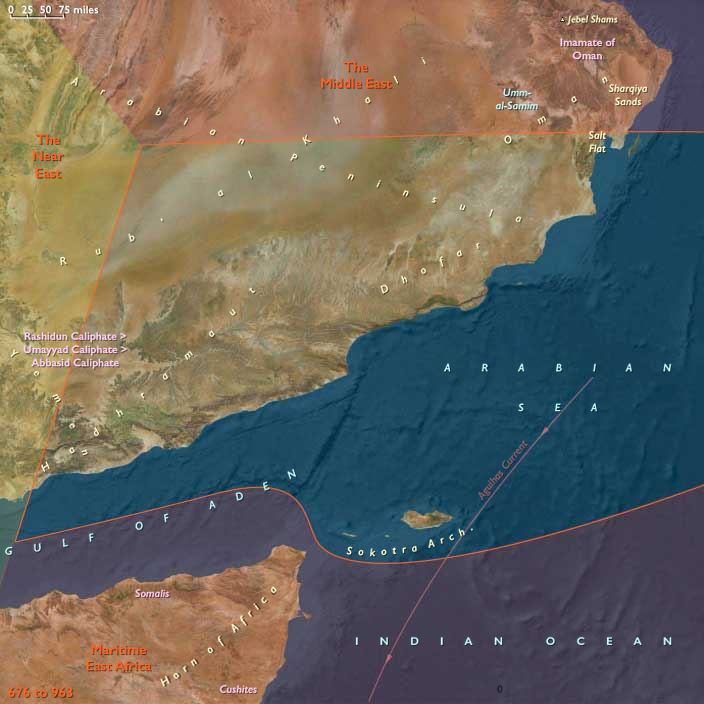
Southeast Arabia (820 – 963 CE): Frankincense…
820 CE to 963 CE
Southeast Arabia (820 – 963 CE): Frankincense Valleys, Desert Caravans, and Socotran Sailors
Geographic and Environmental Context
Southeast Arabia includes the Empty Quarter of Saudi Arabia, eastern Yemen (Hadhramaut and eastern Aden), the southern regions of Oman (Dhofar and al-Wusta), and the island of Socotra.
-
The Hadhramaut wadis supported clustered farming and trade towns.
-
Dhofar’s limestone escarpments sustained frankincense groves.
-
The Empty Quarter formed a sparsely populated desert barrier.
-
Socotra, in the Arabian Sea, served as a maritime waystation between Arabia and India.
Climate and Environmental Shifts
-
Hot, arid conditions dominated the interior;
-
The Khareef (monsoon rains) in Dhofar sustained frankincense trees;
-
Socotra’s semi-arid climate enabled mixed subsistence and resin gathering.
Societies and Political Developments
-
Hadhramaut towns (Shibam, Tarim predecessors) organized around tribal confederations.
-
Dhofar’s incense producers operated within tribal frameworks, exporting resin northward.
-
Socotra was under fluctuating Arab/Abbasid maritime influence, with local chiefs mediating between sailors and inland clans.
-
The Empty Quarter remained a nomadic domain, with Bedouin groups traversing fringes for pasture and caravan guidance.
Economy and Trade
-
Frankincense and myrrh from Dhofar and Hadhramaut remained the region’s most valuable exports, sold into Oman, Yemen, and northern markets.
-
Caravans carried aromatics through the desert to Najran (Near East) and beyond.
-
Socotra provided stopovers for Indian Ocean traders, supplying resins, honey, and dried fish.
Subsistence and Technology
-
Terrace farming and well irrigation in Hadhramaut wadis.
-
Resin tapping, goat herding, date palm cultivation.
-
Socotra’s outrigger canoes and sewn-plank boats enabled coastal and Indian Ocean crossings.
Movement and Interaction Corridors
-
Caravan trails linked Hadhramaut and Dhofar to Najran and Aden (Near East).
-
Maritime lanes through Socotra carried ships between Basra, Siraf, and western India.
Belief and Symbolism
-
Islam predominated under Abbasid influence, though tribal and customary rituals persisted in incense groves.
-
Socotra’s Christian community (a legacy of earlier Byzantine–Aksumite contact) coexisted with Muslims, gradually assimilating.
Long-Term Significance
By 963 CE, Southeast Arabia was a specialized incense-producing and maritime subregion, linking caravan deserts and Indian Ocean trade through Dhofar’s groves and Socotra’s harbors.
Images

Southeast Arabia (with civilization) ©2024-24 Electric prism, Inc. All rights reserved
Groups
Commodities
Subjects
Regions
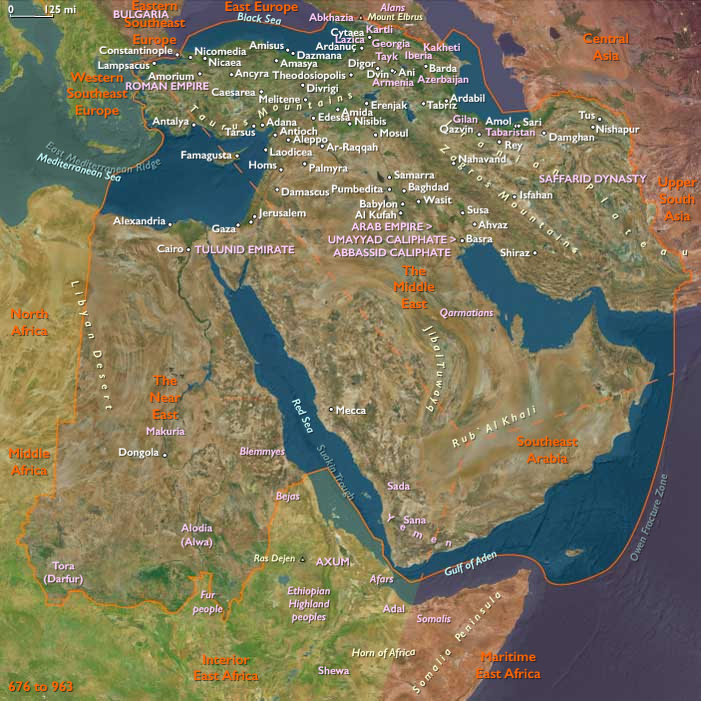
The Near and Middle East
View →Subregions