
Australasia (1828–1971 CE) Colonial Nationhood, Industrial …
Years: 1828 - 1971
Australasia (1828–1971 CE)
Colonial Nationhood, Industrial Growth, and Indigenous Revivals
Geography & Environmental Context
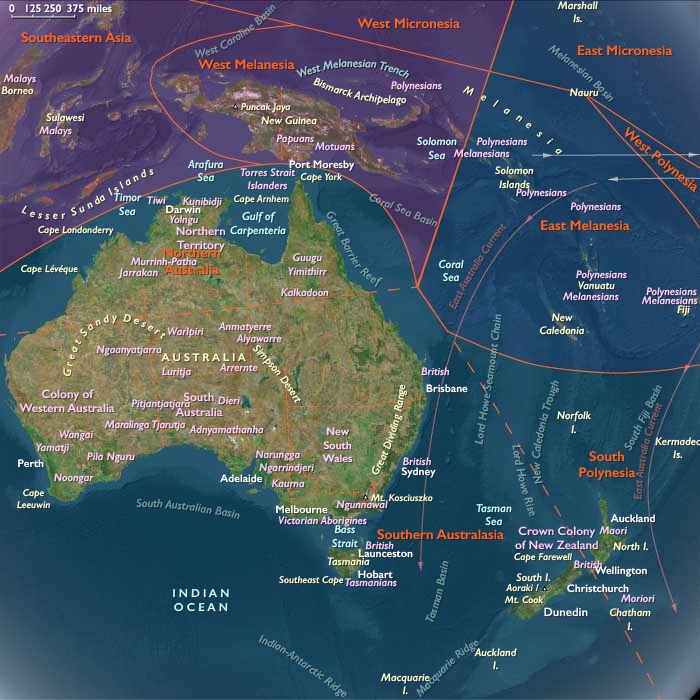
Australasia consists of three fixed subregions:
-
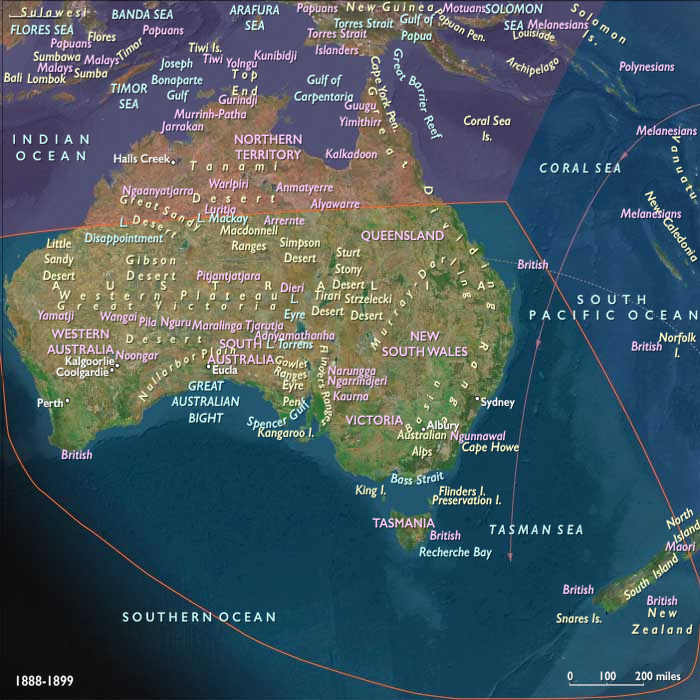
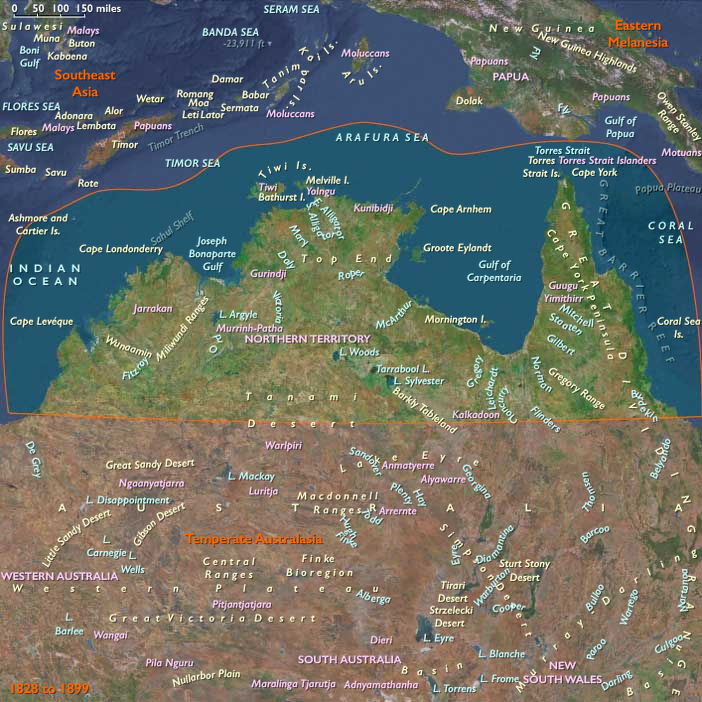
Northern Australia: the Northern Territory’s Top End, Queensland north of the Tropic of Capricorn, and the Kimberley and Pilbara regions of Western Australia.
-
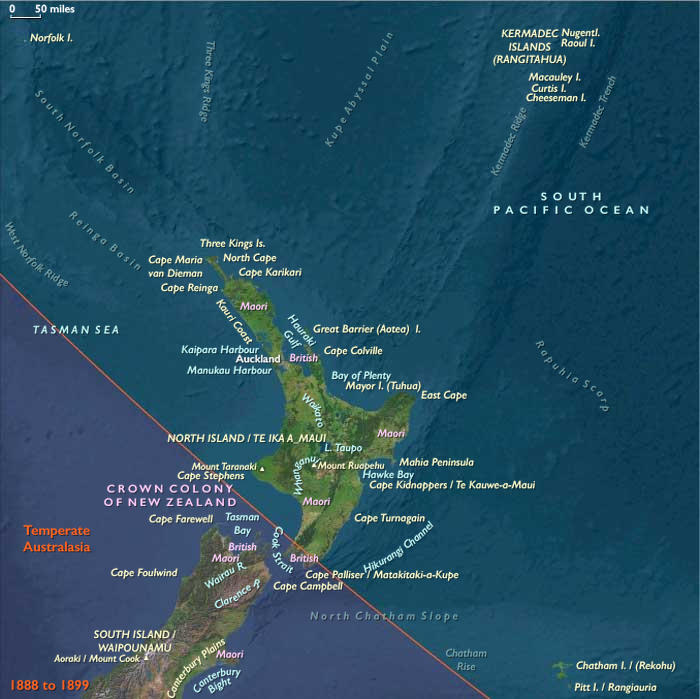
Southern Australasia: the southern portions of Australia (New South Wales, Victoria, South Australia, southern Queensland, southern Western Australia, and Tasmania) together with New Zealand’s South Island, the Cook Strait, and the southwestern tip of the North Island.
-
South Polynesia: New Zealand’s North Island (except its southwestern tip), the Chatham Islands, Norfolk Island, and the Kermadec Islands.
This region stretches from the monsoonal tropics to the temperate southern seas, embracing deserts, grasslands, alpine ranges, rainforests, and fertile coasts. Its environments shaped distinct settlement patterns—from pastoral frontiers in the north to industrial cities and ports in the south.
Climate & Environmental Shifts
The 19th century brought alternating droughts and floods to the Australian interior and devastating cyclones to the north. The temperate south and New Zealand enjoyed steadier climates suited to farming and livestock. In the 20th century, large-scale irrigation and dam projects—like the Snowy Mountains Scheme (1949–74)—reengineered water systems. Severe bushfires and erosion followed deforestation. In New Zealand, glacial retreat and soil loss accompanied agricultural intensification.
Subsistence & Settlement
-
Indigenous peoples: Aboriginal Australians and Māori endured dispossession but sustained knowledge systems tied to land and water.
-
Colonial expansion:
-
By mid-19th century, British settlers dominated governance across Australia and New Zealand. Gold rushes in Victoria (1850s) and Otago (1860s) spurred migration and urban growth.
-
Agriculture and pastoralism expanded rapidly: sheep and cattle across the Australian interior; dairy and grain farming in New Zealand’s fertile plains.
-
Urbanization concentrated populations in Sydney, Melbourne, Adelaide, Hobart, Wellington, Christchurch, and Auckland.
-
-
Postwar migration after 1945 diversified populations, bringing Southern Europeans and later Asians into the labor force.
Technology & Material Culture
Railways, ports, and telegraph lines linked inland farms to coastal cities. Refrigerated shipping (from the 1880s) allowed export of meat and dairy to Britain, binding the region to global markets. Industrialization advanced after WWII with car manufacturing, mining, and hydroelectric power. Everyday life modernized through electricity, radio, and television. Indigenous art and craft persisted, later inspiring national cultural renewal.
Movement & Interaction Corridors
-
Maritime networks tied Australian and New Zealand ports to Britain, India, and Asia; by the 20th century, trans-Pacific links expanded.
-
Migration corridors: British immigration dominated until postwar diversification. Māori and Pacific Islander movement into cities accelerated after WWII.
-
Military routes: Troops departed from Sydney, Melbourne, and Wellington to fight in imperial and world wars. Airfields built for WWII became postwar travel arteries.
Cultural & Symbolic Expressions
-
Indigenous resilience: Aboriginal songlines, ceremonies, and art remained vital despite suppression; Māori maintained marae, carving, and haka, fueling cultural revival by mid-century.
-
Colonial and national cultures:
-
Australia federated in 1901; New Zealand became a dominion in 1907.
-
Literature, art, and sport (rugby, cricket, Australian rules football) forged shared identities.
-
European-derived traditions blended with Indigenous and migrant influences.
-
-
Religion: Predominantly Christian, yet increasingly secular; missions evolved into welfare institutions and later arenas of protest.
Environmental Adaptation & Resilience
-
Agriculture: Innovations in irrigation, fertilizers, and animal breeding increased yields but damaged ecosystems.
-
Water management: Dams and schemes tamed drought-prone rivers; conservation movements began with national parks.
-
Urban adaptation: Expanding infrastructure mitigated fires and floods but encouraged suburban sprawl.
-
Indigenous adaptation: Aboriginal and Māori communities pursued land rights and cultural renewal, asserting continuity through change.
Political & Military Shocks
-
Colonial wars and resistance: Frontier conflicts persisted into the late 19th century; Māori resistance in New Zealand’s Land Wars (1840s–70s) ended with major land loss.
-
Nationhood: Australia’s federation (1901) and New Zealand’s dominion status (1907) consolidated self-government.
-
World wars: Heavy ANZAC losses at Gallipoli (1915) and elsewhere shaped national mythologies.
-
Economic crises: The Great Depression (1930s) brought hardship, followed by postwar recovery.
-
Cold War alliances: The ANZUS Treaty (1951) aligned Australia and New Zealand with the U.S.; nuclear testing in the Pacific spurred emerging antinuclear movements.
-
Civil rights: The 1967 Australian referendum recognized Aboriginal peoples in the census; Māori activism gained momentum in the 1960s–70s.
Transition
Between 1828 and 1971, Australasia evolved from colonial outposts into industrial democracies and regional powers. British migrants built settler nations tied to imperial trade, yet by mid-century both countries forged independent identities. Indigenous peoples, long marginalized, reasserted presence through cultural revival and political activism. The postwar era saw booming cities, resource exports, and closer Pacific engagement. By 1971, Australia and New Zealand were prosperous, urbanized, and globally connected—modern states still reckoning with colonial legacies and embracing their Pacific and Indigenous dimensions.
Groups
- Australians, Indigenous
- Aboriginal Tasmanians
- Polynesians
- Aotearoa
- Maori people
- Australia, British
- New Zealand Company
- New Zealand, British Colony of
- Australia
- New Zealand, (British) Dominion of
- Australia, Commonwealth of
- New Zealand (Aotearoa)
Topics
- Oceania, Settlement of
- Little Ice Age, Warm Phase I
- Little Ice Age (LIA)
- Australian frontier wars
- New Zealand Wars
- Victorian Gold Rush, Australia
- Central Otago Gold Rush, New Zealand
- Western Australian gold rushes
- 1891 Australian shearers' strike
- Dardanelles Campaign (Gallipoli Campaign)
- Depression, Great
- World War, Second (World War II)
- Cold War
Commodoties
Subjects
- Symbols
- Watercraft
- Painting and Drawing
- Conflict
- Mayhem
- Faith
- Government
- Custom and Law
- Cosmology
- Human Migration
Regions
Subregions
Years: 1828 - 1971
Groups
- Australians, Indigenous
- Aboriginal Tasmanians
- Polynesians
- Aotearoa
- Maori people
- Australia, British
- New Zealand Company
- New Zealand, British Colony of
- Australia
- New Zealand, (British) Dominion of
- Australia, Commonwealth of
- New Zealand (Aotearoa)
Topics
- Oceania, Settlement of
- Little Ice Age, Warm Phase I
- Little Ice Age (LIA)
- Australian frontier wars
- New Zealand Wars
- Victorian Gold Rush, Australia
- Central Otago Gold Rush, New Zealand
- Western Australian gold rushes
- 1891 Australian shearers' strike
- Dardanelles Campaign (Gallipoli Campaign)
- Depression, Great
- World War, Second (World War II)
- Cold War
Commodoties
Subjects
- Symbols
- Watercraft
- Painting and Drawing
- Conflict
- Mayhem
- Faith
- Government
- Custom and Law
- Cosmology
- Human Migration
Regions
Subregions