
Southern Macaronesia (1396–1539 CE): Conquest and Atlantic…
1396 CE to 1539 CE
Southern Macaronesia (1396–1539 CE): Conquest and Atlantic Integration
Geographic & Environmental Context
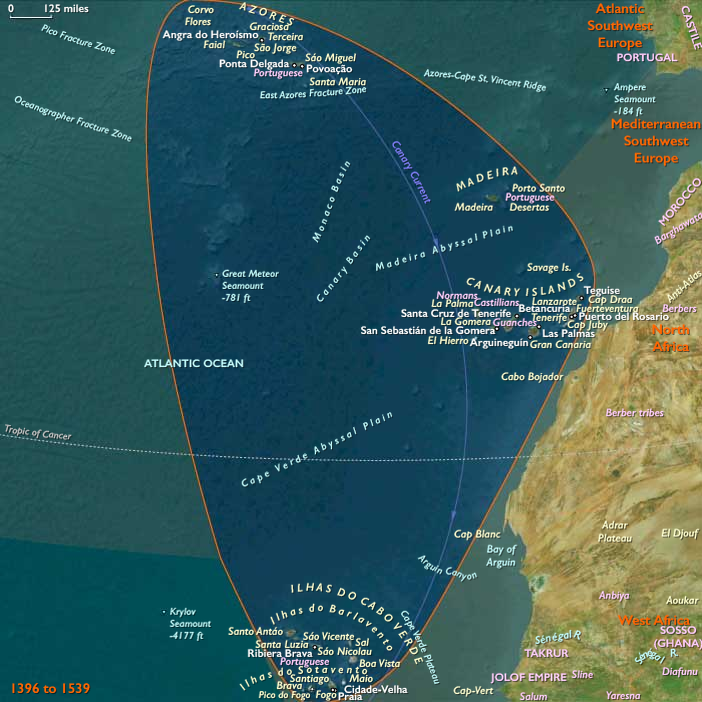
The subregion of Southern Macaronesia includes the Canary Islands and Cape Verde Islands. The Canaries offered fertile volcanic soils and cloud forests in uplands, while Cape Verde’s smaller islands remained more arid and fragile.
Climate & Environmental Shifts
Little Ice Age variability brought alternating drought and storm years. The Canaries retained laurisilva in mountain belts but saw increased clearance for farming. Cape Verde faced harsh rainfall variability but sustained small-scale agriculture once colonized.
Subsistence & Settlement
-
Canaries: The Castilian conquest (1402–1496) subdued Guanche polities. Colonists introduced wheat, vineyards, sugarcane, and livestock. Indigenous populations collapsed under war, enslavement, and disease.
-
Cape Verde: Discovered and settled by the Portuguese in the 1460s. Colonists planted sugar and introduced enslaved Africans, making the islands key to the emerging Atlantic slave trade.
Technology & Material Culture
European colonists brought iron tools, firearms, and plantation technologies. Sugar mills, stone churches, and forts appeared. Hybrid Afro-Portuguese crafts, textiles, and religious practices developed in Cape Verde.
Movement & Interaction Corridors
The archipelagos became pivotal Atlantic waystations:
-
The Canaries exported grain, wine, and sugar to Europe.
-
Cape Verde supplied slaves, cattle, and goods for Iberian fleets.
-
Both chains provisioned ships crossing to Africa and the Americas.
Cultural & Symbolic Expressions
Christianity was imposed through churches, chapels, and missions, though Guanche and African traditions persisted in hybrid forms. Festivals, music, and oral traditions blended Iberian and African elements, creating creole cultures in Cape Verde.
Environmental Adaptation & Resilience
Deforestation in the Canaries destabilized ecosystems; colonists adapted with terracing and irrigation. Cape Verde’s fragile environment struggled with overgrazing and erosion, but resilience emerged through diversified subsistence, fishing, and trade.
Transition
By 1539 CE, Southern Macaronesia was fully integrated into Iberian empires: the Canaries absorbed into Castile, Cape Verde into Portugal. Both archipelagos were transformed into stepping-stones of empire and Atlantic exchange.
Topics
Regions
Macaronesia
View →Subregions
