Event
Maritime South Asia (7,821–6,094 BCE): Monsoon Foragers,…
Maritime South Asia (7,821–6,094 BCE): Monsoon Foragers, Rainforest Hunters, and the Reefs beneath the Rising Sea.
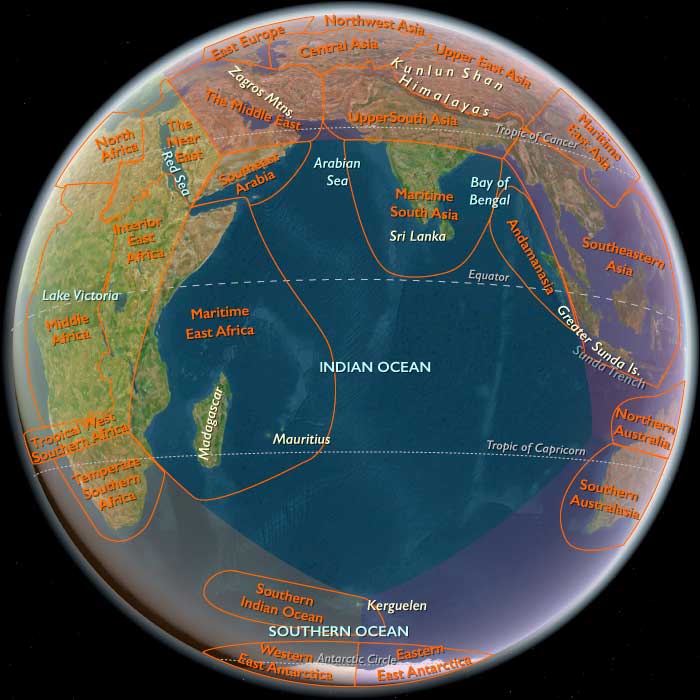
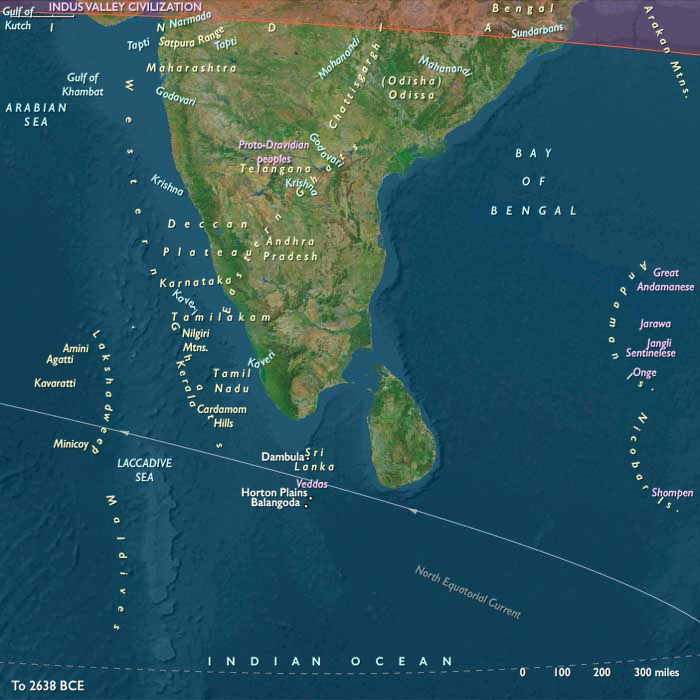
During the Early Holocene, Maritime South Asia extended across peninsular India and Sri Lanka and outward into the coral archipelagos of Lakshadweep, the Maldives and Chagos. Human communities had occupied the mainland and Sri Lanka for tens of thousands of years, while the remote coral regions of the central Indian Ocean remained without human settlement. Across the period, strong monsoons, changing forests and grasslands, rising seas and rapid reef growth reshaped environments in very different ways.
Across peninsular India, hunter-gatherer communities occupied river valleys, rockshelters, woodland margins, savannas and seasonal wetlands. Microlithic technologies inherited from much older South Asian traditions remained widespread, with small blades and backed implements used alongside bone, wood, fibre and other organic materials.
In the Deccan, landscapes varied from moist woodland along rivers and higher rainfall zones to dry deciduous forest, scrub and naturally open grasslands. Communities moved between water sources, plant foods and hunting grounds according to season. Rivers such as the Krishna, Godavari, Tungabhadra and Kaveri provided especially important corridors through the peninsula.
During the earlier part of the age, an intensified Indian summer monsoon supported relatively moist conditions across much of southern India. Toward the later centuries, monsoon strength began to weaken, gradually altering vegetation, lake levels and seasonal water availability. These changes occurred long before livestock pastoralism or agriculture transformed the peninsula.
At Jwalapuram in southeastern India, long-established microlithic traditions continued into the Early Holocene. Communities exploited both wooded uplands and neighboring river valleys, adapting technologies that had roots deep in the Late Pleistocene. Similar small-stone industries occurred across much of the peninsula without constituting a single cultural or ethnic population.
Sri Lanka supported one of South Asia's most intensively documented rainforest foraging traditions. In the humid southwest, caves and rockshelters such as Fa-Hien Lena, Batadomba-lena and Kitulgala Beli-lena formed parts of wider landscapes of tropical forest, streams and uplands used repeatedly by human communities.
Sri Lankan foragers hunted small arboreal and semi-arboreal mammals, gathered nuts and other forest plants, collected freshwater snails and exploited a wide range of other rainforest foods. Bone projectile points, small stone tools and organic technologies supported life in dense forest. Coastal materials transported inland demonstrate movement or exchange between rainforest communities and the shore.
These Sri Lankan communities remained hunters and gatherers throughout the period. Their successful occupation of tropical rainforest did not depend upon farming, and no rice fields, livestock villages or agricultural clearings formed part of the landscape. Human presence remained embedded within extensive natural forest.
Around both Sri Lanka and peninsular India, rising sea level continued to inundate low coastal ground. Estuaries expanded, river mouths shifted and former shoreline camps disappeared beneath later marine waters or sediment. The Early Holocene coastline therefore differed substantially from the modern one.
Far offshore, Lakshadweep followed a completely different history. Coral reefs grew upward beneath the rising Arabian Sea, developing shallow platforms and lagoons while later reef islands remained unstable, absent or incompletely formed. No secure human settlement belonged to these islands during this age.
The Maldives were even more dramatically unlike their later appearance. For most of the period, the Pleistocene reef foundations remained submerged beneath the rising central Indian Ocean. Major Holocene reef growth began only near the close of the age, around 6,150 BCE, when corals started building rapidly upward over the older limestone surface.
The sandy and rubble islands that later supported Maldivian settlement had not yet formed. Reef growth, lagoon development, coral communities and open ocean therefore defined the archipelago, without people, coconut groves or permanent dry land resembling the later inhabited islands.
Farther south, Chagos likewise remained an unpeopled reef world. Coral growth and marine sedimentation continued across submerged platforms, while the later dry islands of Diego Garcia and neighboring atolls had not yet developed into their mature Holocene forms.
Across the oceanic component of Maritime South Asia, the principal history was therefore geological and ecological rather than human. Coral reefs responded to rising sea level, waves and changing water depth while fish, mollusks, turtles, sharks and other marine organisms occupied developing reef environments.
Legacy of the Age
By 6,094 BCE, Maritime South Asia contained a striking contrast between ancient human landscapes and newly developing oceanic ones. Peninsular India remained occupied by mobile hunter-gatherers whose microlithic technologies had deep Late Pleistocene roots, while Sri Lanka supported highly specialized tropical-rainforest foraging societies using sophisticated stone, bone and organic technologies. Agriculture and pastoralism had not yet transformed either region. Offshore, Lakshadweep remained an uninhabited reef system, while major Holocene reef growth in the Maldives had only just begun and the later dry islands of the Maldives and Chagos still lay far in the future. The defining history of the age was therefore the persistence of ancient foraging traditions on long-inhabited land beside an Indian Ocean whose coral island geography was still being built beneath the rising sea.

-
{# Image navigates to the detail page; the magnifying-glass chip is the only Fancybox lightbox trigger (kept a separate sibling — anchors can't nest). #}
 The Indian Ocean Lands
World
-
{# Image navigates to the detail page; the magnifying-glass chip is the only Fancybox lightbox trigger (kept a separate sibling — anchors can't nest). #}
 South Asia
Region
-
{# Image navigates to the detail page; the magnifying-glass chip is the only Fancybox lightbox trigger (kept a separate sibling — anchors can't nest). #}
 Maritime South Asia
Subregion