Event
Southern South Atlantic (1828–1971 CE): Island Community,…
Southern South Atlantic (1828–1971 CE): Island Community, Industrial Whaling, and Permanent Science
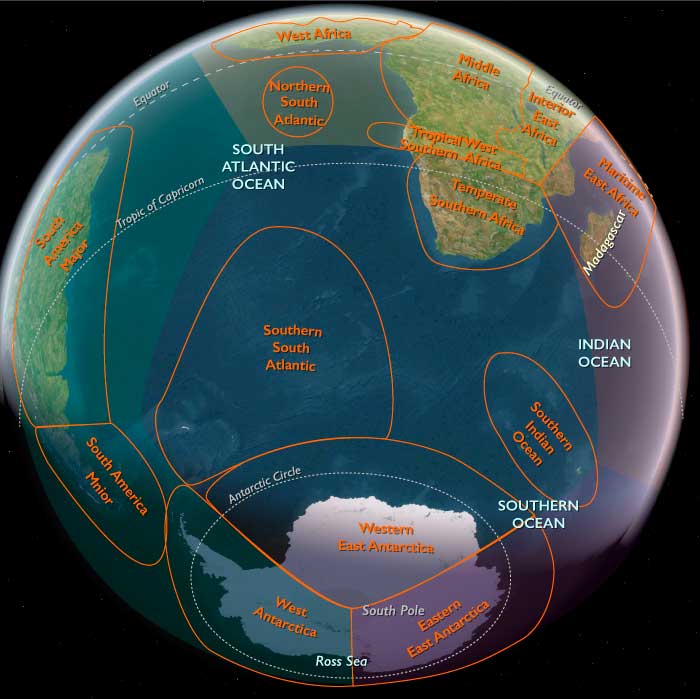
Geographic Parameters
Human presence remained concentrated in a few places: the settlement plain of Tristan, selected South Georgia bays, Laurie and Signy islands in the South Orkneys, and the Gough weather-station site. Bouvet and the South Sandwich Islands remained almost entirely unoccupied.
Tristanian Society
Tristan’s population developed through a small number of founding families, later arrivals, shipwreck survivors, and spouses brought from elsewhere. The community combined household gardens, potatoes, livestock, fishing, boat work, gathering, and exchange with visiting ships. Local stone construction and communal systems helped residents endure isolation and severe weather.
The decline of sailing traffic increased isolation during the later nineteenth and early twentieth centuries, while missionary, naval, administrative, and eventually radio contacts connected the island more regularly to Britain and South Africa. The settlement was named Edinburgh of the Seven Seas after the Duke of Edinburgh’s 1867 visit, although residents commonly continued to call it simply the Settlement.
The 1961 volcanic eruption forced the population’s evacuation to Britain. Most residents chose to return in 1963, re-establishing the island community and affirming its attachment to place.
Industrial Whaling
The principal new organizing system was the industrial processing enclave. Carl Anton Larsen established Grytviken in 1904, inaugurating shore-based commercial whaling on South Georgia. Stations later operated at Leith Harbour, Stromness, Husvik, Ocean Harbour, Prince Olav Harbour, and elsewhere. Steam catcher boats, explosive harpoons, flensing platforms, boilers, cookers, tanks, workshops, barracks, hospitals, and rail or pipe systems transformed selected bays.
Workers came principally from Norway and Britain, with others drawn into multinational crews. These were transient industrial populations rather than permanent island societies. The stations depended on imported food, coal or oil, machinery, medical services, and seasonal shipping.
Industrial whaling killed immense numbers of whales and altered Southern Ocean food webs. Shore stations declined after pelagic factory ships expanded in the late 1920s, and collapsing whale populations made continued exploitation progressively less viable. The final South Georgia operations ceased in 1966.
Science and Meteorology
Scientific occupation became permanent in parts of the subregion. The Scottish National Antarctic Expedition established its Laurie Island station in 1903 and transferred it to Argentina in 1904, creating Orcadas Station. Signy began as a British scientific station in 1947. South Africa established continuous meteorological operations on Gough in 1956.
Research focused on weather, magnetism, oceanography, geology, glaciology, biology, and wildlife. Stations introduced radio masts, fuel stores, generators, laboratories, small boats, and regular relief voyages, but remained tiny within their island environments.
Exploration and Strategic Systems
South Georgia served expeditions traveling toward Antarctica and became associated with Ernest Shackleton’s 1916 crossing and his death and burial at Grytviken in 1922. During the world wars and early Cold War, Tristan, South Georgia, Gough, and the South Orkneys gained strategic value as weather, radio, patrol, and observation points.
Bouvet was landed upon and claimed by the Norwegian Norvegia expedition in 1927; Norway subsequently consolidated sovereignty over the island.
Environmental Transformation
Introduced rats and mice severely affected ground-nesting birds on South Georgia. Reindeer introduced by whalers damaged vegetation in selected districts. Industrial waste, fuel, buildings, whale bones, and machinery reshaped station bays. Tristan and Gough also suffered ecological change from introduced plants and animals.
At the same time, reduced sealing allowed fur seals and elephant seals to recover in many locations. Industrial abandonment opened former work areas to recolonization, although pollutants and unstable ruins remained.
Political and Administrative Development
Britain administered Tristan and South Georgia within changing South Atlantic colonial arrangements. Argentina maintained Orcadas and asserted claims in the South Orkneys and South Georgia region. Norway administered Bouvet. Scientific occupation thus became intertwined with sovereignty, although most territory remained physically unoccupied.
Legacy of the Age
By 1971 CE, the subregion contained three sharply contrasting human landscapes: a small permanent community on Tristan; abandoned or declining industrial whaling districts on South Georgia; and sparse scientific stations on Gough, South Georgia, and the South Orkneys. Human systems were historically consequential but geographically narrow. Beyond them, glaciers, tussock, cliffs, sea ice, wildlife colonies, and open ocean remained dominant.

-
{# Image navigates to the detail page; the magnifying-glass chip is the only Fancybox lightbox trigger (kept a separate sibling — anchors can't nest). #}
 The African South
World
The African South
World
-
{# Image navigates to the detail page; the magnifying-glass chip is the only Fancybox lightbox trigger (kept a separate sibling — anchors can't nest). #}
 South Atlantic
Region
South Atlantic
Region
-
{# Image navigates to the detail page; the magnifying-glass chip is the only Fancybox lightbox trigger (kept a separate sibling — anchors can't nest). #}
 Southern South Atlantic
Subregion
Southern South Atlantic
Subregion