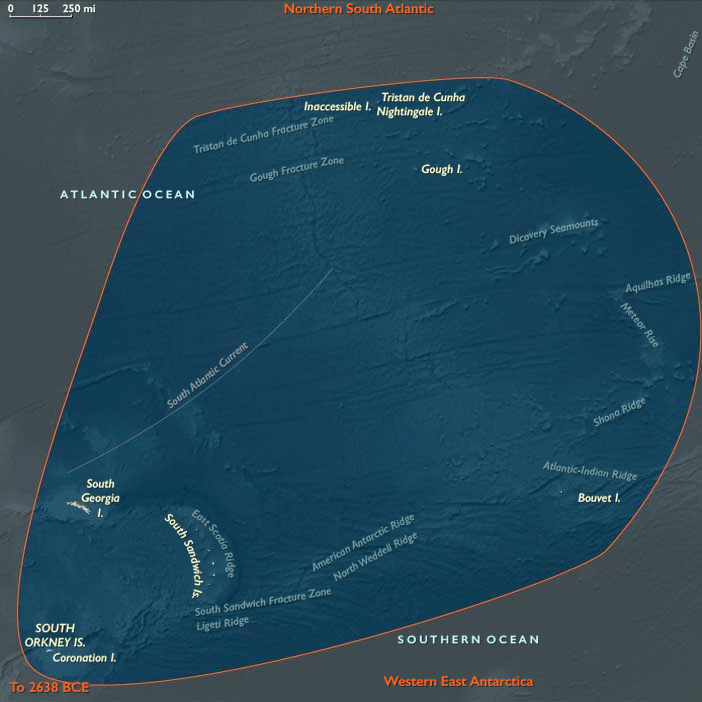
Southern South Atlantic (4,365–2,638 BCE): Mature Holocene…
4365 BCE to 2638 BCE
Southern South Atlantic (4,365–2,638 BCE): Mature Holocene Ecologies
Geographic & Environmental Context
The subregion of Southern South Atlantic includes the Tristan da Cunha archipelago, Bouvet Island, South Georgia and the South Sandwich Islands, and the South Orkney Islands (including Coronation Island). These islands formed scattered high points in the vast ocean, bound together by the westerlies and the Antarctic Circumpolar Current (ACC). Tristan da Cunha and Gough offered volcanic peaks and increasingly vegetated slopes. Bouvet remained mostly glaciated, its small volcanic cone projecting into turbulent seas. South Georgia and the South Orkneys combined fjords, icefields, and growing stretches of tundra-like vegetation. The South Sandwich Islands stood as isolated volcanic ridges with limited ecological niches.
Climate & Environmental Shifts
By this mid-Holocene interval, global temperatures were stable to slightly cooling compared to earlier peaks. In the Southern South Atlantic, glaciers on South Georgia and the Orkneys persisted but were smaller than in previous millennia, while coastal zones expanded. Westerly winds drove storm systems year-round. Sea ice advanced seasonally but retreated fully in summer, supporting productive polynyas and upwelling zones. Overall, climates were cool, windy, and oceanic, but favorable for rich marine ecosystems.
Subsistence & Settlement
Humans were still absent. Ecological communities matured:
-
Vegetation on Tristan and Gough thickened into tussock grasslands, mosses, and ferns. On South Georgia’s ice-free plains, similar tundra communities spread.
-
Penguins and seabirds flourished, with dense colonies of king, macaroni, and gentoo penguins, alongside albatrosses, petrels, and skuas.
-
Seals established major rookeries, particularly on South Georgia’s beaches.
-
Offshore, krill blooms and nutrient upwellings supported whales, fish, and squid in abundance.
Technology & Material Culture
Across the globe, Neolithic societies were transitioning toward early metallurgy and expanding agricultural frontiers. None of this touched the Southern South Atlantic. Its ecosystems remained entirely free of human technology or modification.
Movement & Interaction Corridors
The ACC linked these islands into wider Southern Ocean systems. Migratory whales congregated in summer feeding grounds around South Georgia, then migrated north in winter. Seabirds bridged hemispheres, carrying nutrients between continents. Penguins and seals adjusted breeding cycles to seasonal ice extent. Nutrient cycling between sea and land intensified as rookeries expanded, fertilizing soils and accelerating plant colonization.
Cultural & Symbolic Expressions
There were no human symbolic systems tied to the region. Instead, symbolic continuity was natural: the cyclical return of penguins and whales, the seasonal greening of tussock slopes, and the advance and retreat of sea ice inscribed rhythms of time.
Environmental Adaptation & Resilience
Species thrived by adapting to seasonal extremes. Penguins and seals selected breeding sites based on ice retreat and storm exposure. Seabirds adjusted migration timing to productivity pulses. Plants colonized new ground quickly, anchoring soils against erosion. Krill, the keystone of the marine web, adapted to fluctuating sea-ice cover and under-ice algae cycles, ensuring resilience of higher predators.
Transition
By 2,638 BCE, the Southern South Atlantic had stabilized into a mature Holocene ecosystem. Its volcanic islands and glaciated coasts supported dense wildlife, fertile grasslands, and thriving marine food chains. Still unseen by humans, the subregion flourished as one of the most biologically rich theaters of the Southern Ocean.
Images

Southern South Atlantic in the Late Holocene
Subjects
Regions
South Atlantic
View →Subregions