
Event
The Spanish Baroque and the Churrigueresque Style…
The Spanish Baroque and the Churrigueresque Style
Spanish Baroque, while sharing similarities with Italian Baroque, distinguishes itself through a heightened emphasis on surface decoration and intricate detail.
The most celebrated figure of this artistic movement is José Benito Churriguera, whose work epitomizes the Spanish Baroque’s fascination with rich ornamentation and elaborate textural embellishments. His opulent designs inspired a generation of architects, leading to the emergence of the Churrigueresque style, a term used to describe the highly decorative architectural trends of late seventeenth- and early eighteenth-century Spain.
His brothers also left their mark on Spanish architecture. Joaquín Churriguera (1674–1724) is best known for his contributions to the Salamanca Cathedral (1714–1724, later dismantled after the 1755 Lisbon earthquake) and the Colegio de Calatrava (begun in 1717) in Salamanca. Meanwhile, Alberto Churriguera (1686–1750) designed the Plaza Mayor of Salamanca, one of the most distinguished public squares in Spain.
-
{# Image navigates to the detail page; the magnifying-glass chip is the only Fancybox lightbox trigger (kept a separate sibling — anchors can't nest). #}
 The North Atlantic Lands
World
-
{# Image navigates to the detail page; the magnifying-glass chip is the only Fancybox lightbox trigger (kept a separate sibling — anchors can't nest). #}
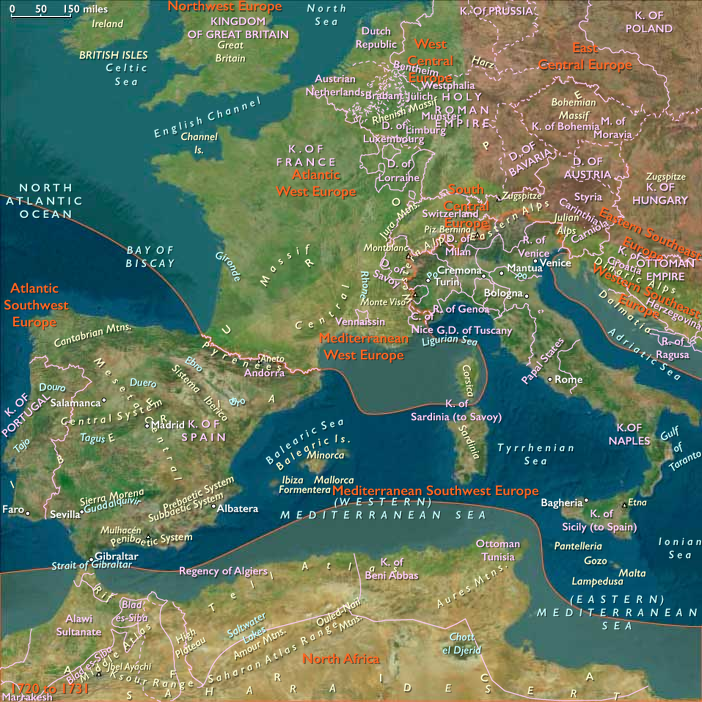 Southwest Europe
Region
-
{# Image navigates to the detail page; the magnifying-glass chip is the only Fancybox lightbox trigger (kept a separate sibling — anchors can't nest). #}
 Atlantic Southwest Europe
Subregion
