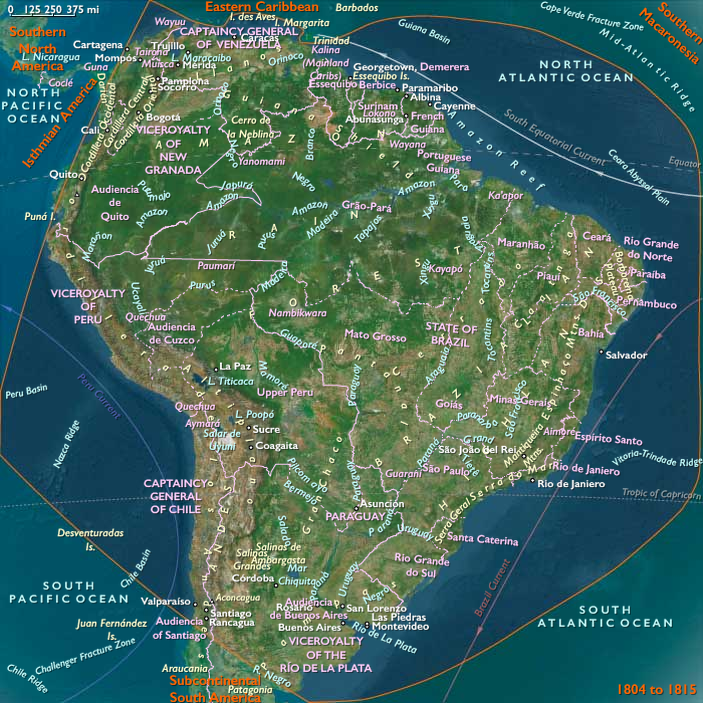
The interior of the Banda Oriental, led…
1804 CE to 1815 CE
Artigas, now forty-six years old, is the scion of a family that had settled in Montevideo in 1726.
Influenced by federalism, Artigas had been dissatisfied with the administration of the former colonial government in Buenos Aires, particularly with its discrimination against Montevideo in commercial affairs.
Artigas's army wins its most important victory against the Spaniards in the Battle of Las Piedras on May 18, 1811.
He then besieges Montevideo from May to October 1811.
Elío saves Montevideo only by inviting in the Portuguese forces from Brazil, which pour into Uruguay and dominate most of the country by July 1811.
This October Elio concludes a peace treaty with Buenos Aires that provides for the lifting of the siege of Montevideo and the withdrawal of all the troops of Artigas, Portugal, and Spain from Uruguay.
Artigas, his three thousand troops, and thirteen thousand civilians evacuate Salto, on the Rio Uruguay, and cross the river to the Argentine town of Ayuf, where they camp for several months.
This trek is considered the first step in the formation of the Uruguayan nation.
The Portuguese and Spanish troops do not withdraw until 1812.
At the beginning of 1813, after Artigas has returned to the Banda Oriental, having emerged as a champion of federalism against the unitary centralism of Buenos Aires, the new government in Buenos Aires convenes a constituent assembly.
The Banda Oriental's delegates to elect assembly representatives gather and, under instructions issued by Artigas, propose a series of political directives.
Later known as the "Instructions of the Year Thirteen," these directives include the declaration of the colonies' independence and the formation of a confederation of the provinces (the United Provinces of the Rio de la Plata) from the former Viceroyalty of the Rio de la Plata (dissolved in 1810 when independence was declared).
This formula, inspired by the Constitution of the United States, would have guaranteed political and economic autonomy for each area, particularly that of the Banda Oriental with respect to Buenos Aires.
However, the assembly refuses to seat the delegates from the Banda Oriental, and Buenos Aires pursues a system based on unitary centralism.
Consequently, Artigas breaks with Buenos Aires and again besieges Montevideo.
Artigas lifts his siege of Montevideo at the beginning of 1814, but warfare continues among the Uruguayans, Spaniards, and Argentines.
In June 1814, Montevideo surrenders to the troops of Buenos Aires.
Artigas controls the countryside, however, and his army retakes the city in early 1815.
Once the troops from Buenos Aires have withdrawn, the Banda Oriental appoints its first autonomous government.
Artigas establishes the administrative center in the northwest of the country, where in 1815 he organizes the Federal League under his protection.
It consists of six provinces—including four present-day Argentine provinces—demarcated by the Rio Parana, Rio Uruguay, and Rio de la Plata—with Montevideo as the overseas port.
The basis for political union is customs unification and free internal trade.
To regulate external trade, the protectionist Customs Regulations Act (1815) is adopted.
This same year, Artigas also attempts to implement agrarian reform in the Banda Oriental by distributing land confiscated from his enemies to supporters of the revolution, including Indians and mestizos (people of mixed Indian and European ancestry).
Locations
People
Groups
Charrúa
View →
Tupi people (Amerind tribe)
View →
Chaná
View →
Bohán
View →
Yaro people
View →
Guaraní (Amerind tribe)
View →
Portuguese people
View →
English people
View →
Spain, Habsburg Kingdom of
View →
Spaniards (Latins)
View →
Canary Islanders
View →
Brazil, Colonial
View →
Río de la Plata, Viceroyalty of
View →
Britain (United Kingdom of Great Britain and Ireland)
View →
Río de la Plata, United Provinces of the
View →
Topics
Regions
South America
View →Subregions