
Stephen regains Khotyn from Poland in a…
1466 CE
Stephen regains Khotyn from Poland in a diplomatic victory in 1466, but in the same year, Corvinus becomes on bad terms with King Casimir IV Jagiellon of Poland, which frustrates the Hungarian king further, given that Moldavia is a Polish fief.
Locations
Groups
Subjects
Regions
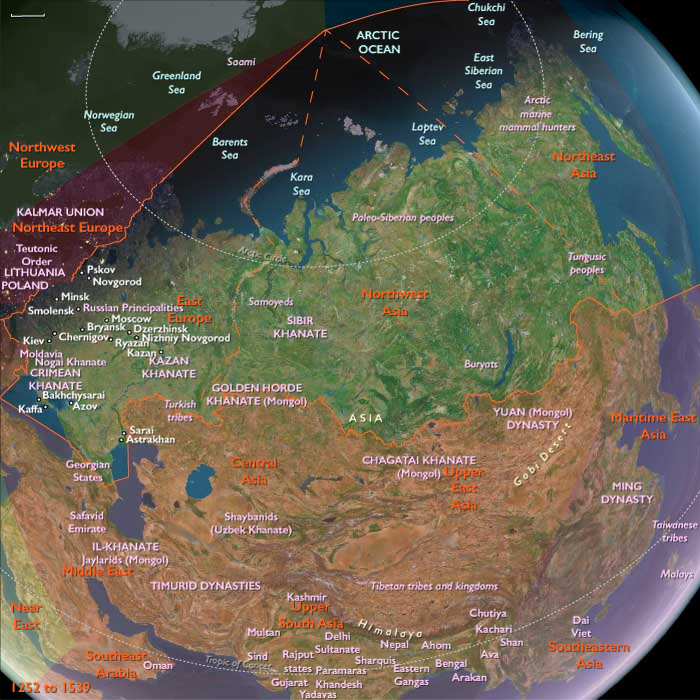
Northeastern Eurasia
View →Subregions
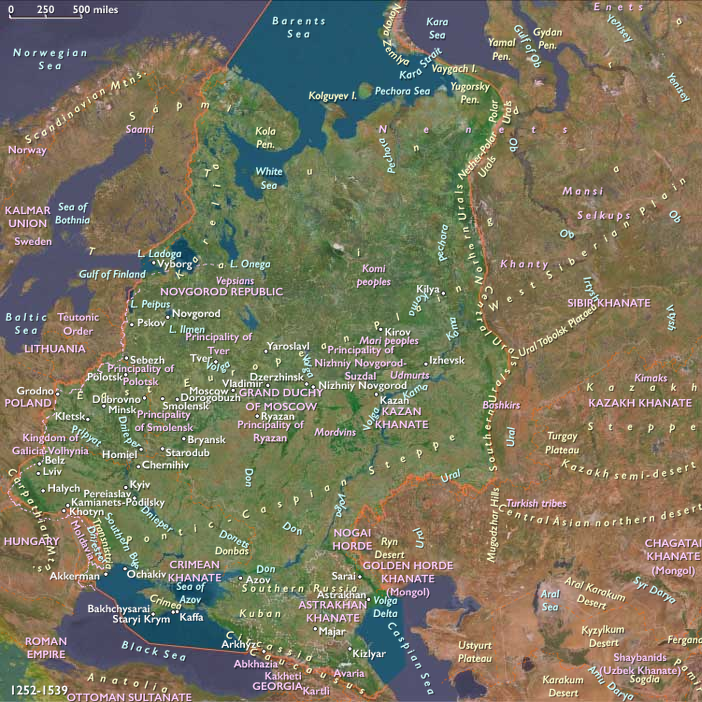
East Europe
View →Related Events
No active filters.
Showing 10 events out of 41086 total
Astrakhan, situated in the delta of the Volga River about sixty miles (one hundred kilometers) from the northwest shore of the Caspian Sea, becomes prominent around 1466 as the capital of one of the Tatar khanates that has emerged from the breakup of the Golden Horde.
The archbishop has ruled Sweden independently until 1466, when plots by his opponents compel him to solicit military support from Christian.
The Swedish opposition repudiates Danish control and again agitates for Charles’ recall.
Chisinau (Kisin’ov), situated on the Byk River, a Dnestr tributary, is first mentioned in 1466 when under the rule of…
…Stephen III, who, reigning from 1457 as voivode of Moldavia, which had come under Ottoman suzerainty in 1455, rejects both Ottoman and Polish suzerainty and, ruling from his capital at Suceava established in 1466, expands Moldavia's sphere of influence to the mouths of the Danube and into Wallachia.
Skanderbeg successfully repulses another attempt in 1466, bringing to thirteen the total number of major Turkish invasions he has combated since 1444.
Most of Hercegovina, heretofore a client state of Hungary-Croatia, falls to the Ottoman Turks shortly after the death of Duke Stjepan Vukcic in 1466.
Many of the Bogomils of Hercegovina and …
… Bosnia, numerous in Bosnia in this and the previous century, adopt Islam.
Rijeka, or Fiume, located on the Kvarner (Quarnero) Gulf, an arm of the Adriatic Sea, about forty miles (sixty kilometers) southeast of Trieste, is the principal seaport and the third-largest city in Croatia (after Zagreb and Split).
Because of its strategic position and its excellent deep-water port, the city has been fiercely contested over the centuries, especially among Italy, Hungary, and Croatia, changing hands and demographics many times.
Traces of Neolithic settlements can be found in the region, but the earliest modern settlements on the site were Celtic Tharsatica (modern Trsat, now part of Rijeka) on the hill, and the tribe of mariners, the Liburni, in the natural harbor below.
The city long retained its dual character.
Pliny mentioned Tarsatica in his Natural History (iii.140).
In the time of Augustus, the Romans rebuilt Tharsatica as a municipium Flumen, situated on the right bank of small river Rječina (whose name means "the big river").
It became a city within the Roman Province of Dalmatia until the sixth century.
Rijeka after the fourth century was rededicated to St. Vitus, the city's patron saint, as Terra Fluminis sancti Sancti Viti or, in German, Sankt Veit am Pflaum.
The town from the fifth century onward was ruled successively by the Ostrogoths, the imperial Greeks, the Lombards, and the Avars.
Croats settled the city starting in the seventh century, giving it the Croatian name, Rika svetoga Vida ("the river of St. Vitus").
At the time, Rijeka was a feudal stronghold surrounded by a wall.
At the center of the city, its highest point, was a fortress.
Rijeka was attacked in 799 by the Frankish troops of Charlemagne.
Their Siege of Trsat was at first repulsed, during which the Frankish commander Duke Eric of Friuli was killed.
The Frankish forces finally occupied and devastated the castle, however, while the Duchy of Croatia passed under the overlordship of the Carolingian Empire.
The town from about 925 was part of the Kingdom of Croatia, from 1102 in personal union with Hungary.
Trsat Castle and the town was rebuilt under the rule of the House of Frankopan.
The Rijeka citizens in 1288 signed the Law codex of Vinodol, one of the oldest codes of law in Europe.
Rijeka is a rival to Venice by 1466, when the city is purchased by the Habsburg emperor Frederick III, Archduke of Austria.
It will remain under Habsburg overlordship for over four hundred and fifty years.
Tensions with the College of Cardinals come to the fore in 1466 when Paul II, in an attempt to downsize redundant offices, proceeds to annul the college of abbreviators, whose function it is to formulate papal documents.
A storm of indignation arises, inasmuch as rhetoricians and poets with humanist training, of which Paul deeply disapproves, have long been accustomed to benefiting from employment in such positions.
Bartolomeo Platina, who is one of these, writes a threatening letter to the Pope, and is imprisoned but later discharged.
Piero completes the splendid fresco cycle in the Church of San Francesco in Arezzo in 1466, filling the three walls of the choir with narrative scenes whose subject is the Legend of the True Cross, which traces the history of the wood on which Christ was crucified from its first form as a branch of the Tree of Knowledge.
Piero's treatment of the complex story includes the Discovery of the Wood of the True Cross and the Meeting of Solomon and the Queen of Sheba.
Piero has the Queen kneeling in adoration of the sacred wood; on the right she tells Solomon of her premonition that Christ will be nailed to it.
His composition, while conveying an illusion of simplicity, provides endless variation by juxtaposing the harmony of the natural setting with the classical ordering of the architecture.