
...Tayma, and ...
621 CE
...Tayma, and ...
Locations
People
Groups
Commodities
Regions
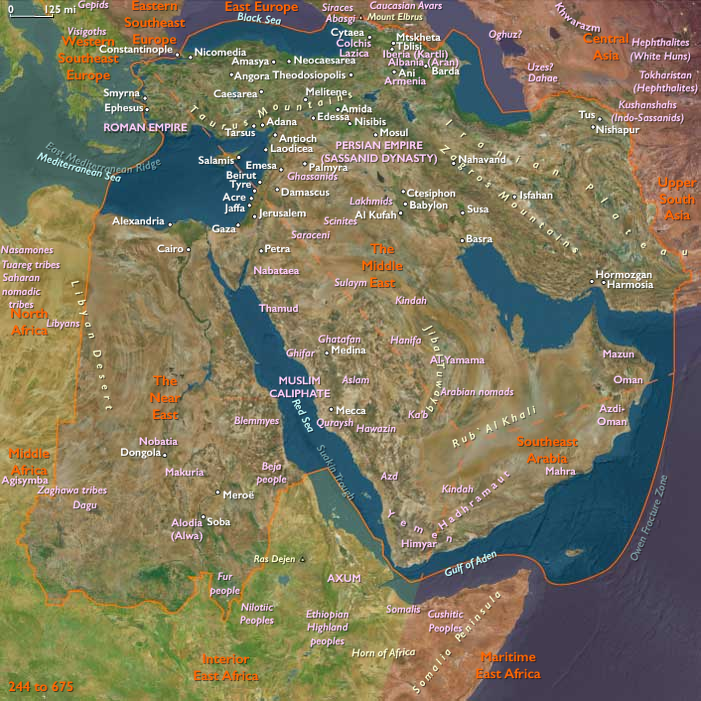
The Near and Middle East
View →Subregions
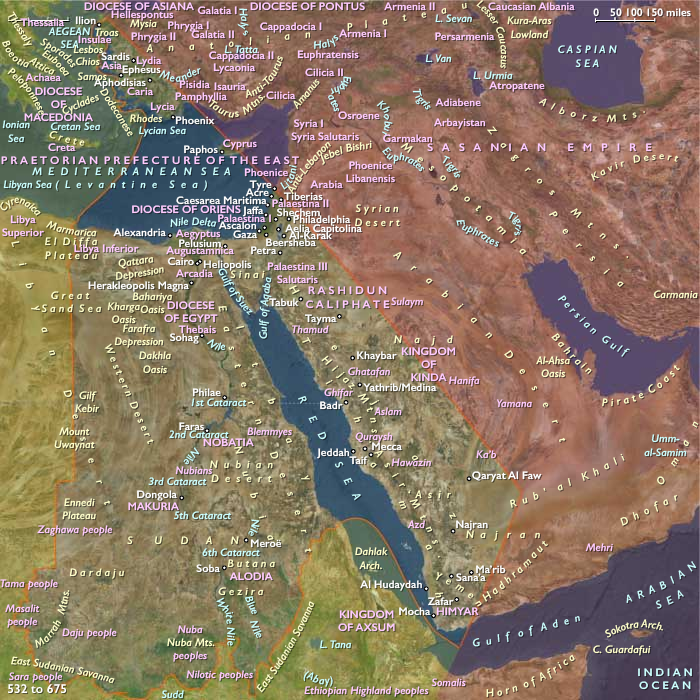
Near East
View →Related Events
No active filters.
Showing 10 events out of 56927 total
Li Shimin, after defeating Liu, had started a campaign against Wang's Zheng state in fall 620.
He initially could not decisively defeat Zheng, but by spring 621 has put the Zheng capital Luoyang under a tight siege, although he is not able to capture it.
Wang seeks aid from Dou.
The latter agrees, concerned that a Tang victory over Zheng would also mean his own demise, but at the same time is eager to exploit the weakness of the Zheng and claim its domains for himself.
Emperor Gaozu is initially fearful that Dou and Wang would be able to sandwich Li Shimin's forces between them and orders Li Shimin to retreat, but upon Li Shimin's petition changes his mind and permits Li Shimin to remain in the Luoyang region.
Li Shimin, leaving Li Yuanji in charge of the siege of Luoyang, advances and takes up a position at Hulao Pass.
On May 28, 621, the Tang and Xia forces engage at Hulao, and Li Shimin defeats Dou, capturing him.
Despairing, Wang also surrenders, and most of the Zheng territory is seized by the Tang.
The Tang also seize Xia territory, but after Emperor Gaozu executes Dou, Dou's general Liu Heita rises against the Tang and seizes most of the former Xia territory, while …
…Xu Yuanlang, a rebel leader who had previously submitted to Zheng, also rises in revolt, occupying the modern Shandong region.
Also in 621, Li Xiaogong defeats Xiao Xian the Emperor of Liang, who, with his capital at Jiangling, had controlled the modern Hubei, Hunan, and Guangxi region, forcing Xiao Xian to surrender.
Li Fuwei's lieutenant Fu Gongshi defeats Li Zitong on another front, forcing him to surrender as well.
Liang and Wu territory are seized by Tang.
Three sources of strength will enable Heraclius to turn defeat into victory.
The first is the pattern of military government as he and the nucleus of his army know it in the exarchates of North Africa or Ravenna.
As it had been in the West, so it now is in the East.
Civil problems are inseparable from the military: Heraclius cannot hope to dispense justice, collect taxes, protect the church, and assure the future to his dynasty unless military power reinforces his orders.
A system of military government, the exarchate, has accomplished these objectives so well in the West that, in a moment of despair, Heraclius seeks to return to the land of his origins.
In all likelihood, he applies similar principles of military rule to his possessions throughout Asia Minor, granting his generals (strategoi) both civil and military authority over those lands that they occupy with their “themes,” as the army groups, or corps, are called in the first years of the seventh century.
Second, during the social upheaval of the previous decade, the imperial treasury had doubtless seized the estates of prominent individuals who had been executed either during Phocas' reign of terror or after his death.
In consequence, though the treasury lacks money, it nonetheless possesses land in abundance, and Heraclius can easily support with grants of land those cavalry soldiers whose expenses in horses and armament he cannot hope to meet with cash.
If this hypothesis is correct, then, even before 622, themes, or army groups—including the guards (Opsikioi), the Armenians (Armeniakoi), and the Easterners (Anatolikoi)—are given lands and settled throughout Asia Minor in so permanent a fashion that, before the century is out, the lands occupied by these themes will identified by the names of those who occupy them.
The Opsikioi are to be found in the Opsikion theme, the Armeniakoi in the Armeniakon, and the Anatolikoi in the Anatolikon.
The term theme will cease hereafter to identify an army group and describe instead the medieval Greek imperial unit of local administration, the theme under the authority of the themal commander, the general (strategos).
Many warlike Jewish clans live in Arabia by the early seventh century, the majority having immigrated there after the Roman persecutions of the second century; they proclaim the superiority of their monotheistic ethos and eschatology (doctrine of last things).
They engage in commerce and agriculture, having introduced the date palm, grape vines and the honeybee.
Their knowledge of irrigation gains them renown, especially in the agricultural oases of Khaybar, ...
...Yathrib, inhabited by three Jewish clans as well as several pagan Arab tribes.
The Jews had settled among the original Arabs, developed agriculture there, and control the best lands.
Later Arab immigrants belonging to the tribes of al-Aws and al-Khazraj are, however, in a stronger position.
The effective units among the Arabs are eight or more clans, but nearly all of these had become involved in serious feuds.
Much blood had been shed in the Battle of Bu'ath, fought in 617 between Banu Aus and Banu Khazraj, the Arab tribes of Yathrib in the south-eastern quarter of the oasis, belonging to the Jewish tribe of Banu Qurayza.
The Aws are supported by the Jewish tribes of Banu Nadir and Banu Qurayza, and by the Arab Bedouins of the Muzayna tribe; the leader of the alliance was Hudayr ibn Simak.
The opposing force, led by Amr ibn al-Numan, consisted of the majority of the Khazraj tribe and the Bedouin tribes of Juhayna and Ashja.
The Awsite clan of Haritha and the Khazrajite chief Abdullah ibn Ubayy remained neutral.
In the course of the battle, the Aws and their allies initially had to retreat, but then they counterattacked and defeated the Khazraj; both leaders of the opposing forces were killed.
Despite the victory of the Aws, the outcome of the battle was an uneasy truce rather than a definite settlement.
Ttwelve men of Yathrib, visiting Mecca in the summer of 621 for the annual pilgrimage to the Ka'bah (at this time a pagan shrine), secretly declare themselves Muslims to Muhammad, the founder of the religion of Islam and of the Muslim community, and return to make propaganda for him at home.
In inviting Muhammad to Yathrib, many of the Arabs there probably hope that he will act as an arbiter among the opposing parties.
Possibly, their contact with the Jews has prepared them for a messianic religious leader, who will deliver them from oppression and erect a just kingdom.
King Sisebut dies in 621 after a nine-year reign and is succeeded by his thirteen-year-old son Reccared II, who is placed on the throne by the Visigothic nobility but dies after two months.
Suintila, his half-uncle and regent, becomes king of the Visigothic Kingdom, under whom the Jews exiled in 610 return to imperial territories in Spain.
Li Shimin defeats Liu Heita in spring 622, forcing him to flee to the Eastern Turks, but Liu Heita soon returns with Turkish reinforcements and kills Emperor Gaozu's nephew Li Daoxuan the Prince of Huaiyang in battle, again seizing former Xia territory, although by this point Li Shimin and Li Yuanji have also defeated Xu Yuanlang and reduced his territory to a few cities.
Meanwhile, an intense rivalry has developed between Li Jiancheng and Li Shimin, as, while Li Jiancheng has made some contributions toward Tang's reunification of China, Li Shimin has been the one defeating and capturing the major rivals Xue Rengao, Liu Wuzhou, Dou Jiande, and Wang Shichong, causing him to possess the greater reputation among the army.
Li Yuanji, who is also often relied on by Emperor Gaozu as a general, supports Li Jiancheng in this rivalry, and often pushes Li Jiancheng toward a more hardline position against Li Shimin, wanting to be crown prince when Li Jiancheng becomes emperor.
Li Jiancheng and Li Yuanji have better relations with Emperor Gaozu's favored young concubines than does Li Shimin (as their mother Duchess Dou had died before Tang's establishment), and those concubines help rehabilitate Li Jiancheng's standing before Emperor Gaozu, causing him to no longer consider making Li Shimin crown prince instead, as he had at one point considered.
By winter 622, Liu Heita poses the only remaining major threat against Tang rule.
At the suggestion of his staff members Wang Gui and Wei Zheng, who argue that Li Jiancheng needs some personal victories to establish his reputation, Li Jiancheng volunteers to command the army against Liu Heita.
Emperor Gaozu thus sends Li Jiancheng, assisted by Li Yuanji.