
Southern Australasia (1108 – 1251 CE): Evolving…
1108 CE to 1251 CE
Southern Australasia (1108 – 1251 CE): Evolving Landscapes, Hunter-Gatherer Societies, and Oceanic Frontiers
Geographic and Environmental Context
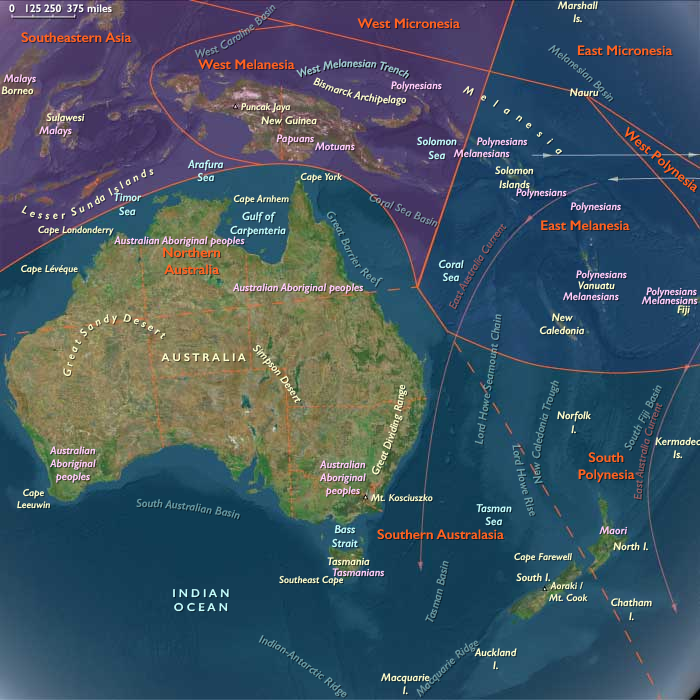
Southern Australasia includes the southern parts of Australia — New South Wales, Victoria, South Australia, Western Australia, and Tasmania — along with the temperate regions of New Zealand’s North and South Islands.
-
This subregion encompassed diverse environments: coastal plains, river valleys, inland grasslands, and temperate forests.
-
Tasmania was connected by maritime traditions to mainland groups, though isolated since the end of the Ice Age.
-
In Aotearoa (New Zealand), Polynesian settlers expanded into the South Island and southern parts of the North Island during this age, adapting to cooler climates.
Climate and Environmental Shifts
-
The Medieval Warm Period brought slightly milder conditions in temperate zones, stabilizing rainfall and supporting resource productivity.
-
In southern Australia, alternating wet and dry cycles shaped foraging strategies and fire management.
-
In New Zealand, the relatively cool climate limited tropical Polynesian crops; adaptation emphasized sweet potato (kūmara) storage, supplemented by foraging and hunting.
Societies and Political Developments
-
Aboriginal Australians in temperate zones continued to live in mobile hunter-gatherer societies, organized into clans and language groups tied to ancestral landscapes (Country).
-
Complex systems of kinship, ritual law, and Dreaming stories maintained social order and resource management.
-
Māori ancestors in Aotearoa consolidated settlement in southern regions, forming tribal groups (iwi and hapū) structured through descent and ritual leadership.
-
Competition for resources encouraged expansion into new territories, with fortified villages (pā) beginning to appear.
Economy and Trade
-
Aboriginal Australians sustained economies based on seasonal mobility: fishing, shellfish gathering, plant harvesting, and hunting kangaroos, emus, and smaller animals.
-
Fire-stick farming was used to manage landscapes, encourage grasslands, and improve hunting yields.
-
Māori horticulture centered on kūmara, supported by storage pits and careful seasonal planting. Moa hunting provided a major, though unsustainable, food source.
-
Exchange occurred through kin-based reciprocity, with Aboriginal groups trading stone, ochre, and ritual goods across long distances.
Subsistence and Technology
-
Stone tools, wooden implements, and bark canoes remained widespread in Australia.
-
Elaborate fish traps and weirs were maintained in river systems such as the Murray-Darling.
-
Māori technologies included earth ovens (hāngī), storage pits, stone adzes, and large ocean-going canoes (waka).
-
Cloaks woven from flax and bird feathers reflected both practicality and prestige in Māori society.
Movement and Interaction Corridors
-
Aboriginal Australians moved seasonally between coastal, riverine, and inland zones, guided by ritual songlines.
-
Coastal trade connected clans across southern Australia, exchanging stone axes, ochre, and shell ornaments.
-
Māori voyaging linked northern and southern New Zealand, extending settlement southward into Canterbury, Otago, and the South Island.
-
Movement reinforced kinship ties and distributed resources across ecological zones.
Belief and Symbolism
-
Aboriginal spirituality emphasized the Dreaming, with sacred landscapes and ancestral beings guiding law, subsistence, and ceremony.
-
Ceremonies reinforced cosmological ties, embedding social memory in song, dance, and rock art.
-
Māori cosmology honored Rangi (Sky Father) and Papa (Earth Mother), emphasizing mana (sacred authority) and tapu (ritual restriction).
-
Ritual specialists (tohunga) guided agriculture, voyaging, and religious practice.
Adaptation and Resilience
-
Aboriginal societies relied on ecological knowledge and mobility, adapting to seasonal variability and long-term climate shifts.
-
Fire management sustained biodiversity and ensured consistent food supplies.
-
Māori communities developed storage and preservation strategies to sustain kūmara crops through cool winters.
-
Social resilience was reinforced by kinship systems, ritual law, and cultural adaptation to new environments.
Long-Term Significance
By 1251 CE, Southern Australasia was a mosaic of resilient societies: Aboriginal Australians maintained sophisticated systems of foraging, fire management, and spiritual ecology, while Māori ancestors adapted Polynesian lifeways to New Zealand’s temperate climate. This period laid the foundation for enduring cultural continuity in Australia and the emergence of distinctive Māori identity and institutions in Aotearoa.
Groups
Subjects
Regions
Australasia
View →Subregions
