Southern Africa (1540 – 1683 CE) Herders,…
1540 CE to 1683 CE
Southern Africa (1540 – 1683 CE)
Herders, Farmers, and the Dawn of Colonial Frontiers
Geography & Environmental Context
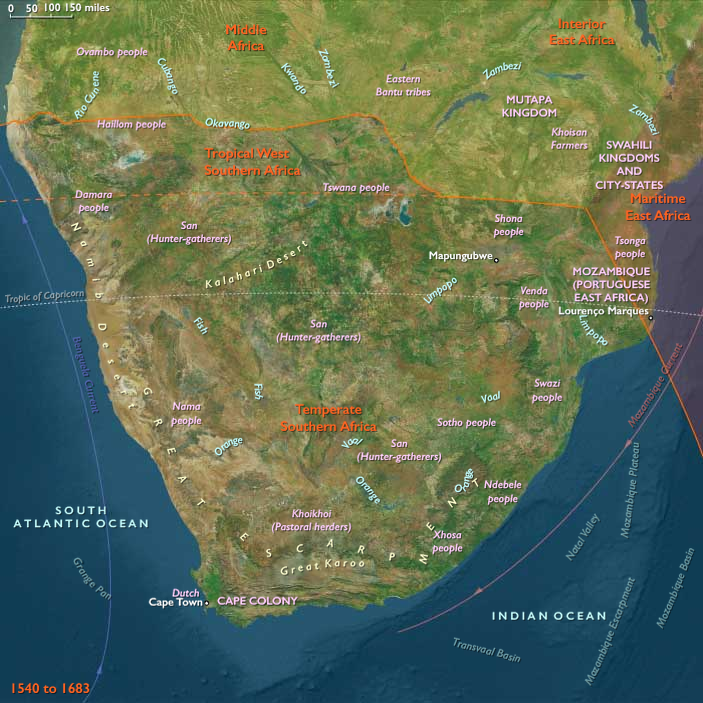
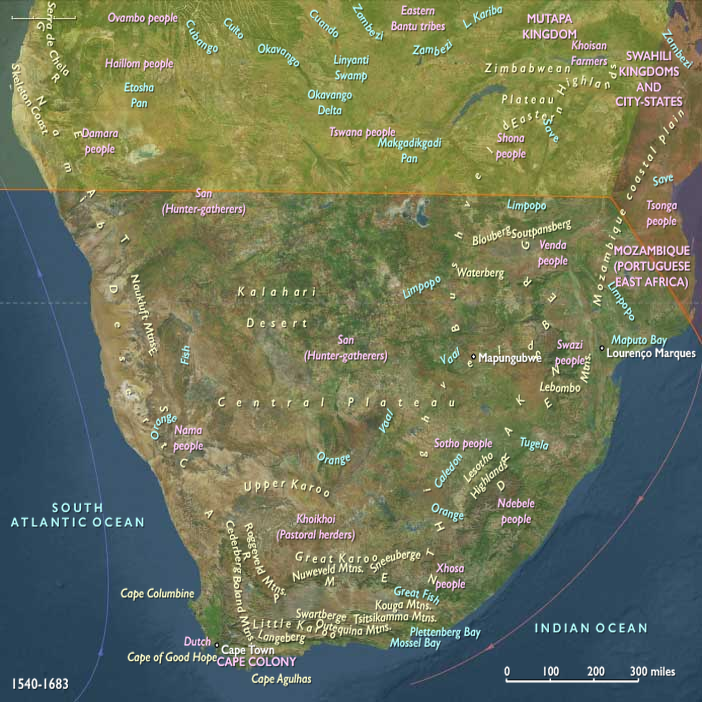
Southern Africa in this era stretched from the Cape of Good Hope and Namaqualand through the Karoo and Kalahari margins, across the Highveld and southern Zimbabwe plateau, to the Okavango–Chobe–Etosha corridor and southwestern Mozambique. Landscapes varied from winter-rain Cape lowlands and summer-rain Highveld plains to desert basins, salt pans, and inland deltas.
The Little Ice Age brought cooler winters and erratic rainfall. Drought cycles shrank herds and forced migration; wet decades filled the Okavango and Chobe floodplains, expanding fishing and grazing. This alternating pattern of aridity and abundance shaped both ecological strategies and political geography.
Peoples, Subsistence & Settlement
Herders and Foragers of the Cape and Karoo
-
Khoekhoen maintained transhumant cattle-and-sheep cycles, moving seasonally between the Berg, Breede, and Olifants valleys and the Namaqualand plains.
-
San foragers inhabited mountains and deserts—the Cederberg, Drakensberg, and Kalahari—hunting antelope and gathering bulbs, berries, and tubers.
Farming Polities of the Highveld and Plateau
-
Bantu-speaking farmers across the Highveld, Lesotho, Eswatini, southern Zimbabwe, and southwestern Mozambique grew sorghum, millet, and beans while keeping large cattle herds.
-
Stone-walled homesteads spread across the southern Zimbabwe plateau and Limpopo valley, heirs to Khami-eraarchitectural and political traditions.
-
In wetter eastern foothills, intensive terracing and mixed cropping supported growing chiefdoms that blended ritual and economic authority around cattle wealth.
Wetland and Delta Societies
-
Along the Okavango, Chobe, and Zambezi, communities combined fishing, flood-recession gardening, and hunting.
-
Inland delta farmers cultivated millet and beans on receding floodplains; canoe transport knit dispersed settlements into seasonal circuits.
Technology & Material Culture
-
Indigenous toolkits: iron hoes, spears, and pottery paralleled older stone and bone technologies among San groups. Mat shelters, leatherwork, bead ornaments, and cattle kraals defined Khoekhoen life; rock art flourished in the Drakensberg and Matobo Hills.
-
Architectural traditions: Zimbabwe-plateau elites built stone-walled courts and cattle enclosures, while Highveld farmers ringed homesteads with dry-stone stock walls.
-
Incoming technologies: Dutch settlers (after 1652) introduced wagons, plows, firearms, iron tools, and permanent masonry, establishing the first European fort and irrigated gardens at Table Bay.
Movement & Exchange Corridors
-
Pastoral migrations crisscrossed the Cape and Karoo; livestock exchanges linked herders to coastal shellfish zones and interior salt pans.
-
Trade networks radiated north and east: ivory, cattle, and gold moved from the Zimbabwe plateau toward Sofala, while beads and cloth filtered inland from the Indian Ocean.
-
River highways—the Okavango and Chobe—channeled salt, ivory, and grain among Ovambo, Herero, and Kavango groups.
-
Maritime entry: Portuguese navigators skirted the Skeleton and Mozambican coasts, and in 1652 the Dutch East India Company (VOC) established a refreshment station at Table Bay, inaugurating a colonial presence that would expand rapidly inland.
Cultural & Symbolic Expressions
-
Khoekhoen rituals centered on cattle feasts, ancestral cairns, and puberty ceremonies marking ties to land and herd.
-
San rock paintings and trance dances depicted eland, rain animals, and healing journeys, blending art with shamanic cosmology.
-
Highveld farmers maintained ancestor shrines at cattle byres; rainmaking and initiation ceremonies underpinned chiefly legitimacy.
-
Delta and savanna peoples celebrated seasonal floods with fishing festivals and initiation rites tied to river spirits.
-
Dutch colonists brought Calvinist worship, VOC bureaucratic ceremony, and early slave importations that seeded a mixed Cape culture.
Environmental Adaptation & Resilience
Communities met climatic volatility through diversification and mobility:
-
Herders rotated pastures, diversified stock, and gathered shellfish during droughts.
-
Farmers intercropped, stored grain, and used manure from kraals to maintain soil fertility.
-
Foragers exploited wide territories and cached dried meat and roots.
-
Wetland dwellers shifted gardens with flood cycles and dried fish and grain for lean seasons.
-
Dutch settlers experimented with wheat, vines, orchards, and irrigation ditches, reshaping Table Mountain’s slopes into a Mediterranean farm zone.
Conflict & Power Shifts
-
Khoekhoen–San rivalries over hunting grounds and water pre-dated Europeans but sharpened as herds expanded.
-
Highveld consolidation produced fortified chiefdoms commanding cattle and labor through alliance and raiding.
-
Zimbabwe plateau elites maintained Khami-derived political systems linking stone architecture, trade, and ritual kingship.
-
VOC colonization provoked the First and Second Khoekhoen–Dutch Wars (1659–60, 1673–77). Firearms, horses, and fortified farms displaced herders from key pastures and began the long process of colonial dispossession.
Tropical West Southern Africa: Wetlands and Cattle Worlds
Further north, Herero pastoralists built cattle-rich societies along the savanna fringe, while San groups persisted in desert and dune zones. Etosha’s salt pans supplied trade salt; Okavango and Chobe polities exchanged ivory and captives with Angolan and Mozambican traders, linking the interior to both Atlantic and Indian Ocean circuits. Cattle sacrifice, trance dance, and initiation rites expressed cosmologies of fertility and rain, while mobility and kin networks underpinned survival amid drought and flood.
Transition (1540 – 1683 CE)
By 1683, Southern Africa remained overwhelmingly indigenous in population and character, but its historical trajectory had bent toward global entanglement.
-
At the Cape, Dutch colonization had begun to reorder land and labor.
-
Inland, farming and herding polities maintained robust economies and ritual life.
-
Farther north, salt and cattle networks tied the Okavango and Chobe valleys to wider African trades.
Across this vast southern world, cattle, stone, and rain defined wealth and power, while the first European foothold signaled a coming century of transformation—from independent pastoral and agricultural systems to frontier zones caught between indigenous resilience and the expanding circuits of the Atlantic and Indian Oceans.
Images

Temperate Southern Africa (with civilization) ©2024-25 Electric Prism, Inc. All rights reserved.
Groups
Topics
Commodities
Subjects
Regions