
The Diet of Würzburg ends the seven-year…
1121 CE
The Diet of Würzburg ends the seven-year rebellion of the German princes against Emperor Henry V in 1121.
Locations
Commodities
Subjects
Regions
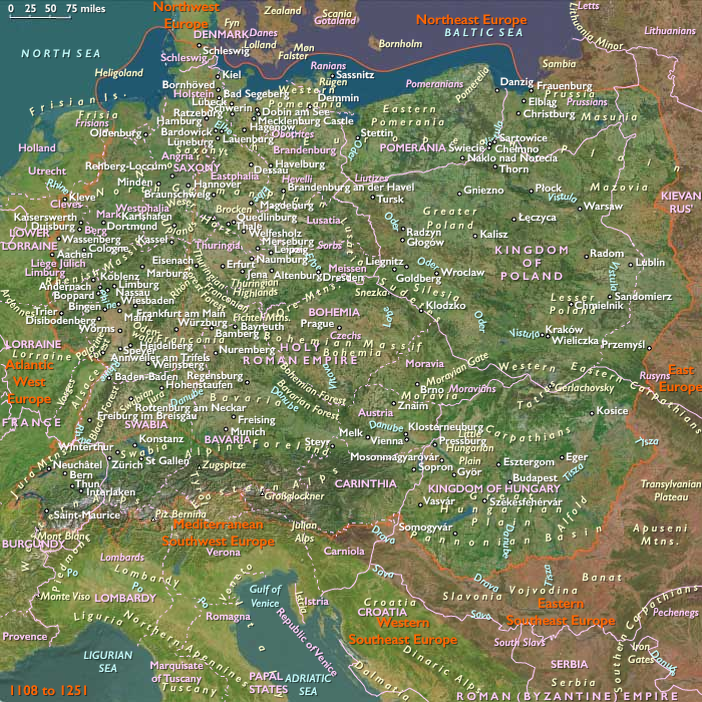
Central Europe
View →Subregions

West Central Europe
View →Related Events
No active filters.
Showing 10 events out of 49324 total
A Berber state arises in Tinmel in the Atlas Mountains of Morocco about 1120, inspired by Ibn Tumart and his demands for juridicial and puritanical moral reform and a strict concept of the unity of God.
In 1121, Ibn Tumart proclaims himself the mahdi, or messiah, come to purify Islam, thereby initiating a mass movement directed against the Almoravids.
The revolutionary and fanatical Islamic sect is known as the Almohads (Arabic: al-Muwah hidun, the Unitarians).
Bernard of Clairvaux and the Condemnation of Peter Abelard at the Council of Soissons (1121 CE)
By 1121, Bernard of Clairvaux, though recognizing the role of reason in theology, had emerged as the primary opponent of rationalist theologians, particularly those whose intellectual inquiry threatened religious orthodoxy.
Among his chief adversaries was Peter Abelard, a brilliant but controversial philosopher and theologian, whose dialectical approach to theology challenged traditional interpretations of doctrine.
Bernard’s Opposition to Abelard’s Rationalism
- Abelard applied rigorous logical analysis to Christian doctrine, particularly in his writings on the Trinity.
- Bernard, deeply rooted in mystical theology, feared that Abelard’s rationalism undermined faith, making reason rather than revelation the foundation of theological understanding.
- Bernard specifically doubted Abelard’s orthodoxy on the Trinity, accusing him of reducing the doctrine to a form of modalism—a heretical view that treats the Father, Son, and Holy Spirit as merely different modes of God’s existence rather than distinct persons.
The Council of Soissons (1121)
- At Bernard’s instigation, Abelard was summoned before the Council of Soissons to defend his theological positions.
- The council, composed primarily of churchmen unsympathetic to Abelard’s rationalist methods, was heavily influenced by Bernard.
- Abelard’s defense was not well received, and under pressure from Bernard and other clerics, the council condemned his teachings.
- One of Abelard’s books on the Trinity was ordered to be burned, marking a significant defeat for the scholar.
Aftermath and Continued Conflict
- Abelard submitted to the ruling but continued to refine and defend his theological positions, leading to further conflicts with Bernard in later years.
- The rivalry between Abelard and Bernard would culminate in another major theological confrontation at the Council of Sens (1141).
- Bernard’s triumph at Soissons solidified his position as the guardian of orthodoxy, reinforcing the dominance of faith-driven mysticism over rationalist theology within the medieval Church.
While the Council of Soissons was a major setback for Abelard, it also highlighted the growing divide between scholastic rationalism and traditional monastic theology, a debate that would shape medieval intellectual history for generations.
The Concordat of Worms condemns Pierre Abélard's writings on the Holy Trinity.
The Georgian population, having been at war for the better part of twenty years, needs to become productive again.
The people continue to challenge the authority of the king, David IV, and the city of Tbilisi remains in Seljuq hands.
David IV has radically reformed his military, having resettled a Kipchak tribe of fourteen thousand families from the Northern Caucasus in Georgia in 1118–1120 and obliging every Georgian and Kipchak family to provide one soldier with a horse and weapons.
This army, fifty-six thousand strong, is entirely dependent on the King.
Kipchaks have been settled in different regions of Georgia, some in Inner Kartli province, others given lands along the border.
They are quickly assimilated into Georgian society.
David IV had moved his army to western Georgia In 1120, and suddenly attacked a Seljuq force, of whom only an small portion escaped.
The king had then entered neighboring Shirvan and taken the town of Qabala.
In the winter of 1120–1121, the Georgian troops successfully attack the Seljuq settlements on the eastern and southwestern approaches to the Transcaucasus.
Muslim powers are increasingly concerned about the rapid rise of a Christian state in southern Caucasia.
Grand Seljuq Sultan Mahmud II declares a holy war on Georgia in 1121 and rallies a large coalition of Muslim states led by the Artuqid Najm al-din El-ğazi and Toğrul b. Muhammad.
The size of the Muslim army is still a matter of debate with numbers ranging from fantastic six hundred thousand men (Walter the Chancellor’s Bella Antiochena, Matthew of Edessa) to four hundred thousand (Smbat Sparapet’s Chronicle) to modern Georgian estimates of two hundred and fifty thousand to four hundred thousand men.
All sources agree that the Muslim powers gathered an army that was far much larger than the Georgian force of fifty-six thousand men.
However, on August 12, 1121, David and his army rout the Seljuqs on the fields at the base of Mount Didgori.
The victory signals the emergence of Georgia as a significant military power and shifts the regional balance in favor of Georgian cultural and political supremacy.
The Venetians had been pleased to help drive the Normans out of the Adriatic Sea but had demanded a heavy price.
Emperor Alexios I Komnenos had in 1108 granted them trading privileges in Constantinople and elsewhere on terms calculated to outbid the empire’s Greek merchants.
This charter, the cornerstone of the commercial empire of Venice in the eastern Mediterranean, has fed the flames of Greek resentment against the Latins and has provoked the rich, who might have been encouraged to invest their capital in shipbuilding and trade, to rely on the more familiar security of landed property.
Venice had at first been chiefly concerned with gaining control of the European trading ports of the Empire, leaving to private interests the commercial opportunities in Syria and Asia Minor.
Although the Venetians had been the first to win a commercial quarter in Constantinople, they antagonize the Greeks by their arrogance and lawlessness as well as by their superior enterprise.
John II Komnenos, seeking to strengthen imperial finances by ending Venetian trading privileges in the empire, is forced to restore them in 1122 after an unsuccessful war.
John, who keeps an austere court, proves a gifted soldier and diplomat, having reestablished imperial authority in the Balkans by reincorporating Serbia, annihilates the Pecheneg forces in 1122 at the Battle of Beroia, and checks Hungarian expansion.
Constantinople’s victory effectively destroys the Pechenegs as an independent force.
For some time, significant communities of Pechenegs will remain in Hungary, but eventually the Pechenegs will cease to be a distinct people and will be assimilated by neighboring peoples such as the Bulgarians and Magyars.
David IV follows his success with the capture of Tbilisi, the last Muslim enclave, and moves the Georgian capital there.
Al-Mustarshid, son of the preceding Caliph, Al-Mustazhir, has achieved more independence as a ruler while the Seljuq sultan Mahmud II is engaged in war in the East.
In 1122, al-Mustarshid deposes and imprisons his vizier Amid al-dawla Jalal al-Din Hasan ibn Ali.
Mahmud II then imposes Ahmad ibn Nizam al-Mulk as his vizier.
The Navarro-Aragonese king Alfonso the Battler founds a confraternity of knights in 1122 in Belchite to fight against the Almoravids; it is the start of the military orders in Aragon.
Years later, he will organize a branch of the Militia Christi of the Holy Land at Monreal del Campo.
Guy, Bishop of Lescar, is present for the foundation of the Confraternity of Belchite.