
The abbot of St. Gallen becomes a…
1206 CE
The abbot of St. Gallen becomes a prince of the church in the Holy Roman Empire in about 1206.
Subjects
Regions
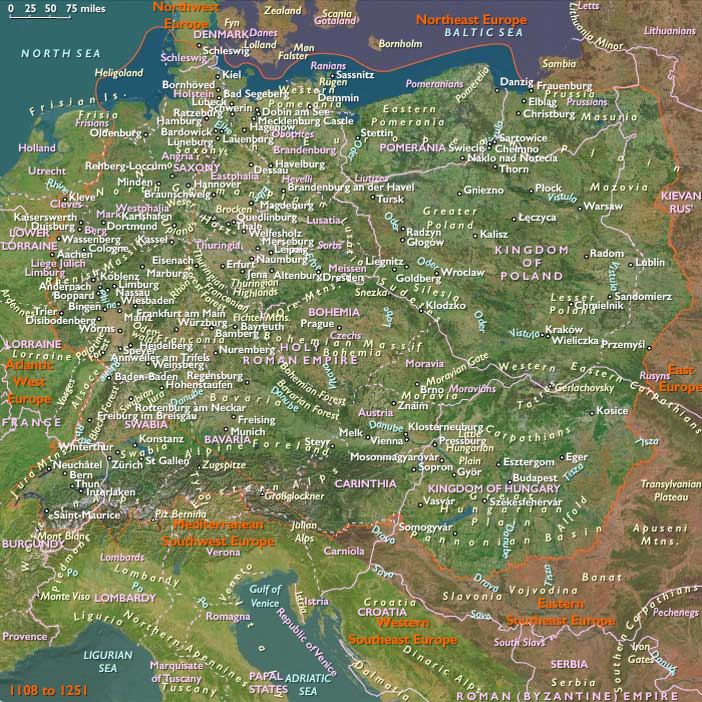
Central Europe
View →Subregions

South Central Europe
View →Related Events
No active filters.
Showing 10 events out of 47545 total
Meanwhile in the Tangut Kingdom, Huanzong’s cousin Li Anquan kills the emperor in a coup d'état with the empress and installs himself as Emperor Xiangzong.
Located south of the Gobi Desert and west of the Jin dynasty’s holdings, the Western Xia state is the weakest of China’s kingdoms.
It is thus a ripe target on which Genghis Khan can test the performance of his disciplined massed cavalry and, if successful, gain control of revenues from the East-West caravan routes.
The Western Xia army is also untrained and ill-equipped.
Regarding Western Xia as a roadblock to China, Genghis will repeatedly invade the state.
Temüjin, after years of struggle and bloodshed in the cause of unifying the warring tribes under his rule, is in 1206 formally proclaimed Genghis Khan (“universal ruler,”“strong ruler,” or “oceanic ruler), ruler of all the Mongols, marking the official start of the Mongol Empire.
Muqali, an important companion of Genghis Khan born of the Jalair clan in 1170, had served Genghis' enemy (serving as a slave or Nak for Genghis' rival, the aunt of his father of the Jurkin clan) in his early days but had been captured.
Genghis had rewarded the defiant Muqali for his integrity and wisdom, and has since been a loyal lieutenant of the rising khan.
Muqali is now appointed myriarch of the left wing of the newly reorganized Mongol army, and granted immunity for up to nine breaches of the law.
An unconfirmed theory holds that the Semigallians, one of the Baltic tribes that lives in Zemgale, in present south central Latvia and northern Lithuania, were one of the first Baltic tribes to establish a monarchy, yet one weak in comparison to the power of the Semigallian nobles.
One of the most notable Semigallian leaders was Viestards (Viesturs).
Upon uniting hostile Semigallian clans into a single state in early thirteenth century, Viestards forms an alliance with the Livonian Brothers of the Sword to defeat his enemies, including the Livs.
The territory of Saaremaa has been inhabited for at least five thousand years, according to archaeological finds.
Sagas mention numerous skirmishes between the Finnish-speaking islanders, called Oesilians, and Vikings.
Saaremaa is the wealthiest county of ancient Estonia and the home of notorious Estonian pirates, sometimes called the Eastern Vikings.
From the twelfth century, chroniclers' descriptions of Estonian, Oeselian and Curonian raids along the coasts of Sweden and Denmark become more frequent.
The Chronicle of Henry of Livonia describes a fleet of sixteen ships and five hundred Oesilians ravaging the area that is now southern Sweden, then belonging to Denmark.
In 1206, Denmark’s King Valdemar II and Archbishop Andreas Sunonis raid Saaremaa Island in present Estonia, forcing the islanders to submit.
The Danes build a fortress, but finding no volunteers to man it, they burn it down themselves and leave the island.
King Valdemar attempts to influence the outcome of the Norwegian succession in 1204 by leading a Danish fleet and army to Viken, Norway in support of Erling Steinvegg, the pretender to the Norwegian throne.
This results in the second Bagler War, which is to last until 1208, when the question of the Norwegian succession will be temporarily settled.
The Norwegian king owes allegiance to the king of Denmark.
A Slavic settlement called Drežďany, the Old Slavic word for forest people, had developed around the late twelfth century on the southern bank of the River Elbe in upper Saxony near the present-day Czech border.
Another settlement existed on the northern bank, but its Slavic name is unclear.
Dietrich, Margrave of Meissen, chooses Dresden as his interim residence in 1206, as documented in a record calling the place "Civitas Dresdene".
The Arab engineer al-Jazari, a prominent polymath, describes fifty mechanical devices in his book (title translated to English) The Book of Knowledge of Ingenious Mechanical Devices, along with instructions on how to construct them.
He was named after the area in which he was born, Al-Jazira—the traditional Arabic name for what was northern Mesopotamia and what is now northwestern Iraq and northeastern Syria, between the Tigris and the Euphrates.
Like his father before him, he served as chief engineer at the Artuklu Palace, the residence of the Diyarbakir branch of the Turkish Artuqid dynasty which ruled across eastern Anatolia as vassals of the Zengid rulers of Mosul and later Ayyubid general Saladin.
While many of al-Jazari's inventions may now appear to be trivial, the most significant aspect of al-Jazari's machines are the mechanisms, components, ideas, methods, and design features which they employ.
India’s Hindu population, regarded by the Muslim minority, after extensive plundering, as docile, do not rebel against the Ghorids, despite the overbearing rule of Sultan Muhammad Ghori, possibly because Muslim émigrés bring rumors of Mongol fighting in Persia.
Muhammad is assassinated, however, in Lahore in 1206.
(The historians Hasan Nizami and Ferishta record the killing of Ghori at the hands of the Gakhars, a Punjabi tribe.
However, Ferishta is known to have often confused them with the Khokhars, a Rajput clan, and other historians have alluded the killing to a band of Hindu Khokhars of the Salt Range, as many campaigns had been undertaken against the Khokhars by Ghori in the Punjab.)
Ghori reportedly had trained thousands of Turkic slaves in the art of warfare and administration.
Most of his slaves had been given an excellent education: during his reign many hardworking and intelligent slaves have risen to positions of excellence.
The childless sultan’s kingdom is divided upon Ghori’s death into many parts by his slaves: …
…Taj-ud-Din Yildoz becomes the ruler of Ghazni; …
…Ikhtiyar Uddin Muhammad bin Bakhtiyar Khilji, a member of the Turkic Khilji, who had headed the armies that conquered much of northeastern India, receives Bengal; and …