
Filters:
The Rhine as Rome’s Northern Frontier and …
Years: 45BCE - 99
The Rhine as Rome’s Northern Frontier and the Limes Germanicus (c. 12 CE – 69 CE)
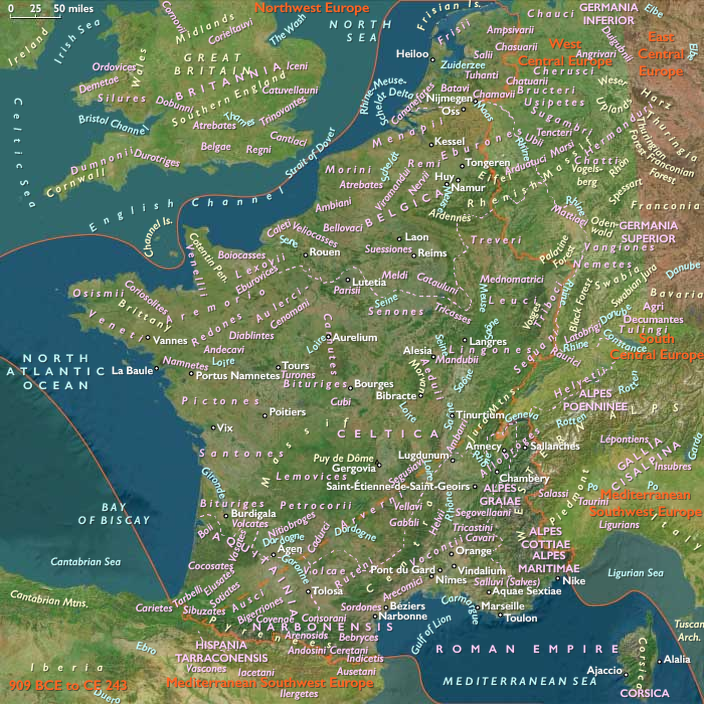
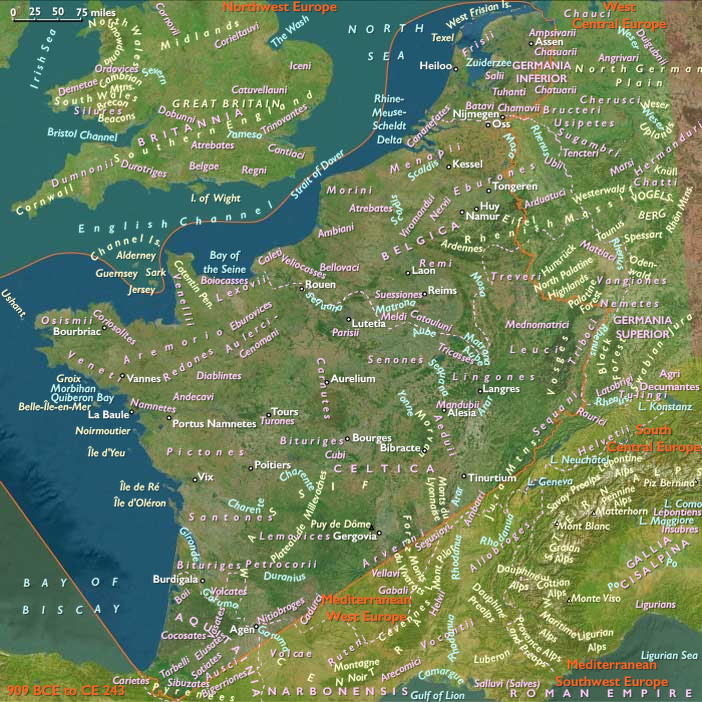
By 12 CE, the Rhine River had become Rome’s fixed northern frontier in Western Europe, marking the boundary between the Roman Empire and free Germania. Along this frontier, the Limes Germanicus was gradually established as a series of military fortifications, watchtowers, and roads, securing Rome’s hold over Germania Inferior and neighboring provinces.
Roman Provinces and Settlements Along the Rhine
- Initially, the territory south of the Rhine was part of Gallia Belgica.
- As Rome solidified its control, the region was reorganized into the province of Germania Inferior, while further east, Germania Superior was also established.
- Several important Roman towns and fortifications arose along the Limes Germanicus, including:
- Nijmegen (Ulpia Noviomagus Batavorum) – A major military and administrative center in modern Netherlands.
- Voorburg (Forum Hadriani) – Another significant Roman settlement and trade hub.
The Role of the Frisii, Batavi, and Cananefates
- The Frisii, a Germanic tribe north of the Rhine, remained outside direct Roman rule but under Roman influence and military control.
- The Batavi and Cananefates, Germanic border tribes, became valuable auxiliaries, supplying highly skilled cavalry and soldiers to the Roman military.
- These auxiliaries played a key role in Roman campaigns, including those of Julius Caesar, Drusus, and Germanicus.
The Batavian Rebellion (69–70 CE)
- In 69 CE, during the chaos of the Year of the Four Emperors, the Batavians, led by Julius Civilis, rebelled against Roman rule.
- The rebellion, supported by other discontented Germanic and Gallic tribes, led to:
- The destruction of Roman forts along the Rhine.
- The defection of Batavian auxiliary troops.
- A temporary expulsion of Roman forces from the region.
- However, the rebellion was eventually crushed by Roman reinforcements, led by Quintus Petillius Cerialis, restoring Roman control.
Significance of the Rhine as Rome’s Frontier
- The Limes Germanicus became a permanent Roman defensive line, shaping the political and military landscape of northern Europe.
- The Batavian Rebellion demonstrated both the strength and the limits of Roman rule in the northern provinces.
- Rome’s control over Germania Inferior ensured that the Rhine frontier remained stable, though it would remain a contested boundary between Roman and Germanic peoples for centuries.
The Rhine frontier and its military settlements played a crucial role in Roman strategy, influencing the development of Northwestern Europe and the long-term interactions between Rome and the Germanic world.
Groups
- Roman Republic
- Cananefates (Germanic tribe)
- Frisii (East Germanic tribe)
- Batavi (Germanic tribe)
- Germania Inferior (Roman province)
- Roman Principate (Rome)
- Gallia Belgica (Roman province)
- Roman Empire (Rome): Julio-Claudian dynasty
- Roman Empire (Rome): Flavian dynasty
- Roman Empire (Rome): Nerva-Antonine dynasty
Topics
Commodoties
Subjects
Regions
Subregions
Years: 45BCE - 99
Groups
- Roman Republic
- Cananefates (Germanic tribe)
- Frisii (East Germanic tribe)
- Batavi (Germanic tribe)
- Germania Inferior (Roman province)
- Roman Principate (Rome)
- Gallia Belgica (Roman province)
- Roman Empire (Rome): Julio-Claudian dynasty
- Roman Empire (Rome): Flavian dynasty
- Roman Empire (Rome): Nerva-Antonine dynasty
Topics
Commodoties
Subjects
Regions
Subregions