The Austrian army had been defeated by…
February 1801 CE
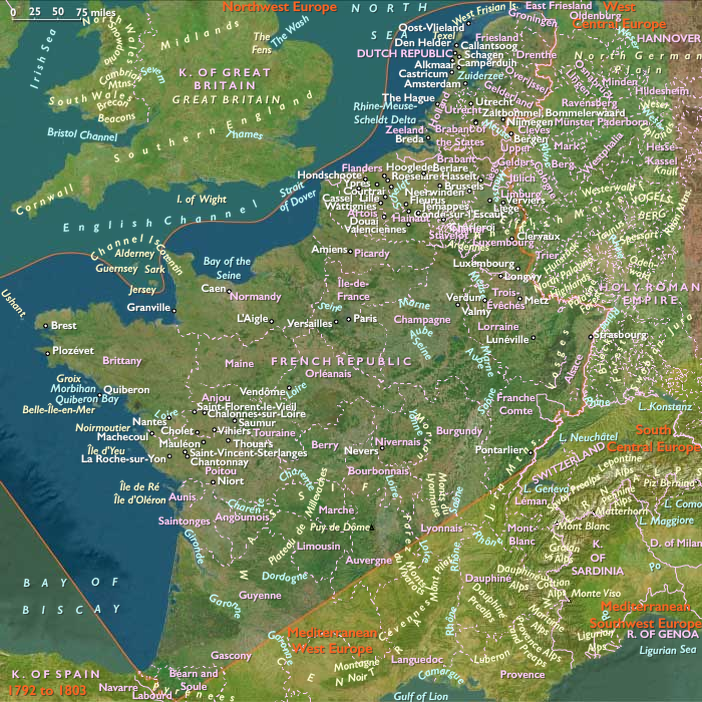
The Austrian army had been defeated by Bonaparte at the Battle of Marengo on June 14, 1800, and then by Moreau at the Battle of Hohenlinden on December 3 of the same year.
The Battle of Marengo had inaugurated the political idea that is to continue its development until Napoleon's Moscow campaign.
Bonaparte plans only to keep the Duchy of Milan for France, setting aside Austria, and is thought to prepare a new campaign in the East.
Austria, forced to sue for peace, signs another in a series of treaties.
The French Republic and the Holy Roman Emperor Francis II, negotiating both on behalf of his own domains and of the Holy Roman Empire, conclude the Treaty of Lunéville on February 9.
Joseph Bonaparte signs for France, and Count Ludwig von Cobenzl, the Austrian foreign minister, signs for the Emperor.
This treaty marks the end of the Second Coalition; after this treaty, Britain is the sole nation still at war with France.
The Treaty declares that "there shall be, henceforth and forever, peace, amity, and good understanding" among the parties.
The treaty requires Austria to enforce the conditions of the earlier Treaty of Campo Formio (concluded on October 17, 1797).
Certain Austrian holdings in Germany are relinquished; French control is extended to the left bank of the Rhine, "in complete sovereignty", but they renounce any claim to territories east of the Rhine.
Contested boundaries in Italy are set, and the Grand Duchy of Tuscany is awarded to the French but the duke is compensated with lands in Germany.
The two parties agree to respect the independence of the Batavian, Cisalpine, Helvetic and Ligurian republics.
In northern Italy, the two semi-independent bishoprics of Trento and Brixen are secularized and annexed to Austria.
Napoleon annexes additional German land and suggests that the larger German territories compensate themselves by confiscating the ecclesiastical states and free cities.
Locations
People
Groups
Topics
Regions
West Europe
View →Subregions