The Badshahi Mosque in Lahore epitomizes the…
April 1673 CE
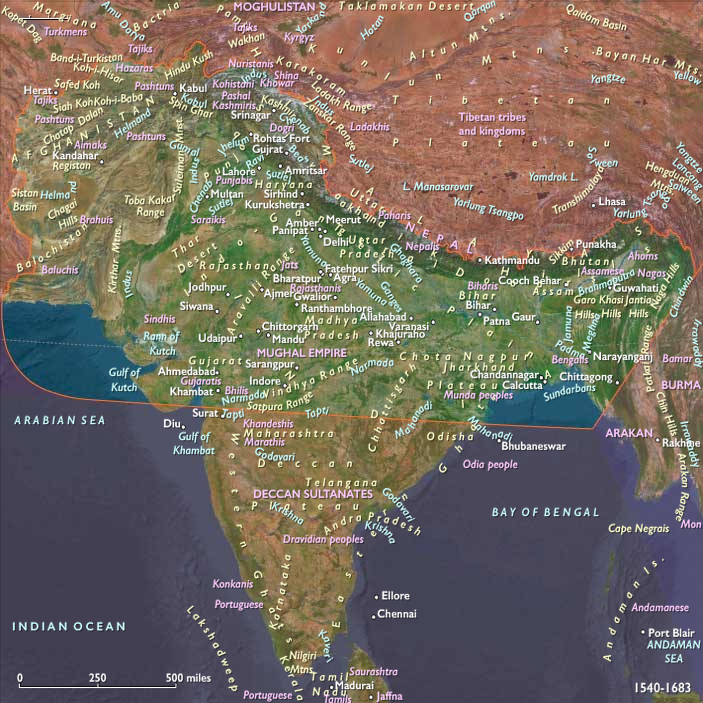
The Badshahi Mosque in Lahore epitomizes the beauty, passion and grandeur of the Mughal era.
Aurangzeb, the sixth Mughal Emperor, who has assumed the title 'Alamgir', meaning 'Conqueror of the World,’ had in 1671 ordered its construction.
Completed in April 1673, the huge mosque closely resembles that of the slightly smaller Jama Mosque in Delhi, which had been built in 1648 by Aurangzeb's father and predecessor, Shah Jahan.
The design of the mosque—bold, vast and majestic in its expression—is inspired by Islamic, Persian, Central Asian and Indian influences.
Capable of accommodating ten thousand worshipers in its main prayer hall and a further one hundred thousand in its courtyard and porticoes, it will remain the largest mosque in the world for a period of three hundred and thirteen years years, until overtaken in size in 1986 by the completion of the Faisal Mosque in Islamabad.
Today, it remains the second largest mosque in Pakistan and South Asia and the fifth largest mosque in the world after the Masjid al-Haram (Grand Mosque) of Mecca, the Al-Masjid al-Nabawi (Prophet's Mosque) in Medina, the Hassan II Mosque in Casablanca and the Faisal Mosque in Islamabad.
The Badshahi Mosque is today Lahore's most famous landmark and a major tourist attraction.
Images

Badshahi Mosque (Photo by Ali Imran, 2005)
Locations
People
Regions
South Asia
View →Subregions