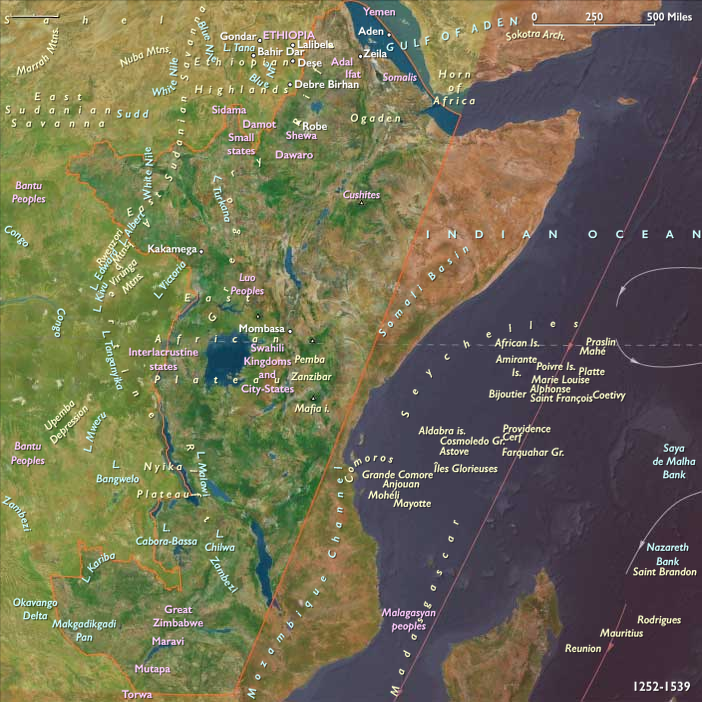
The third type of state to emerge…
1396 CE to 1539 CE
The third type of state to emerge in Uganda is that of Buganda, on the northern shores of Lake Victoria.
This area of swamp and hillside is not attractive to the rulers of pastoral states farther north and west.
It becomes a refuge area, however, for those who wish to escape rule by Bunyoro or for factions within Bunyoro who are defeated in contests for power.
One such group from Bunyoro, headed by Prince Kimera, arrives in Buganda early in the fifteenth century.
Assimilation of refugee elements has already strained the ruling abilities of Buganda's various clan chiefs, and a supra-clan political organization is already emerging.
Kimera seizes the initiative in this trend and becomes the first effective king (kabaka) of the fledgling state.
Ganda (root word and adjective for Buganda) oral traditions will later seek to disguise this intrusion from Bunyoro by claiming earlier, shadowy, quasi-supernatural kabakas.
Unlike the Hima caste system or the Bunyoro royal clan political monopoly, Buganda' s kingship is made a kind of state lottery in which all clans can participate.
Each new king is identified with the clan of his mother, rather than that of his father.
All clans readily provide wives to the ruling kabaka, who has eligible sons by most of them.
When the ruler dies, his successor is chosen by clan elders from among the eligible princes, each of whom belongs to the clan of his mother.
In this way, the throne is never the property of a single clan for more than one reign.
Locations
Subjects
Regions
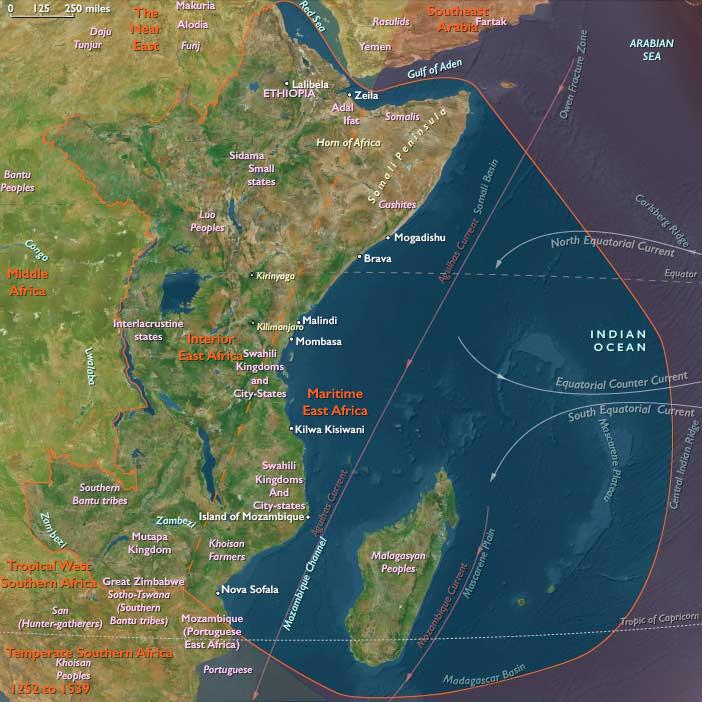
East Africa
View →Subregions