The Bolohoveni, a Vlach population, is mentioned…
1290 CE
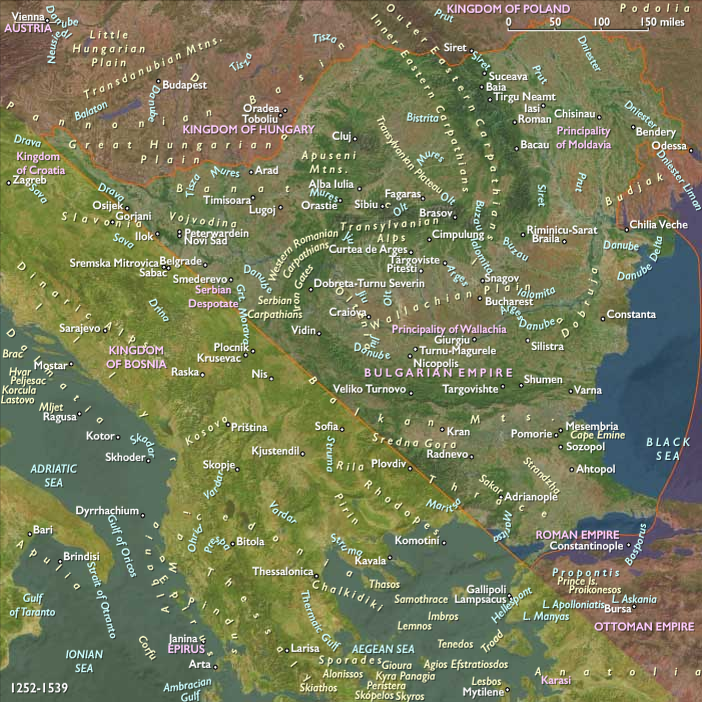
The Bolohoveni, a Vlach population, is mentioned by the Hypatian Chronicle as living in the region of present Moldavia in the thirteenth century.
The chronicle shows that this land is bordered on the principalities of Halych, Volhynia and Kiev.
Archaeological research also identified the location of thirteenth-century fortified settlements in this region.
Alexandru V. Boldur identified Voscodavie, Voscodavti, Voloscovti, Volcovti, Volosovca and their other towns and villages between the middle course of the rivers Nistru/Dniester and Nipru/Dnieper.
The Bolohoveni disappeared from chronicles after their defeat in 1257 by Daniil Romanovich's troops.
In the early thirteenth century, the Brodniks, a possible Slavic–Vlach vassal state of Halych, were present, alongside the Vlachs, in much of the region's territory (towards 1216, the Brodniks are mentioned as in service of Suzdal).
The invasion of the Mongols in Eastern Europe has checked for several decades the political offensive of the Kingdom of Hungary beyond the Carpathians.
Moreover, the territories east of the mountains have fallen under Mongol overlordship, but until 1260, during the first twenty years of the formative period of the Golden Horde, their status is obscure.
The Franciscan William of Rubruck reports that in 1253 he met messengers of the Romanians (Blaci, Blati) and other peoples who carried their gifts to Batu Khan.
According to Thomas Tuscus’ chronicle, the Romanians (Blaci) were at war with the Ruthenians in 1276–1277, and thus prevented the latter’s arrival in support of their ally, King Ottakar II of Bohemia (1253–1278).
This information suggests that the Blaci formed a political entity somewhere in northern Moldavia and they had a military force strong enough to worry the Kingdom of Halych.
Brief mention of Romanians of the sub-Carpathian areas is also made in two papal acts issued in 1279 and 1288 in connection with the papal attempts to reactivate Catholic missionary activities in Eastern Europe.
The Mongol Golden Horde, in 1290, invades Moldavia’s Bessarabia region, the Black Sea coastal and hinterlands bounded by the Dniester river on the east and the Prut river on the west.
Groups
Regions
Southeast Europe
View →Subregions